
Introduction
Transmission capacity development in July 2026 provides a clear snapshot of how India’s power grid is expanding to meet growing demand. The raw data reveals the megawatt (MW) capacity added by major transmission owners, the distribution of that capacity across voltage levels, and the split between intra‑state and inter‑state corridors. Understanding these figures helps investors, policymakers, and industry analysts gauge the health of the electricity infrastructure, identify regional bottlenecks, and anticipate future investment opportunities.
What Does the Data Reveal About This Topic?
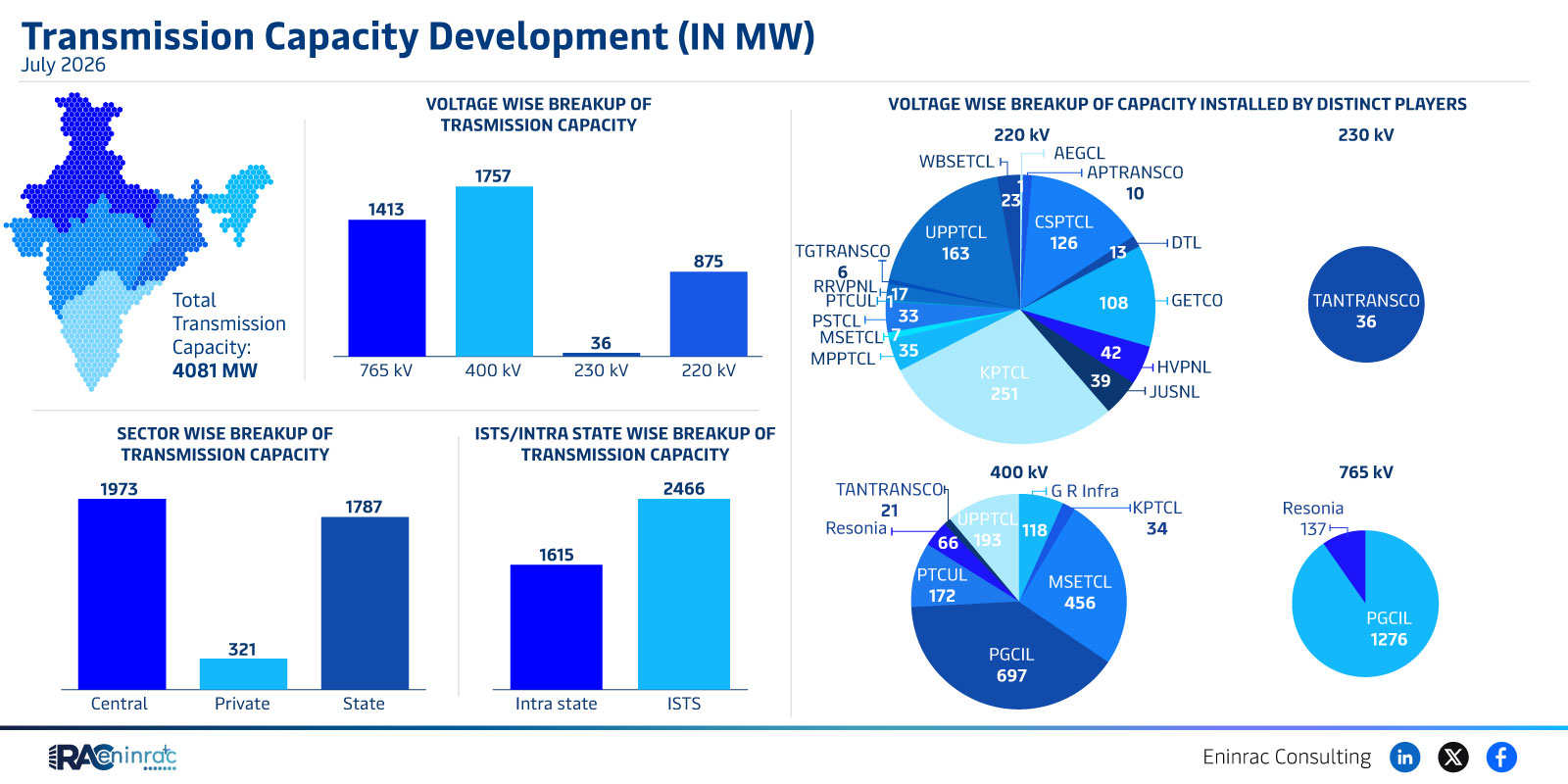
What does the July 2026 dataset tell us about transmission capacity development? It shows that a handful of players dominate the market, with AEGCL contributing the largest single block of 1,757 MW, followed by smaller but significant inputs from entities such as UPPTCL (126 MW). The data also highlights a capacity‑percentage of 36 % attributed to a specific sector, indicating a focused growth area. In essence, the numbers illustrate both concentration of capacity among key utilities and a steady overall expansion of the grid.
Voltage‑Specific Capacity Distribution by Player
A closer look at the voltage‑wise breakup reveals that high‑voltage corridors (765 kV) host the bulk of the added capacity, with figures ranging from 1,973 MW to 2,466 MW across different regions. Lower voltage tiers, while smaller in absolute terms, are crucial for feeding power into state‑level networks and industrial zones. The data also separates central, state, and intra‑state allocations, showing that central transmission corridors receive the largest share, while intra‑state lines account for a modest but essential portion of the network. This layered distribution underscores the strategic planning required to balance long‑distance bulk transfer with localized delivery.
Impact on Sectors and Industries
Transmission capacity development directly influences the renewable energy sector, conventional thermal generation, and emerging electric vehicle charging infrastructure. By expanding high‑voltage corridors, the grid can accommodate larger renewable farms and reduce curtailment, boosting the overall share of clean energy. Conventional power plants benefit from improved export routes, enhancing reliability and market pricing. Investors see reduced transmission risk, while policymakers gain a data‑driven basis for allocating future subsidies and planning new transmission corridors to lock in grid stability.
Key Takeaways
- AEGCL leads the July 2026 capacity additions with 1,757 MW.
- High‑voltage (765 kV) corridors dominate the new capacity, facilitating long‑distance power flow.
- The sector accounts for 36 % of total capacity growth, indicating targeted investment focus.
- Central transmission lines receive the largest share, while intra‑state lines support local distribution.
- Expanded capacity supports both renewable integration and conventional generation reliability.
- Clear data signals opportunities for investors and informs policy decisions on future grid expansion.
FAQs
Which player contributed the most capacity in July 2026?
AEGCL added the highest capacity, reporting 1,757 MW of new transmission lines.
What voltage level holds the majority of the new capacity?
The 765 kV tier carries the bulk of the added capacity, with individual figures between 1,973 MW and 2,466 MW.
How does transmission capacity development affect renewable energy?
By expanding high‑voltage corridors, the grid can transport larger renewable outputs with less curtailment, accelerating clean‑energy adoption.
Why is the 36 % capacity figure important?
It reflects a concentrated investment effort within a specific sector, highlighting where policymakers and investors are focusing resources.
What are the implications for investors?
Greater transmission capacity reduces bottlenecks, lowers project risk, and improves return prospects for power‑sector investments.