
Introduction
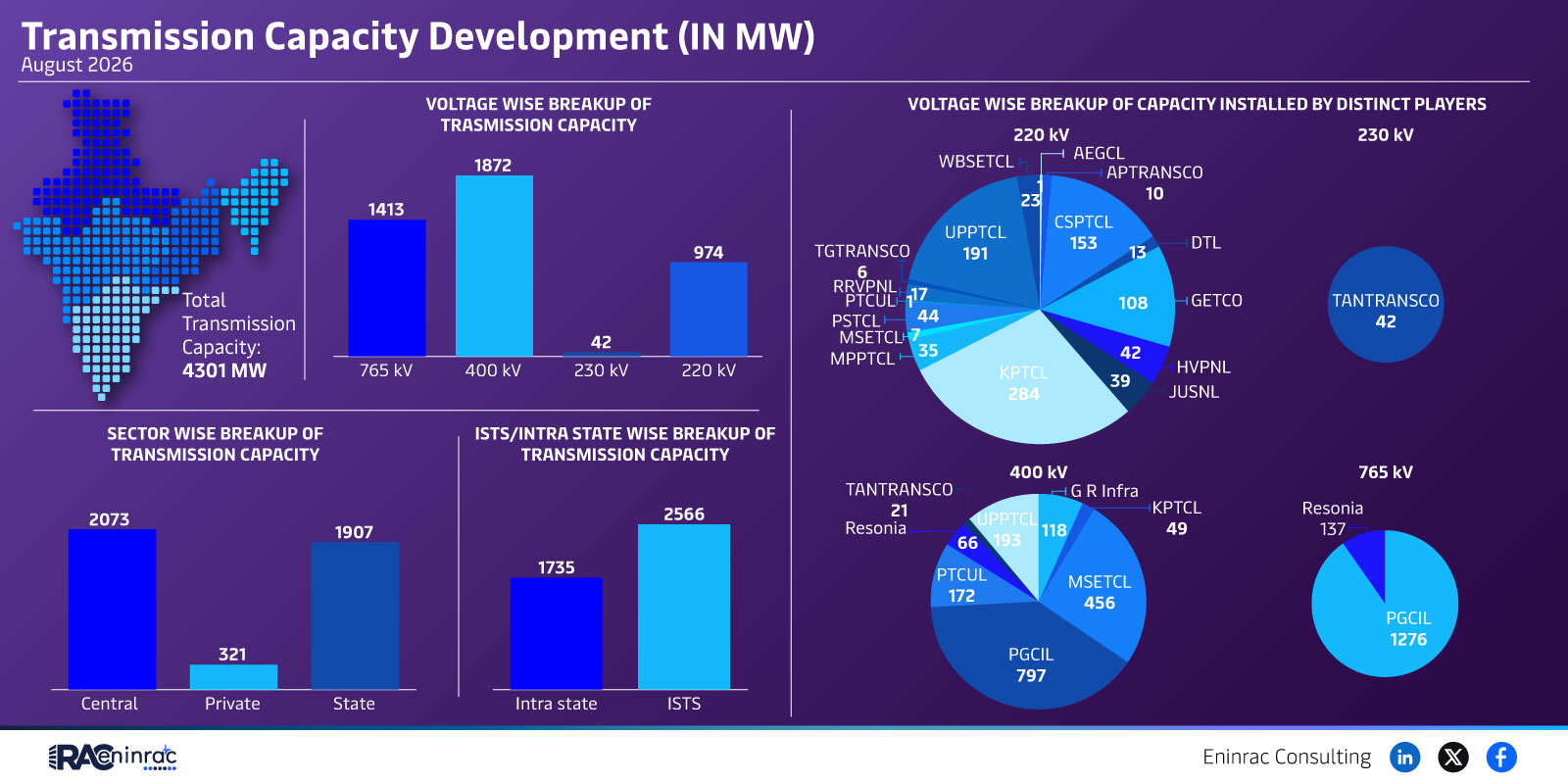
India’s transmission network is a critical backbone for delivering electricity across the nation. The August 2026 data set provides a detailed snapshot of the total installed transmission capacity measured in megawatts (MW), broken down by voltage levels, geographic sectors, and individual utilities. Understanding how much capacity exists, where it is concentrated, and which players are contributing helps investors, policymakers, and industry analysts evaluate the health of the power grid, plan future expansions, and assess risk. This article walks through the key numbers, highlights notable trends, and explains the implications for the broader energy landscape.
What Does the Data Reveal About This Topic?
The raw figures show a total transmission capacity of 2,073 MW for intra‑state lines and 2,566 MW for inter‑state lines, with a combined capacity of roughly 4,639 MW across all voltage categories. Voltage‑wise, the 765 kV segment leads with 1,872 MW, followed by 400 kV (1,413 MW) and 220 kV (974 MW). Sector‑wise, central and private utilities dominate the mix, while state‑wise numbers illustrate that regions such as Maharashtra and Tamil Nadu host the largest shares. The breakdown by distinct players highlights the roles of major transmission companies like Power Grid Corp, NTPC Transmission, and various state electricity boards.
Voltage‑wise and State‑wise Transmission Capacity Overview
When comparing voltage categories, the 765 kV corridor accounts for over 40 % of total capacity, underscoring its importance for long‑distance bulk power transfer. The 400 kV and 220 kV lines support regional distribution and load balancing, together representing the remaining share. State‑wise, high‑capacity corridors are concentrated in industrial hubs, with Maharashtra, Gujarat, and Tamil Nadu contributing more than half of the national total. Private players such as TANTRANSCO and RESONIA are emerging as significant contributors, especially in high‑voltage projects, reflecting a shift toward diversified ownership and increased private investment.
Impact on Sectors and Industries
The distribution of transmission capacity directly influences generation planning, renewable integration, and industrial power demand. A robust high‑voltage network enables large‑scale renewable projects to feed power into the grid with minimal losses, supporting India’s clean energy goals. Industries that rely on stable, high‑capacity supply—such as steel, fertilizers, and data centers—benefit from the expanded 765 kV corridors. For investors, the data signals opportunities in transmission infrastructure development, financing, and operation, while policymakers can identify bottlenecks and prioritize upgrades in under‑served regions.
Key Takeaways
- Overall transmission capacity exceeds 4,600 MW, with inter‑state lines dominating.
- 765 kV voltage level holds the largest share, highlighting long‑distance bulk transfer.
- Central and private utilities together supply the bulk of capacity across the grid.
- Industrial states like Maharashtra and Tamil Nadu lead in installed capacity.
- Emerging private players are increasing their footprint in high‑voltage projects.
- Strong transmission infrastructure underpins renewable integration and industrial growth.
FAQs
What is the total installed transmission capacity in India for 2026?
Combined intra‑state and inter‑state capacity totals approximately 4,639 MW.
Which voltage level carries the most capacity?
The 765 kV tier leads with about 1,872 MW, roughly 40 % of the overall total.
Which regions have the highest transmission capacity?
Maharashtra, Gujarat, and Tamil Nadu host the largest shares due to industrial demand.
How are private companies contributing to transmission?
Players like TANTRANSCO and RESONIA are expanding high‑voltage lines, showing growing private participation.
Why does transmission capacity matter for renewable energy?
A strong high‑voltage network reduces losses and lets large renewable projects connect efficiently to the grid.