
Introduction
India’s power transmission network relies heavily on sub‑stations to balance supply and demand across regions. The August 2026 capacity development report provides a comprehensive snapshot of installed megawatt (MW) capacity, broken down by voltage levels, sector ownership, and individual transmission companies. Understanding this data helps investors, policymakers, and industry analysts gauge the pace of grid expansion, identify bottlenecks, and plan future investments in both conventional and renewable energy integration. The dataset also captures capacity additions by state‑level utilities, offering a granular view of regional progress.
What Does the Data Reveal About This Topic?
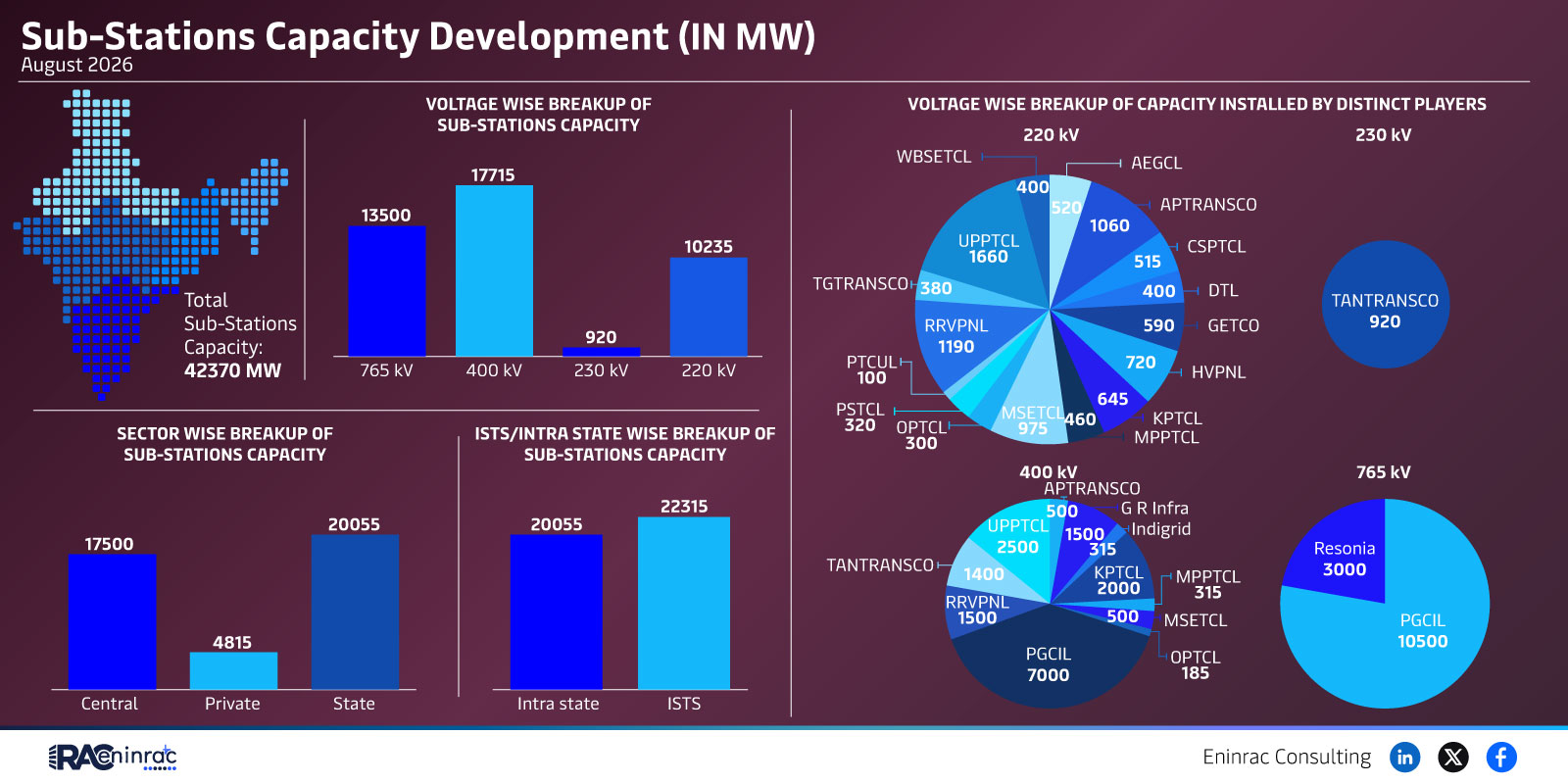
The figures demonstrate that total sub‑station capacity reached approximately 22,315 MW in August 2026, with a notable concentration in the 220 kV and 400 kV segments. Central and private sector players together account for the majority of capacity, while intra‑state and inter‑state (ISTS) connections show distinct distribution patterns. The data answers the key question: where is the Indian grid expanding most aggressively and which entities are leading the effort? Additionally, the split between intra‑state and inter‑state connections indicates where cross‑border power trade is intensifying.
Voltage and Player Specific Capacity Overview
At 220 kV, WBSETCL, AEGCL, APTRANSCO, and CSPTCL dominate with capacities ranging from 590 MW to 1,060 MW. The 400 kV tier is led by GRiInfra and Indigrid, collectively contributing around 4,500 MW. Meanwhile, the 230 kV level is primarily managed by TANTRANSCO with 920 MW, and the 765 kV segment features a single large player, Resonia, with 3,000 MW. The 765 kV line, although limited to one operator, serves as a critical backbone linking major generation hubs to load centers. This tiered structure highlights how higher voltage lines are controlled by fewer, larger utilities, whereas lower voltage networks involve a broader set of regional operators.
Impact on Sectors and Industries
Robust sub‑station capacity underpins a wide range of sectors, from heavy industry and manufacturing to emerging renewable projects. Enhanced transmission strength enables smoother power flow for large‑scale solar and wind farms, reducing curtailment risks. For investors, the concentration of capacity in central and private sectors signals stable revenue streams from transmission tariffs. Policymakers can leverage these insights to prioritize upgrades in underserved regions, promote balanced regional development, and align grid reinforcement with climate‑related goals. Improved sub‑station reliability further reduces transmission losses, enhancing overall system efficiency and supporting India's goal of achieving 450 GW of renewable capacity by 2030.
Key Takeaways
- Total installed sub‑station capacity reached 22,315 MW in August 2026.
- 220 kV and 400 kV voltage levels hold the largest share of capacity.
- Central and private sector utilities together provide over 70 % of capacity.
- Higher voltage segments are dominated by a few large transmission companies.
- Capacity growth supports both conventional power plants and renewable integration.
- Data highlights regional disparities that guide future infrastructure planning.
FAQs
What is the total sub‑station capacity reported for August 2026?
The report lists a combined capacity of about 22,315 MW across all voltage levels.
Which voltage tier has the highest installed capacity?
The 220 kV tier leads with the largest aggregate capacity among all segments.
Who are the main operators of 400 kV sub‑stations?
GRiInfra and Indigrid are the primary players, together supplying roughly 4,500 MW.
How does sub‑station capacity affect renewable energy projects?
Stronger transmission networks reduce curtailment and enable smoother delivery of solar and wind power to the grid.
Why is the private sector’s role significant in grid expansion?
Private utilities bring investment capital and operational efficiency, accelerating capacity upgrades and regional connectivity.