
Introduction
India’s power transmission network continues to expand rapidly, and the September 2026 transmission capacity data provides a clear snapshot of that growth. The report aggregates capacity measured in circuit‑kilometres (cKM) across the country’s high‑voltage corridors, detailing contributions from both central and private utilities. Readers will learn how voltage tiers, regional allocations and key players shape the overall transmission capacity, and why these trends matter for policymakers, investors and energy consumers alike.
What Does the Data Reveal About This Topic?
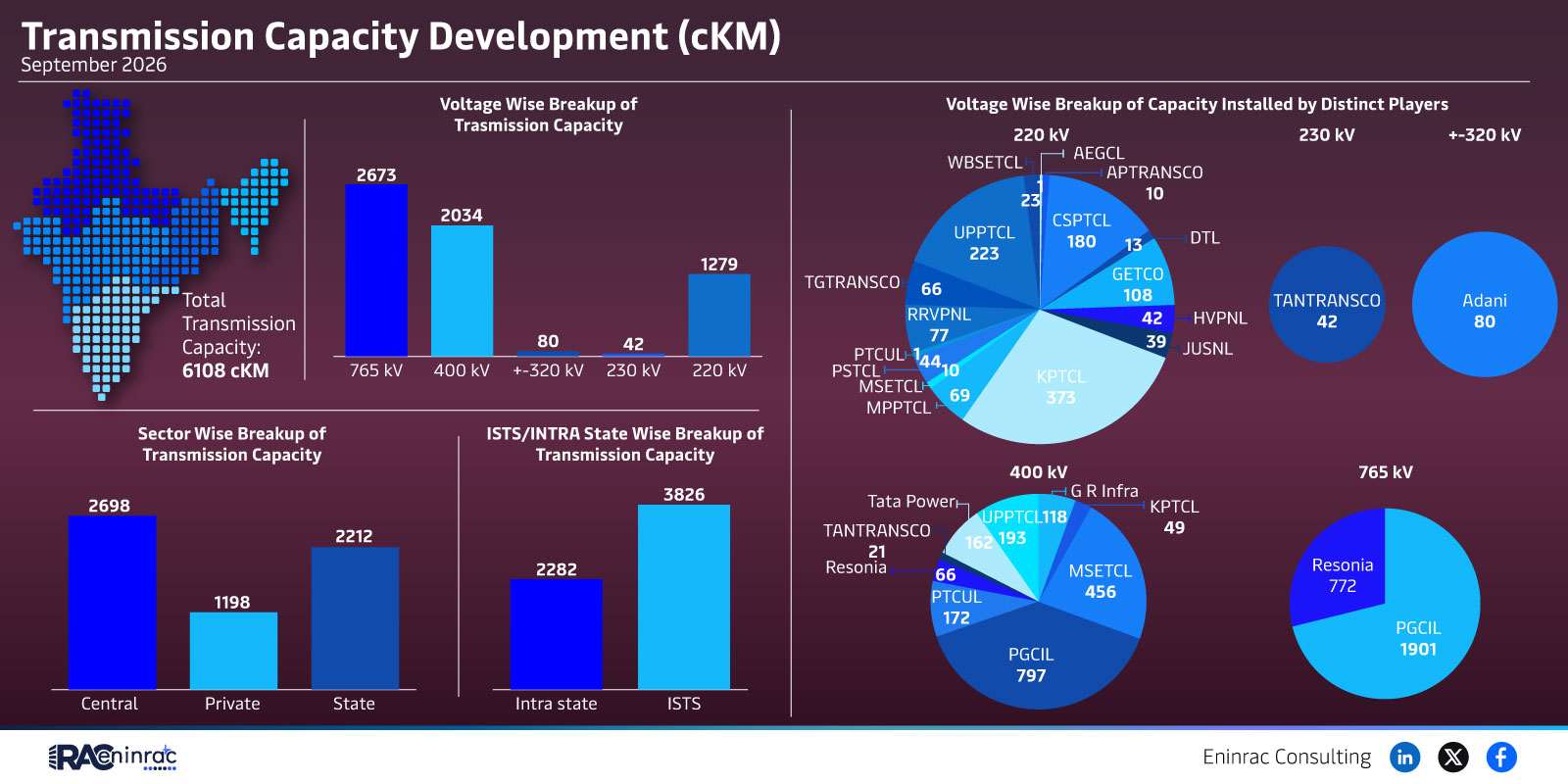
What does the September 2026 data reveal about the state of transmission capacity in India? It shows a total installed capacity of 6,108 cKM spread over five voltage levels: 765 kV, 400 kV, 320 kV, 230 kV and 220 kV. Central transmission utilities account for roughly 2,673 cKM, while private players contribute 2,034 cKM, and intra‑state networks add another 1,279 cKM. The figures also highlight leading states and sectors, with central and private segments together delivering more than 80 percent of the nation’s high‑voltage backbone.
Voltage and Player Distribution Highlights
The breakdown by voltage reveals a clear hierarchy of capacity deployment. The 765 kV corridor, the highest voltage tier, holds 2,673 cKM, reflecting its strategic role in long‑distance bulk power transfer. The 400 kV network follows with 2,034 cKM, serving as the core conduit for regional interconnections. The 320 kV and 230 kV lines collectively add 1,279 cKM, facilitating state‑level distribution, while the 220 kV lines contribute 1,122 cKM, supporting localized load centres. Among the major utilities, WBSETCL, APTRANSCO, TGTRANSCO, and TANTRANSCO together account for a substantial share of the high‑voltage grid, underscoring the importance of both central and private operators in expanding transmission capacity.
Impact on Sectors and Industries
The expanded transmission capacity has direct implications for multiple sectors. For renewable energy developers, greater high‑voltage connectivity reduces curtailment risk and improves project economics. Conventional thermal generators benefit from enhanced grid stability and the ability to dispatch power across larger distances. Investors see a stronger asset base that can attract financing for new generation and storage projects. Policymakers gain a clearer roadmap for meeting national electrification targets, while industrial consumers anticipate more reliable power supply, potentially lowering operational costs.
Key Takeaways
- Total transmission capacity reaches 6,108 cKM.
- 765 kV lines hold the largest capacity share.
- Central utilities contribute over half of the capacity.
- Private players drive growth in 400 kV and 320 kV tiers.
- Key operators include WBSETCL, APTRANSCO and TGTRANSCO.
- Enhanced capacity supports renewable integration and grid stability.
FAQs
What is the significance of cKM in transmission planning?
Circuit‑kilometres (cKM) measure the total length of transmission lines at a given voltage, providing a standard metric to assess network reach and capacity planning.
Which voltage level carries the most capacity in India?
The 765 kV tier carries the highest share, accounting for about 2,673 cKM of the total installed transmission capacity.
How do private utilities affect transmission capacity growth?
Private utilities contribute roughly 2,034 cKM, primarily in the 400 kV and 320 kV segments, accelerating network expansion and enhancing regional connectivity.
What role does transmission capacity play in renewable energy integration?
Higher transmission capacity reduces curtailment and enables renewable power to reach distant load centres, improving overall grid efficiency and supporting clean energy targets.
Where can investors find opportunities in the transmission sector?
Investment prospects exist in upgrading high‑voltage corridors, expanding intra‑state networks, and financing projects led by both central and private transmission owners.