
Introduction
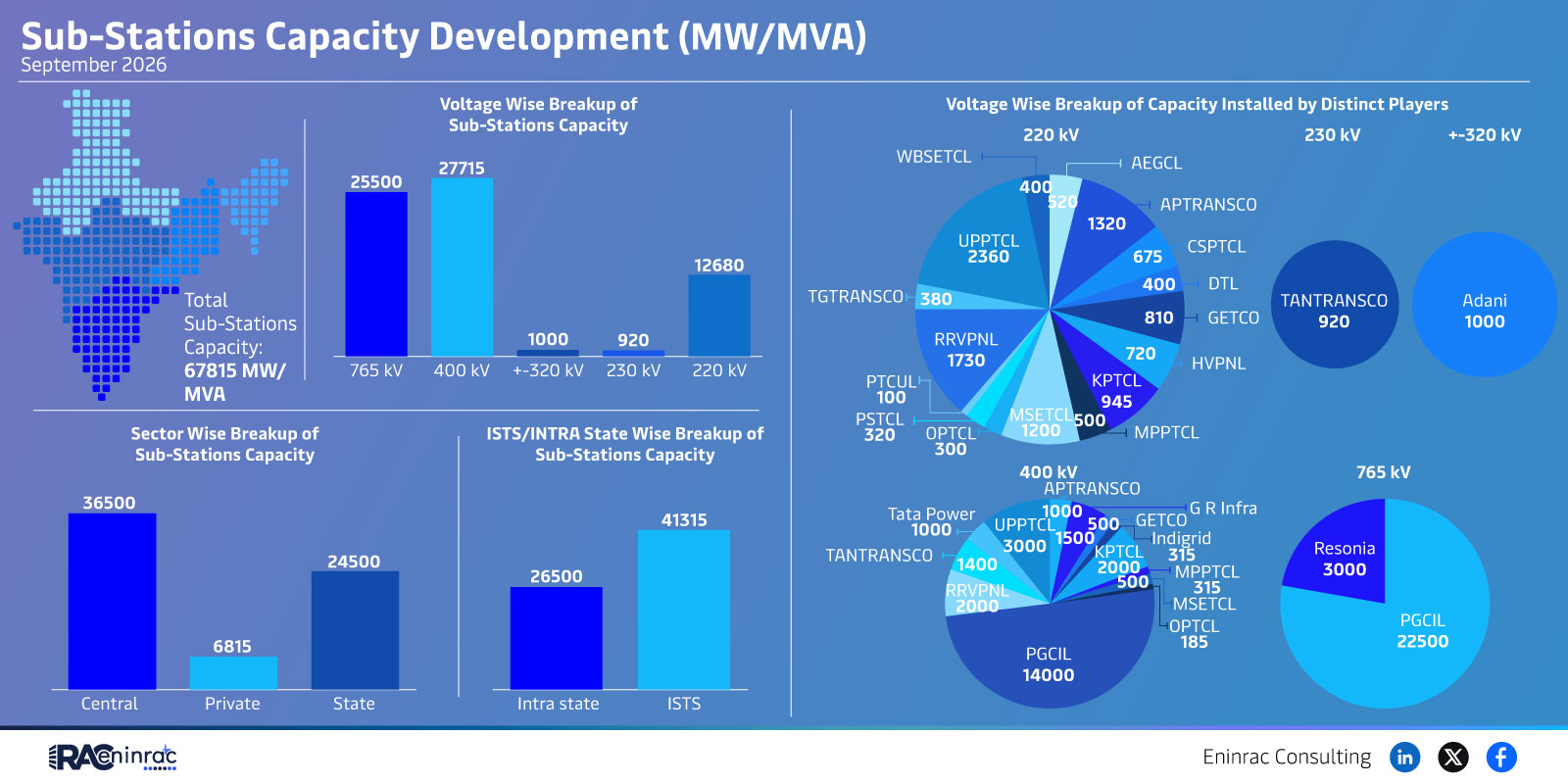
The September 2026 report on sub‑station capacity development in India provides a comprehensive snapshot of the nation’s transmission infrastructure. It lists total installed capacity, breaks it down by voltage levels, distinguishes private and state ownership, and shows sector‑wise contributions. Understanding this data helps investors, policymakers and industry analysts gauge the readiness of the power grid to support growing demand, future energy transitions and grid modernization initiatives.
What Does the Data Reveal About This Topic?
Does the September 2026 dataset indicate an increase in high‑voltage sub‑stations compared with previous years? The figures show a total capacity of 67,815 MW/MVA, with major contributions at 400 kV, 320 kV, 230 kV and 220 kV. The voltage‑wise distribution highlights that the bulk of capacity resides in the 400 kV tier, while lower voltage levels still play a supporting role. This pattern confirms a continued emphasis on high‑voltage corridors to reduce losses, improve transmission efficiency and accommodate larger generation units.
Voltage and Sector Breakdown of Sub‑Station Capacity
When the data is examined by voltage, 27,715 MW/MVA are allocated to the 400 kV class, 25,500 MW/MVA to 320 kV, and 12,680 MW/MVA to 230 kV, with the remaining 2,915 MW/MVA spread across 220 kV and other categories. Sector analysis shows that private players such as WBSETCL, AEGCL, APTRANSCO, CSPTCL, OTL, TGTRANSCO, TANTRANSCO, GETCO and others together account for roughly 36,500 MW/MVA, while state‑owned entities contribute about 41,315 MW/MVA. Intra‑state capacity totals 24,500 MW/MVA, whereas inter‑state (national) capacity reaches 6,815 MW/MVA, indicating a stronger focus on regional networks. The data also reveals that private investment is concentrated in the 320 kV and 230 kV segments, whereas state utilities dominate the 400 kV high‑capacity tier.
Impact on Sectors and Industries
The expansion of sub‑station capacity directly influences generation, transmission and distribution sectors. A larger high‑voltage base enables smoother integration of large‑scale renewable projects, improves bulk power transfer, and reduces congestion in key corridors. For investors, the clear split between private and state ownership highlights opportunities for public‑private partnerships, green financing and targeted infrastructure funds. Policymakers can use the voltage‑wise data to prioritize upgrades, set tariff reforms and design incentive schemes. Utilities benefit from benchmarking their own assets against national averages, while consumers gain from more reliable supply and potentially lower electricity costs.
Key Takeaways
- Total sub‑station capacity reaches 67,815 MW/MVA as of September 2026.
- 400 kV infrastructure holds the largest share, followed by 320 kV and 230 kV.
- Private utilities contribute approximately 36,500 MW/MVA, state entities about 41,315 MW/MVA.
- Intra‑state capacity (24,500 MW/MVA) surpasses inter‑state capacity (6,815 MW/MVA).
- The data underscores a strategic focus on high‑voltage upgrades to support grid reliability.
- Investors can target gaps in lower‑voltage segments for future growth.
FAQs
What is the total installed sub‑station capacity in India for September 2026?
The report records a combined capacity of 67,815 MW/MVA across all voltage levels.
Which voltage level contains the highest capacity?
400 kV sub‑stations account for the largest portion, with 27,715 MW/MVA.
How does private ownership compare to state ownership?
Private utilities hold about 36,500 MW/MVA, while state‑run entities control roughly 41,315 MW/MVA.
What is the share of intra‑state versus inter‑state capacity?
Intra‑state capacity stands at 24,500 MW/MVA, whereas inter‑state capacity is 6,815 MW/MVA.
Why is high‑voltage capacity important for renewable integration?
High‑voltage lines reduce transmission losses and allow large renewable farms to feed power efficiently into the national grid.