
Introduction
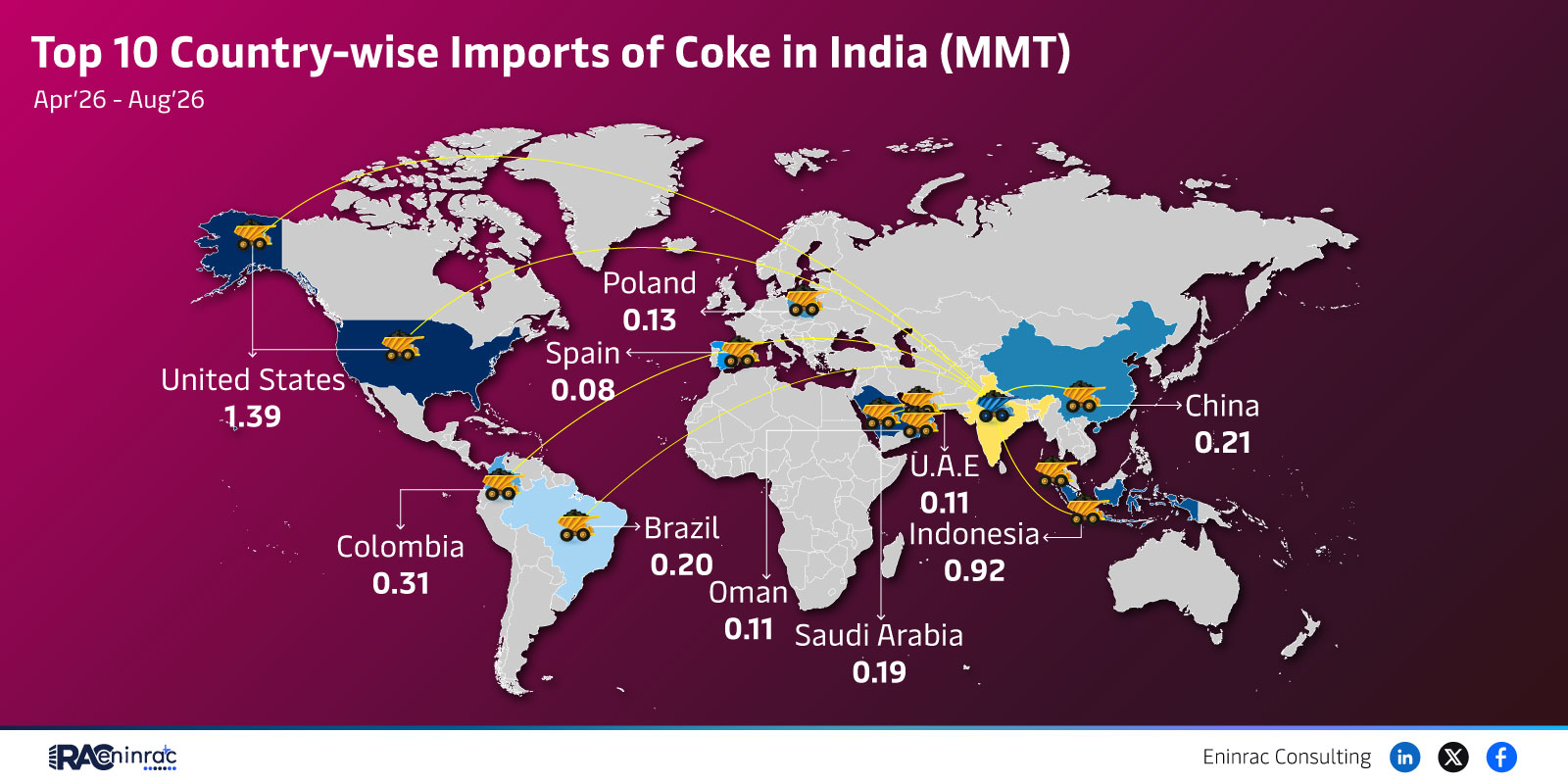
India’s demand for metallurgical coke continues to rise as the steel sector expands, pushing the country to rely increasingly on imports. Between April 26 and August 26, 2026, data shows the top ten exporting nations supplied a combined 0.92 million metric tonnes (MMT) of coke to India. The figures highlight the importance of overseas coke sources for maintaining production schedules and meeting export commitments. Understanding coke imports India helps stakeholders gauge supply dynamics. Analysts use these import metrics to forecast steel output, assess trade deficits, and guide investment decisions in the energy and mining sectors.
What Does the Data Reveal About This Topic?
The snapshot reveals that Indonesia leads the pack with 0.31 MMT, followed closely by Colombia and Saudi Arabia each delivering around 0.11 MMT. A smaller yet notable shipment of 0.19 MMT is recorded from an unnamed source, suggesting additional contributors outside the top three. These numbers underline Indonesia’s strategic positioning as a key coke supplier while also exposing India’s diversified import basket.
Country‑wise Share of Coke Imports to India
When expressed as a share of the total ten‑country import volume, Indonesia accounts for roughly 34 percent, Colombia and Saudi Arabia each hold about 12 percent, and the remaining six countries split the balance of 42 percent. This distribution points to a concentration of supply in Southeast Asia and the Middle East, regions where large coke‑producing facilities and efficient logistics corridors exist. The data also suggests that any disruption in Indonesian coke output could immediately affect more than a third of India’s imported coke supply.
Impact on Sectors and Industries
Metallurgical coke is a critical input for blast‑furnace steelmaking, meaning fluctuations in import volumes directly influence steel production costs and competitiveness. Energy‑intensive industries such as cement and power generation also rely on coke as a fuel, so changes in supply can cascade into pricing pressures across the broader industrial ecosystem. For investors and policymakers, monitoring these import trends offers an early signal of potential supply risks, prompting considerations for domestic coke mining incentives or strategic stockpiling. Consequently, fluctuations in global coke prices can ripple through commodity markets, influencing inflation rates and trade balances.
Key Takeaways
- Indonesia is the leading coke exporter to India, contributing about 34 % of total imports.
- Colombia and Saudi Arabia each supply roughly 12 % of India’s imported coke.
- Six other countries together provide the remaining 42 % of imports, indicating a diversified source base.
- A disruption in Indonesian coke production could affect more than one‑third of India’s supply chain.
- Coke import trends directly affect steel‑making costs and overall industrial competitiveness in India.
- Policymakers may consider boosting domestic coke production or strategic reserves to mitigate import reliance.
FAQs
Which country supplied the most coke to India in Apr‑Aug 2026?
Indonesia with 0.31 MMT.
How much coke did Colombia export to India during the period?
Approximately 0.11 MMT.
Why is coke import data important for the steel industry?
Because coke is essential for blast‑furnace operations, and its price and availability affect steel production costs and output.
What risks does heavy reliance on a single supplier pose?
Supply disruptions, price volatility, and geopolitical factors can jeopardize the steady flow of coke needed for steel plants.
What steps can India take to reduce dependence on imported coke?
Encourage domestic coke mining, invest in alternative fuels, and create strategic coke stockpiles.