
Introduction
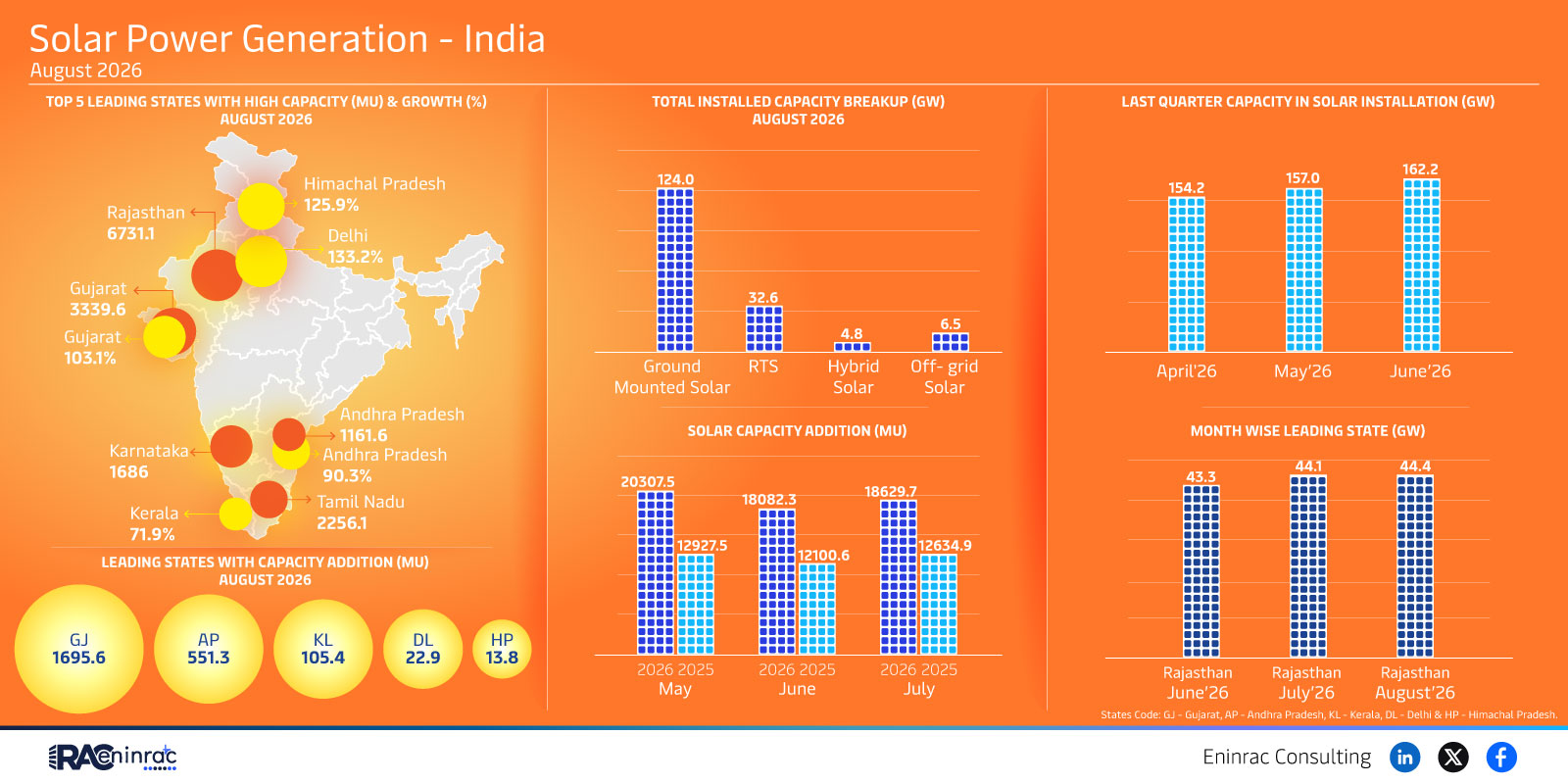
India’s solar power generation in August 2026 showcases a rapid expansion across several states, underscoring the country’s commitment to renewable energy. The data highlights which states are leading in installed capacity, how much new capacity was added during the month, and the overall growth momentum. Readers will learn about the top-performing regions, the scale of capacity additions, and the broader implications for the Indian energy landscape.
What Does the Data Reveal About This Topic?
The raw figures indicate that Tamil Nadu holds the highest capacity at 2,256.1 MW, while Rajasthan emerges as a fast‑growing contributor with significant month‑on‑month additions. The numbers also point to a total national installed solar capacity approaching 162 GW, with a quarterly addition of roughly 32 GW. This suggests that India continues to accelerate its solar rollout, driven by state‑level initiatives and supportive policy frameworks.
State‑Wise Capacity Trends in August 2026
Examining the month‑wise breakdown, Tamil Nadu leads with a capacity addition of about 203 MW, followed by Rajasthan and Gujarat with notable increases. The “Ground RTS Hybrid” and “Mounted Solar” segments together contributed a sizeable share of the 124 MW added in the last quarter. Maharashtra, Andhra Pradesh, and Karnataka also posted modest growth, reflecting a diversified expansion pattern that reduces reliance on a single hub. The data illustrates a shift toward hybrid and grid‑connected installations, indicating a maturing market that embraces varied solar technologies.
Impact on Sectors and Industries
The surge in solar power generation affects multiple stakeholders. Investors see heightened opportunities in project financing and equipment supply chains, while policymakers gain evidence to refine incentive schemes. Utilities benefit from an increasingly stable renewable feed‑in, reducing fossil fuel dependence. Moreover, the construction and engineering sectors experience job creation as new solar farms are commissioned across the leading states.
Key Takeaways
- Tamil Nadu remains the top state with over 2,200 MW of solar capacity.
- Rajasthan recorded the fastest recent growth, adding significant megawatts in August.
- India’s total installed solar capacity approaches 162 GW as of August 2026.
- Hybrid and mounted solar installations together contributed more than 30 GW in the last quarter.
- State‑level initiatives are crucial drivers of the nation’s renewable energy agenda.
- The expanding solar market creates fresh investment, employment, and policy opportunities.
FAQs
Which Indian state had the highest solar capacity in August 2026?
Tamil Nadu topped the list with approximately 2,256 MW of installed solar capacity.
How much new solar capacity was added nationwide in the last quarter?
Around 32 GW of solar capacity was added across India during the most recent quarter.
What types of solar installations drove the recent growth?
Hybrid ground‑mounted systems and traditional mounted solar projects together accounted for the majority of new capacity.
Why is Rajasthan’s growth notable?
Rajasthan’s rapid addition of megawatts highlights its emerging role as a new solar hub, diversifying the geographic spread of generation.
What implications does this growth have for investors?
Increasing capacity creates lucrative opportunities in project financing, equipment supply, and related services as the market matures.