
Introduction
The July 2026 manufacturing report for solar modules and cells reveals a rapid expansion of India’s photovoltaic industry. Leading states such as Uttar Pradesh, Chhattisgarh and Tamil Nadu have added tens of gigawatts of capacity, while a host of domestic manufacturers are scaling production. This article breaks down the key figures, trends and what the data means for investors, policymakers and the wider renewable‑energy ecosystem.
What Does the Data Reveal About This Topic?
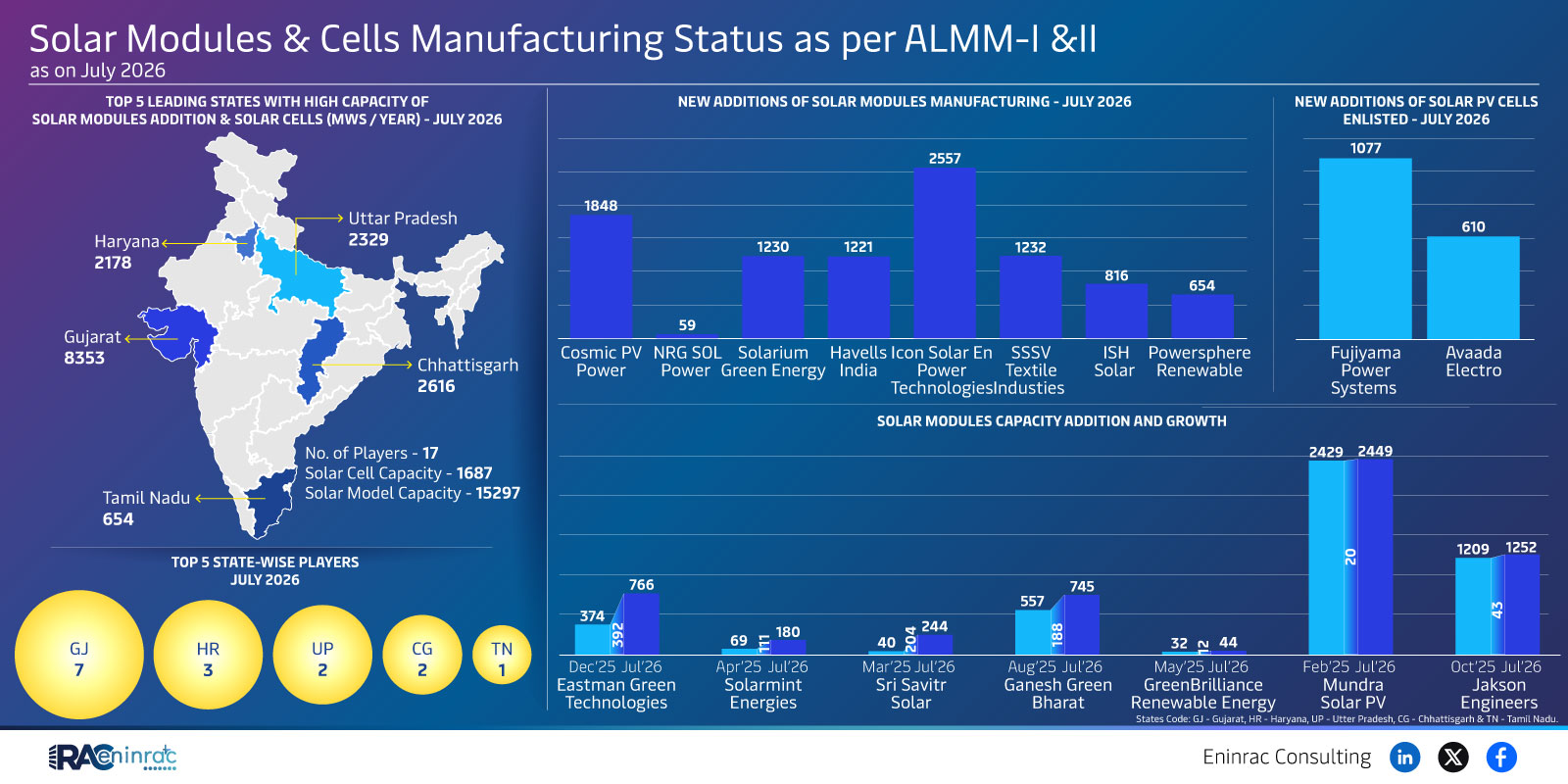
The data shows that Uttar Pradesh contributed 2,329 MW of new solar module capacity, Chhattisgarh added 2,616 MW, and Tamil Nadu led with a remarkable 15,297 MW of module additions. Solar cell capacity rose by 1,687 MW nationally, indicating a balanced growth between modules and cells. These numbers answer the core question: which regions are driving India’s solar manufacturing surge and how significant is the overall capacity increase?
State‑wise Capacity Trends and Leading Manufacturers
Uttar Pradesh’s 2,329 MW addition places the state among the top three module producers, reflecting strong policy incentives and a growing supply chain. Chhattisgarh’s 2,616 MW surpasses UP, driven by new green‑energy parks and a focus on localized production. Tamil Nadu’s 15,297 MW surge dwarfs other states, underpinned by its established industrial base and proximity to key export ports. The report also lists emerging manufacturers such as Cosmic PV, NRGSOL, Solarium, Havellsicon, SolarEn, SSSV, ISH, Powersphere, Power Green Energy India, Power Textile, Fujiyama, Avaada, Electro Technologies, and several others, highlighting a diversified and competitive market.
Impact on Sectors and Industries
The expansion of solar module capacity influences multiple sectors. Renewable‑energy developers gain faster access to domestically produced panels, lowering project costs. The manufacturing boom creates jobs in engineering, logistics and ancillary services, while stimulating demand for raw materials like silicon wafers. Investors see a lower risk profile as supply chain resilience improves, and policymakers can justify further incentives knowing the industry’s growth trajectory. Consumer adoption is also expected to rise as module prices fall due to economies of scale.
Key Takeaways
- Uttar Pradesh, Chhattisgarh and Tamil Nadu together account for over 20 GW of new solar module capacity in July 2026.
- Solar cell capacity addition of 1,687 MW supports the module growth, ensuring balanced production.
- More than a dozen domestic manufacturers are scaling up, indicating a competitive ecosystem.
- State‑level incentives and green‑energy parks are pivotal in driving capacity additions.
- Increased domestic production reduces reliance on imports and improves price stability.
- The surge benefits investors, policymakers, and end‑users across the renewable‑energy value chain.
FAQs
Which Indian state added the most solar module capacity in July 2026?
Tamil Nadu led with an addition of 15,297 MW, far exceeding other states.
How much solar cell capacity was added nationwide?
The report shows a total of 1,687 MW of new solar cell capacity across India.
What are the key manufacturers mentioned in the July 2026 data?
Companies such as Cosmic PV, NRGSOL, Solarium, Havellsicon, SolarEn, SSSV, ISH, Powersphere and Avaada are among the listed manufacturers.
Why does state‑wise capacity growth matter for investors?
It signals regional policy effectiveness, supply‑chain robustness and potential for lower project costs, all of which lower investment risk.
How does increased module capacity affect solar project costs?
Higher domestic output drives down panel prices, improving the economics of new solar installations.