
Introduction
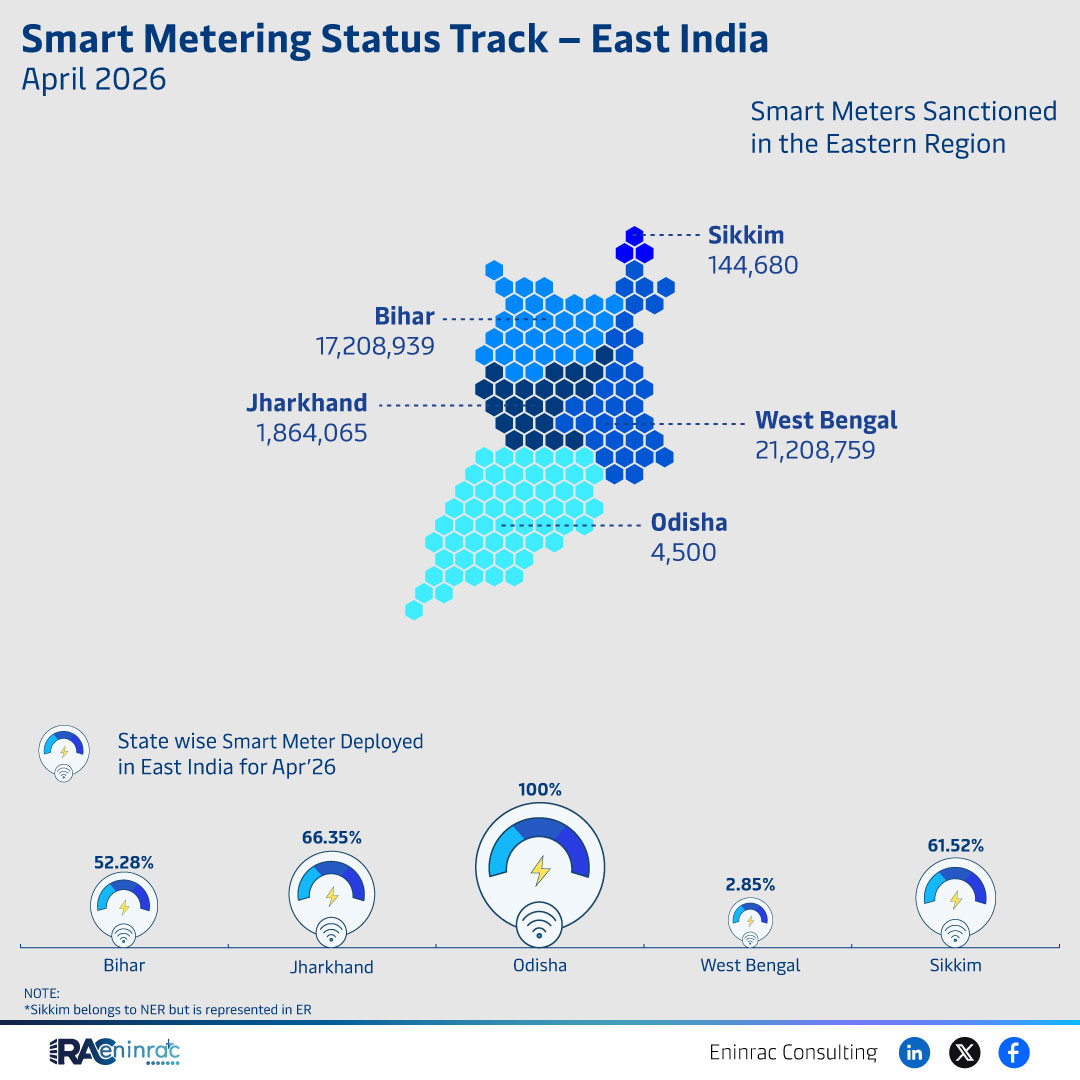
The April 2026 report on smart meter deployment in East India provides a detailed snapshot of how utilities are advancing grid modernization across the region. Understanding the scale of sanctioned meters, the states leading the rollout, and the percentage of deployment helps stakeholders gauge progress toward energy efficiency and digital transformation.
What Does the Data Reveal About This Topic?
Which states have the highest number of sanctioned smart meters and what share of the total deployment does each represent? The data shows Bihar leading with 17,208,939 meters, followed by West Bengal with 21,208,759 meters, while smaller states like Sikkim and Odisha account for 144,680 and 4,500 meters respectively. Overall deployment reaches 66.35% of the sanctioned target across East India.
State‑wise Deployment Highlights
Comparing the figures, West Bengal and Bihar together account for more than 38 million meters, driving the bulk of the region’s smart grid transition. Sikkim, although part of the North‑Eastern Region, is listed under East India and contributes a modest 0.14% of the total. Odisha’s deployment remains low at 4,500 meters, indicating potential for future growth. The deployment percentages—61.52% for Bihar, 52.28% for Jharkhand, and 66.35% overall—illustrate varying speeds of implementation.
Impact on Sectors and Industries
Smart meter deployment directly influences utility operations, consumer billing accuracy, and demand‑side management. For investors, the rapid rollout in Bihar and West Bengal signals a fertile market for IoT hardware, data analytics, and energy‑service companies. Policymakers can leverage the deployment data to design incentive schemes that accelerate adoption in lagging states like Odisha. Consumers benefit from real‑time usage data, leading to more informed energy choices and potential cost savings.
Key Takeaways
- Bihar tops the list with over 17 million sanctioned smart meters.
- West Bengal follows closely with more than 21 million meters, driving regional totals.
- Overall deployment in East India stands at 66.35%, indicating two‑thirds of the target achieved.
- Sikkim’s inclusion highlights cross‑regional reporting practices.
- Odisha’s low figure suggests untapped opportunities for smart grid investments.
- Higher deployment percentages correlate with stronger utility modernization programs.
FAQs
What is the total number of smart meters sanctioned in East India for April 2026?
The combined total across Bihar, Jharkhand, West Bengal, Sikkim, and Odisha is approximately 38.6 million meters.
Which state has the highest deployment percentage?
Bihar leads with a deployment rate of 61.52% of its sanctioned meters.
Why is Sikkim listed under East India?
Although Sikkim belongs to the North‑Eastern Region, the report groups it with East India for consistency in data presentation.
What opportunities exist for investors in low‑deployment states?
States like Odisha present growth potential for smart‑meter manufacturers, data‑analytics firms, and service providers aiming to expand the smart grid footprint.
How does smart meter deployment affect consumers?
Consumers gain access to real‑time usage information, more accurate billing, and the ability to manage energy consumption more efficiently.