
Introduction
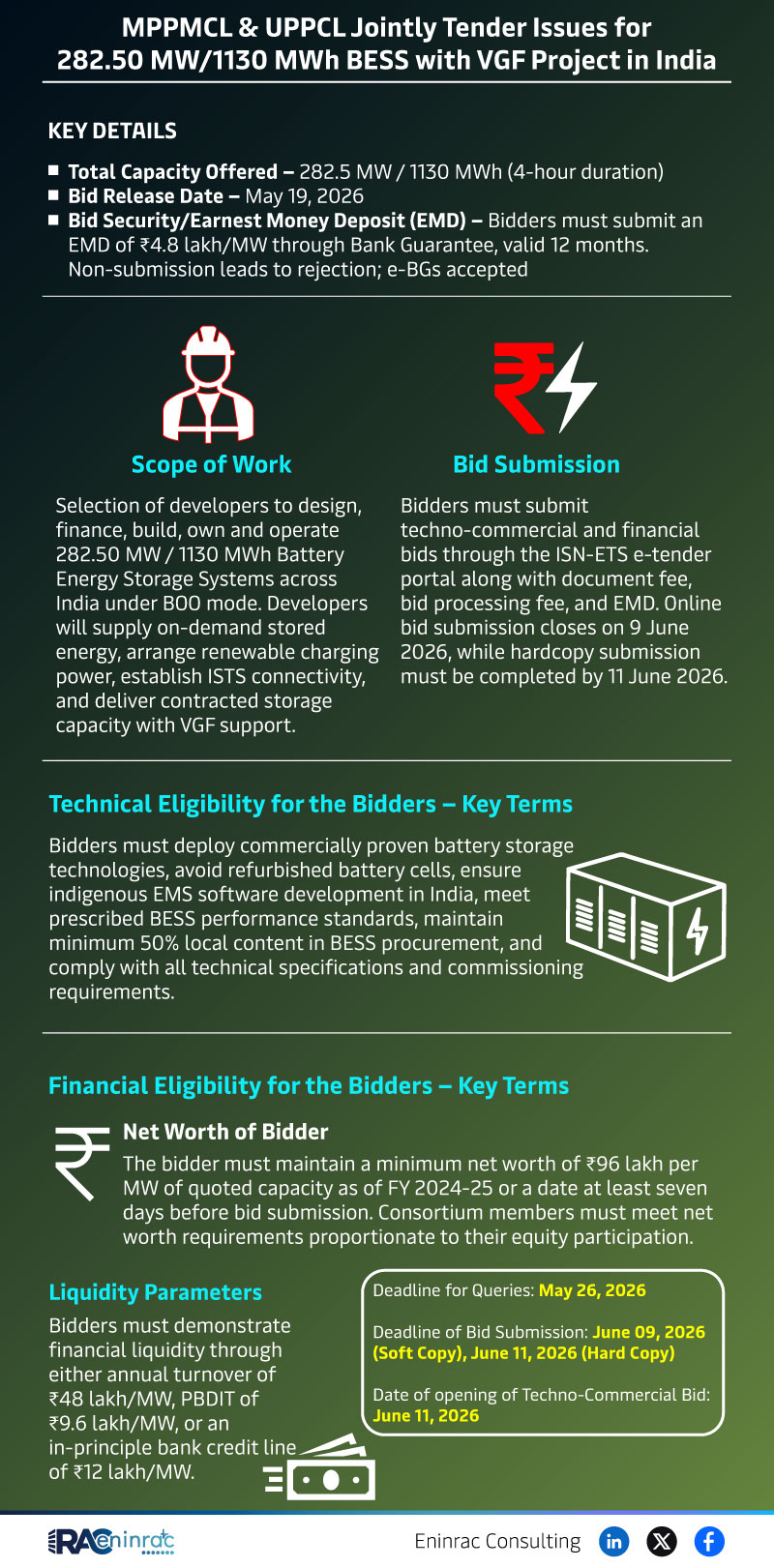
The Maharashtra Power Management and Control Ltd (MPPMCL) and Uttar Pradesh Power Corporation Ltd (UPPCL) have jointly issued a tender for a 282.5 MW / 1130 MWh battery energy storage system (BESS) project in India. The tender, released on 19 May 2026, outlines strict financial, technical and compliance requirements for developers who wish to design, finance, build, own and operate the system under a BOO model with Viability Gap Funding (VGF) support. This article breaks down the tender specifications, eligibility criteria, submission timeline and the broader impact on India’s renewable energy landscape.
What Does the Data Reveal About This Topic?
The data shows that the Indian power sector is accelerating large‑scale storage deployment to complement renewable generation. By mandating a 4‑hour duration, a minimum 50 % local content, and prohibiting refurbished cells, the tender aims to ensure high‑performance, domestically sourced storage that can provide on‑demand power, grid stability and renewable charging support. The financial thresholds—EMD of 24.8 lakh per MW, net‑worth of 796 lakh per MW and specific PBDIT and credit limits—highlight the emphasis on financially robust participants.
Key Tender Requirements and Eligibility
Applicants must submit techno‑commercial bids through the ISN‑ETS e‑tender portal by 9 June 2026 (online) and a hard‑copy by 11 June 2026. The bid security is 24.8 lakh per MW via bank guarantee, valid for 12 months, with e‑BGs accepted. Financial health is measured by a net‑worth of at least 796 lakh per MW as of FY 2024‑25, and consortium members must meet proportional net‑worth based on equity share. Additional financial criteria include a PBDIT of 29.6 lakh per MW and a minimum in‑principle bank credit of 12 lakh per MW. Technical criteria demand commercially proven battery technology, indigenous EMS software, and compliance with performance standards.
Impact on Sectors and Industries
The tender will stimulate growth in several sectors. Battery manufacturers and EMS software developers in India stand to gain from the 50 % local content rule, encouraging domestic supply chains. Renewable power producers will benefit from reliable storage that can smooth intermittency and enable higher renewable penetration. Investors and financial institutions will find new opportunities in financing large‑scale, government‑backed energy projects with VGF incentives. Policymakers can use the tender as a template for future storage auctions, reinforcing India’s commitment to a low‑carbon grid.
Key Takeaways
- 282.5 MW / 1130 MWh BESS tender launched by MPPMCL and UPPCL with VGF support.
- Bid security is 24.8 lakh per MW; net‑worth requirement is 796 lakh per MW.
- Submission deadline: 9 June 2026 online, 11 June 2026 hard copy.
- Technical mandates include 4‑hour duration, 50 % local content, no refurbished cells, and indigenous EMS software.
- Financial thresholds ensure participation of financially strong developers and consortiums.
- The tender accelerates domestic battery manufacturing, renewable integration and investment in grid‑scale storage.
FAQs
What is the total capacity and duration of the BESS tender?
The tender covers 282.5 MW of power capacity with a 1130 MWh energy capacity, providing a 4‑hour discharge duration.
When must bids be submitted?
Online bids close on 9 June 2026, and hard‑copy submissions must be received by 11 June 2026.
What financial guarantees are required?
Applicants must provide an Earnest Money Deposit of 24.8 lakh per MW via bank guarantee, maintain a net‑worth of 796 lakh per MW, and meet PBDIT and credit limits as specified.
Are refurbished battery cells allowed?
No. The tender explicitly requires commercially proven, new battery storage technologies and prohibits refurbished cells.
How does the VGF support work?
The Viability Gap Funding is offered to reduce the financial burden on developers, making the project economically viable while encouraging domestic content and technology development.