
Introduction
The small hydro power sector in India reached a pivotal point in July 2026 as new capacity additions and state‑wise performance data were published. Small hydro, defined as projects under 25 MW, contributes to the country’s renewable mix by harnessing river and stream flows in remote regions. The latest figures show which states are leading in installed capacity, which are adding the most new megawatts, and how monthly trends are shifting as the monsoon season progresses. Understanding these patterns helps policymakers, investors, and developers identify growth opportunities, allocate resources efficiently, and support India’s clean energy targets.
What Does the Data Reveal About This Topic?
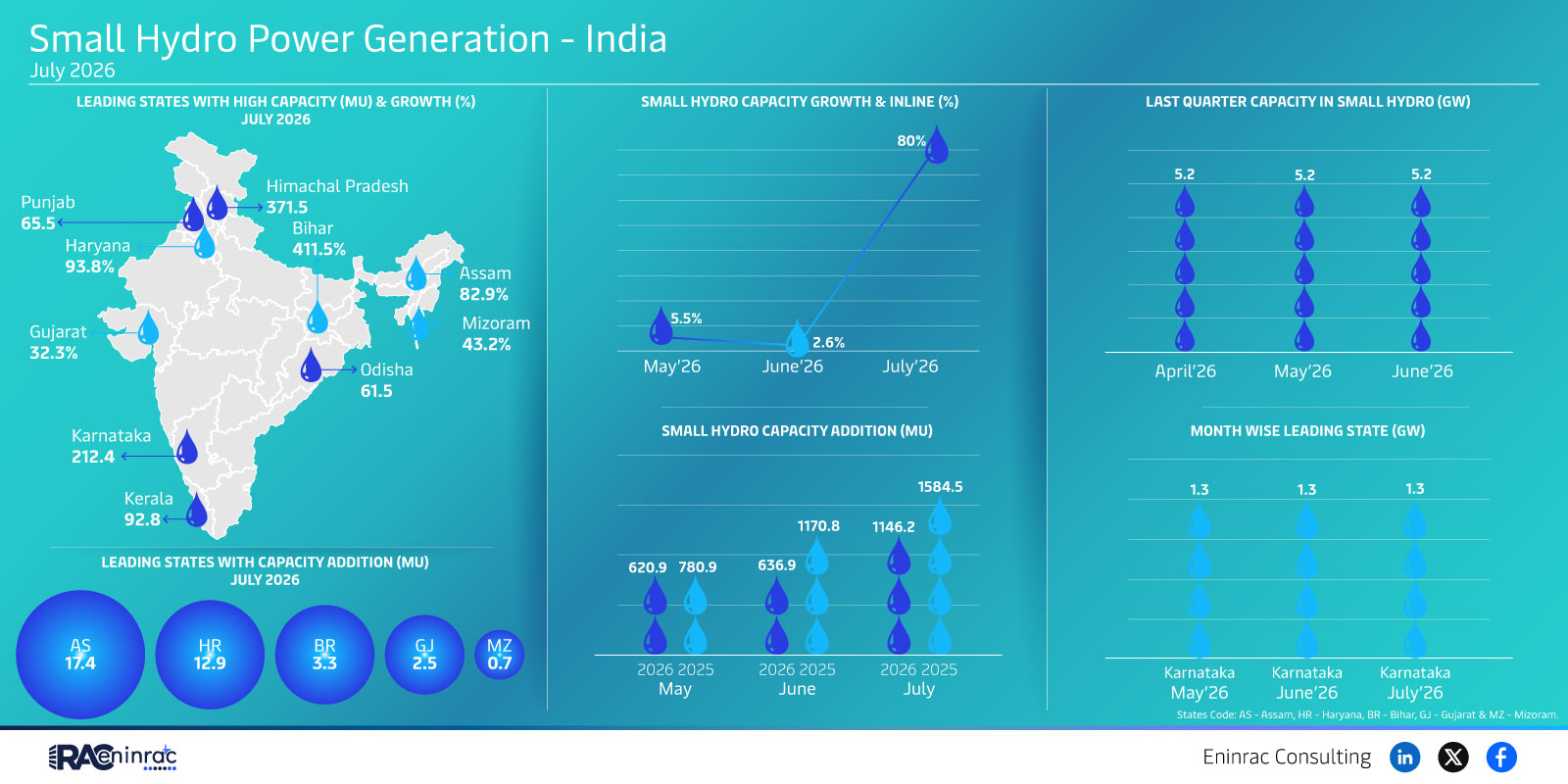
The data answers a simple question: which Indian states are driving small hydro expansion and how fast are they adding capacity? Karnataka dominates both total installed capacity and month‑to‑month growth, consistently reporting the highest figures in May, June and July 2026. The capacity addition chart shows a sharp increase in May 2026 followed by a modest rise in June and a slight dip in July, indicating seasonal influences on project commissioning.
State‑wise Capacity and Growth Trends
The leading states list reveals Karnataka with an impressive 2,122.4 MW of small hydro capacity, far outpacing the next highest, Himachal Pradesh, whose figure is unclear but appears much lower. Bihar’s 411.5 MW and Assam’s 82.9 MW illustrate the diversity of scale across regions. Mizoram’s 43.2 MW, while modest, underscores the penetration of small hydro into northeastern territories. Capacity addition numbers show a total of about 1,584.5 MW added in the reporting period, with May 2026 contributing roughly 1,146.2 MW, June 620.9 MW, and July 780.9 MW. These variations suggest that project approvals and construction timelines are concentrated in the early monsoon months, with a brief resurgence in July.
Impact on Sectors and Industries
The surge in small hydro capacity influences several sectors. Renewable energy investors gain confidence from the steady growth in Karnataka, prompting increased funding and joint‑venture opportunities. Grid operators must integrate additional intermittent generation, enhancing transmission planning and storage solutions. Rural communities benefit from reliable electricity supplied by local hydro projects, supporting agriculture, tourism, and small‑scale industry. Policymakers can leverage the data to fine‑tune incentive schemes, streamline licensing, and prioritize water‑resource management. Equipment manufacturers of turbines and control systems see expanded market demand, while environmental NGOs monitor ecological impacts to ensure sustainable development.
Key Takeaways
- Karnataka leads India with over 2,100 MW of small hydro capacity.
- May 2026 saw the largest monthly capacity addition, exceeding 1,100 MW.
- Seasonal patterns cause capacity additions to peak during early monsoon months.
- States like Himachal Pradesh, Bihar and Assam contribute notable but smaller capacities.
- Growing small hydro capacity supports rural electrification and renewable targets.
- Investors and grid planners must account for rapid, region‑specific growth.
FAQs
What defines “small hydro” in India?
Small hydro refers to hydroelectric projects up to 25 MW that use river or stream flow without large dams.
Why does Karnataka dominate small hydro capacity?
Karnataka has abundant steep river gradients, supportive state policies, and established engineering firms, enabling rapid development of many sub‑25 MW sites.
How does monsoon season affect capacity additions?
High rainfall boosts water flow, allowing construction and commissioning of projects to speed up during May and June, with a slight slowdown as rivers stabilize.
What are the benefits of small hydro for rural areas?
It provides reliable, low‑cost electricity, reduces diesel dependence, supports irrigation, and creates local jobs without large environmental footprints.
How can investors use this state‑wise data?
Investors can target high‑growth states like Karnataka, assess seasonal project pipelines, and align financing with government incentives for small hydro development.