
Introduction
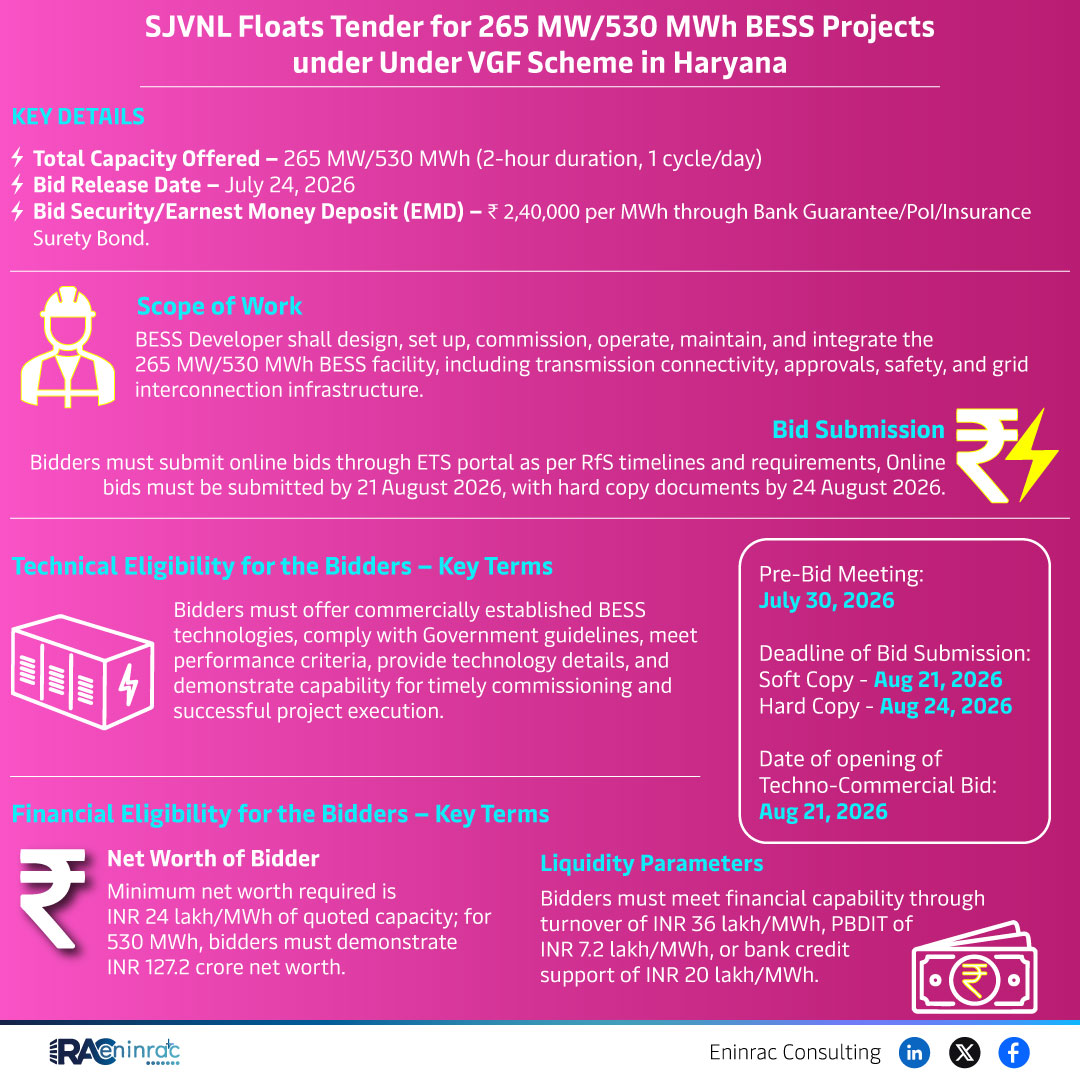
The Haryana government has issued a fresh 265 MW BESS tender in Haryana under the Viability Gap Funding (VGF) scheme. This tender seeks a 265 MW/530 MWh battery energy storage system (BESS) that can deliver a two‑hour duration with one full cycle per day. Developers are expected to design, commission, operate and maintain the full BESS facility, including transmission connectivity, safety standards, and grid interconnection. In this article we break down the key dates, technical and financial eligibility, bid security requirements, and the broader significance for the Indian renewable‑energy landscape.
What Does the Data Reveal About This Topic?
What are the critical parameters of the 265 MW BESS tender in Haryana? The tender offers a total capacity of 265 MW with a storage provision of 530 MWh, meaning the system can discharge at full power for two hours. It mandates a bid security of INR 2,40,000 per MWh supplied via bank guarantee, policy bond, or insurance surety. Financial eligibility demands a net‑worth of INR 127.2 crore, a turnover of INR 36 lakh per MWh, and a profit before depreciation, interest and tax (PBDIT) of INR 7.2 lakh per MWh. These strict criteria underline the government’s focus on financially robust and technically proven bidders.
Bid Timeline and Financial Requirements
The tender timeline is tightly structured. The bid release date is set for 24 July 2026, followed by a pre‑bid meeting on 30 July 2026 to clarify technical queries. Online submissions close on 21 August 2026, with a mandatory hard‑copy submission by 24 August 2026. Technical and financial eligibility documents must be uploaded through the ETS portal. The financial gate‑keeping thresholds—INR 24 lakh net‑worth per MW, INR 36 lakh turnover per MWh, and a PBDIT of INR 7.2 lakh per MWh—ensure that only entities with substantial capital and proven profitability can compete. This approach reduces the risk of project delays and aligns with the VGF scheme’s objective of attracting high‑quality investments.
Impact on Sectors and Industries
Battery storage projects of this scale have far‑reaching implications. For the renewable‑energy sector, the 265 MW BESS will provide critical grid‑balancing services, enabling higher penetration of solar and wind farms by smoothing intermittency. Power utilities will gain a reliable ancillary service that can respond quickly to frequency deviations, enhancing overall grid stability. Investors see a clear signal that Indian states are committing capital to advanced storage technologies, potentially unlocking further private‑sector financing. Policymakers can use the tender as a benchmark for future VGF‑backed storage initiatives, fostering a more resilient and low‑carbon energy mix across the region.
Key Takeaways
- The Haryana tender seeks a 265 MW/530 MWh BESS with a two‑hour discharge duration.
- Bid security is set at INR 2,40,000 per MWh, payable via bank guarantee or surety bond.
- Financial eligibility requires INR 127.2 crore net‑worth and specific turnover and PBDIT ratios.
- Online bids must be submitted by 21 August 2026; hard copies are due by 24 August 2026.
- A pre‑bid meeting on 30 July 2026 will address technical clarifications.
- The project supports grid reliability, renewable integration, and attracts high‑quality investment.
FAQs
When is the deadline for online bid submission?
All online bids must be uploaded to the ETS portal by 21 August 2026.
What is the required bid security per MWh?
The tender demands INR 2,40,000 per MWh, provided through a bank guarantee, policy bond, or insurance surety.
What financial metrics must bidders meet?
Bidders need a net‑worth of INR 127.2 crore, a turnover of INR 36 lakh per MWh, and a PBDIT of INR 7.2 lakh per MWh.
Is there a pre‑bid meeting for technical queries?
Yes, the pre‑bid meeting is scheduled for 30 July 2026 to clarify any technical aspects.
What does the VGF scheme aim to achieve with this tender?
The VGF scheme provides financial support to make large‑scale battery storage projects viable, encouraging private investment and enhancing grid stability.