
Introduction
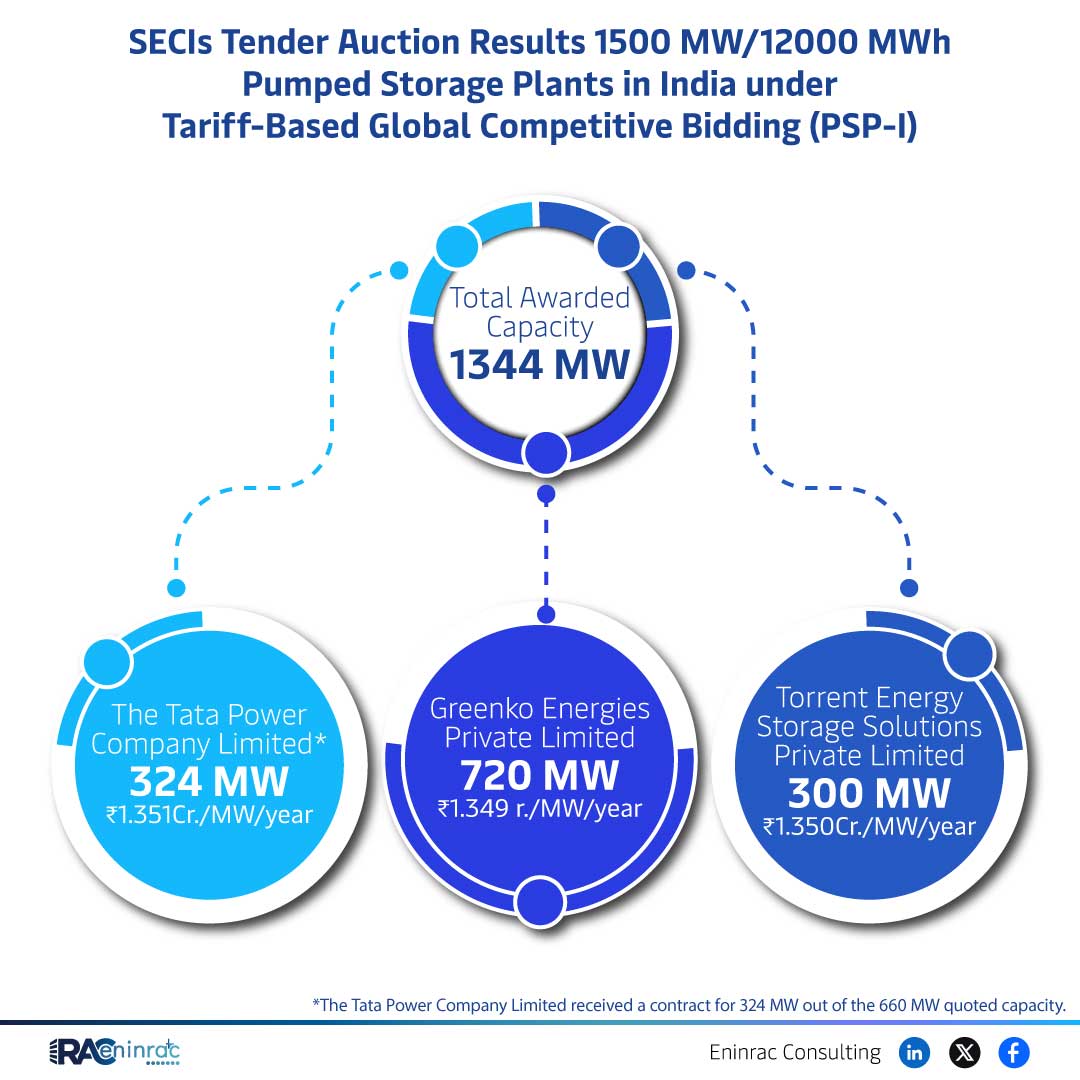
The recent SECIs tender results for pumped storage plants in India under the tariff‑based global competitive bidding (PSP‑I) showcase a significant shift toward large‑scale renewable energy storage. With a total awarded capacity of 1,344 MW, major players such as Greenko Energies, Tata Power Company Limited and Torrent Energy Storage Solutions have secured contracts that will enhance grid stability and support India’s ambitious clean‑energy targets. This article analyses the auction data, explains the implications for the energy sector, and highlights key takeaways for investors and policymakers.
What Does the Data Reveal About This Topic?
What insight does the auction data provide? It reveals that competitive bidding has effectively allocated 1,344 MW of pumped storage capacity, indicating strong market confidence and a clear price signal for storage projects. The awarded capacities—Greenko at 1,351 Cr./MW/year, Tata Power receiving 324 MW of the 660 MW quoted, and Torrent securing 300 MW at 21.350 Cr./MW/year—demonstrate varied tariff levels that reflect project size, location, and technology readiness. This outcome underscores the growing importance of pumped storage auction India as a mechanism to meet renewable integration challenges.
Awarded Capacity and Tariff Overview
The tender awarded a total of 1,344 MW, representing roughly 89% of the 1,500 MW available in the auction. Greenko Energies secured the largest financial commitment with a tariff of 1.351 Cr./MW/year, positioning it as a cost‑effective solution for long‑duration storage. Tata Power’s contract for 324 MW out of its 660 MW bid reflects strategic scaling to meet regional demand while maintaining competitive pricing. Torrent Energy Storage Solutions captured 300 MW at 21.350 Cr./MW/year, highlighting the diversity of cost structures across participants. These figures illustrate how tariff‑based bidding can balance affordability with technology deployment.
Impact on Sectors and Industries
The allocation of pumped storage capacity has far‑reaching effects on multiple fronts. For the renewable energy sector, it provides a critical buffer that enables higher penetration of solar and wind power without jeopardizing grid reliability. Investors view the clear tariff framework as a low‑risk entry point, potentially spurring further capital inflows into energy storage infrastructure. Policymakers gain actionable data to refine future bidding processes and set more accurate price benchmarks. Additionally, manufacturers of turbines, pumps, and control systems are poised to benefit from increased demand driven by the newly awarded projects.
Key Takeaways
- 1,344 MW of pumped storage capacity was awarded, covering 89% of the auctioned volume.
- Greenko Energies achieved the most competitive tariff at 1.351 Cr./MW/year.
- Tata Power secured 324 MW, showcasing a strategic scaling approach.
- Torrent Energy obtained 300 MW with a higher tariff, reflecting project‑specific cost factors.
- The tender demonstrates the effectiveness of tariff‑based global competitive bidding for storage.
- Outcomes are likely to attract further investment and accelerate renewable integration in India.
FAQs
What is the purpose of pumped storage in India's energy mix?
Pumped storage acts as large‑scale battery, storing excess renewable generation and releasing it during peak demand, thereby stabilizing the grid.
How does tariff‑based bidding influence project costs?
It forces developers to submit their lowest viable costs, resulting in more transparent pricing and competitive allocation of capacity.
Why did Tata Power win only part of its quoted capacity?
The selection committee prioritized a balanced portfolio, allocating capacity based on technical feasibility, regional needs, and cost efficiency.
What are the long‑term benefits for investors?
Clear tariff structures reduce revenue uncertainty, making pumped storage projects an attractive long‑term asset class for stable returns.
Will more pumped storage projects be tendered in the future?
Given the success of this auction, the SECIs is expected to continue using competitive bidding to expand India’s storage capacity.