
Introduction
North East India has become a focal point for clean‑energy development, and the latest August 2026 statistics reveal a substantial increase in renewable power installed capacity across the region. This article examines the state‑wise capacity figures, breaks down the contribution of each renewable technology, and discusses the implications for investors, policymakers, and local economies. Readers will gain a clear understanding of how solar, wind, and hydro resources are shaping the energy landscape in Assam, Arunachal Pradesh, Manipur, Meghalaya, Mizoram, Nagaland, and Tripura.
What Does the Data Reveal About This Topic?
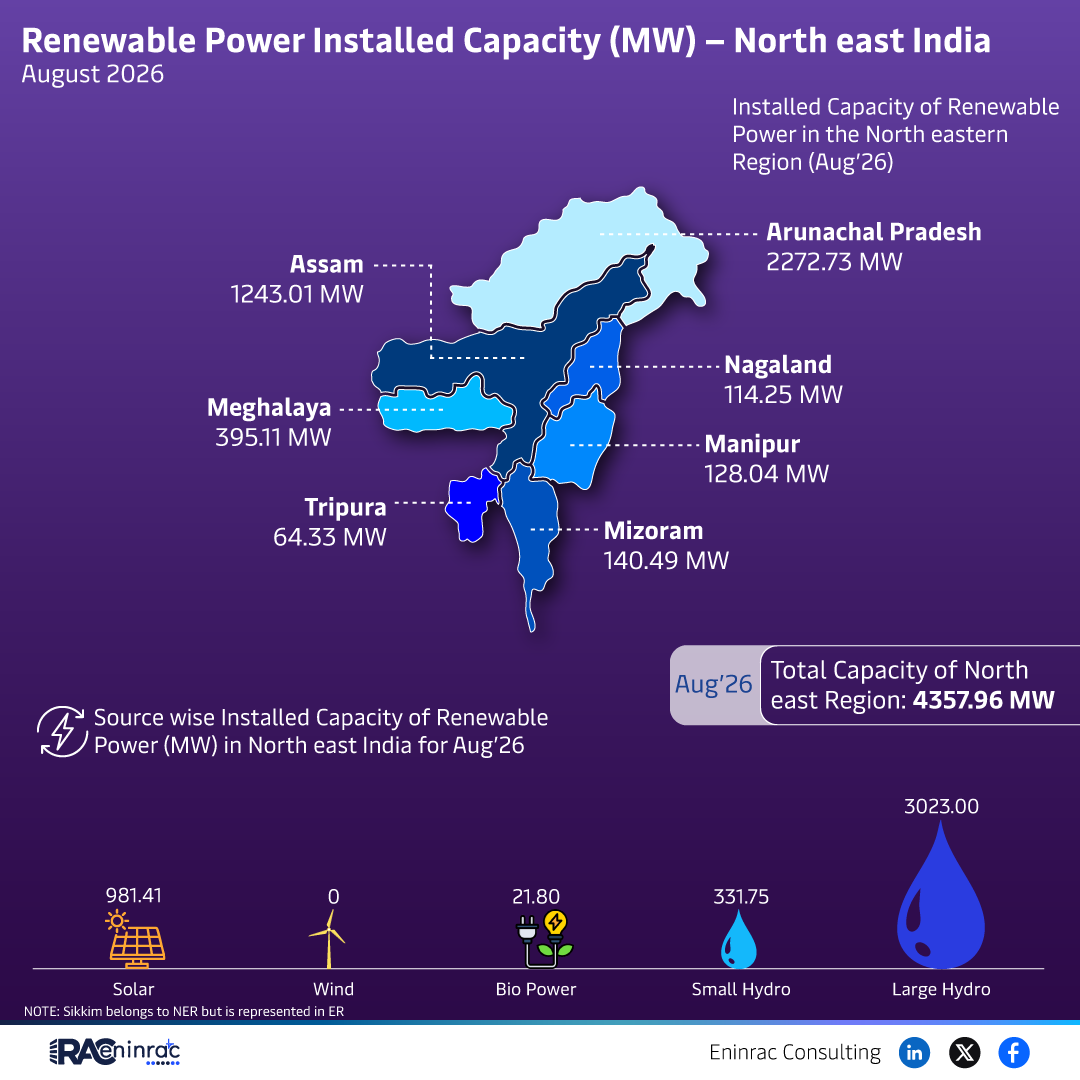
The data shows that the total renewable installed capacity in the North East reached 4,357.96 MW in August 2026, with solar accounting for roughly 70 % of the mix and wind contributing over 20 %. Small and large hydro together supply the remaining share, while bio‑power remains negligible. These numbers answer the key question: which technologies dominate the region’s clean‑energy portfolio and how evenly is capacity distributed among the states?
State‑wise Renewable Capacity in North East India
Assam leads the region with 2,272.73 MW, followed by Nagaland’s 1,243.01 MW. Meghalaya contributes 114.25 MW, Manipur 128.04 MW, Mizoram 140.49 MW, and Tripura 64.33 MW. Arunachal Pradesh registers little or no reported capacity in this snapshot. The total of 4,357.96 MW reflects the combined output of solar (3,023 MW), wind (981.41 MW), small hydro (21.80 MW), and large hydro (331.75 MW). This breakdown highlights solar’s clear leadership and the growing relevance of wind power in the hilly terrain.
Impact on Sectors and Industries
Higher renewable installed capacity drives demand for grid upgrades, storage solutions, and locally manufactured components such as solar panels and wind turbines. It also opens opportunities for financing institutions seeking green investment avenues. For the agricultural sector, reliable clean power enables modern irrigation and processing facilities. Tourism operators benefit from the region’s “green” branding, while local communities experience improved electricity access and reduced dependence on diesel generators.
Key Takeaways
- North East India’s total renewable installed capacity reached 4,357.96 MW in August 2026.
- Solar provides the majority share with 3,023 MW, followed by wind at 981 MW.
- Assam and Nagaland together account for over 80 % of the region’s capacity.
- Hydro resources remain modest but critical for meeting peak demand.
- Bio‑power contribution is currently negligible, indicating room for growth.
- The expanding capacity creates new markets for equipment manufacturers, financiers, and service providers.
FAQs
What is the total renewable power installed capacity in North East India as of August 2026?
The region recorded a combined capacity of 4,357.96 MW.
Which renewable technology contributes the most to this capacity?
Solar power leads with approximately 3,023 MW, representing about 70 % of the total.
How does the capacity of Assam compare to other states?
Assam holds the largest share at 2,272.73 MW, far exceeding the capacities of Meghalaya, Manipur, Mizoram, and Tripura.
Is bio‑power a significant part of the energy mix?
Bio‑power is currently minimal, with essentially zero megawatts reported.
What opportunities does this growth create for investors?
Increased capacity fuels demand for renewable project financing, equipment sourcing, grid infrastructure, and ancillary services, making the region attractive for green investments.