
Introduction
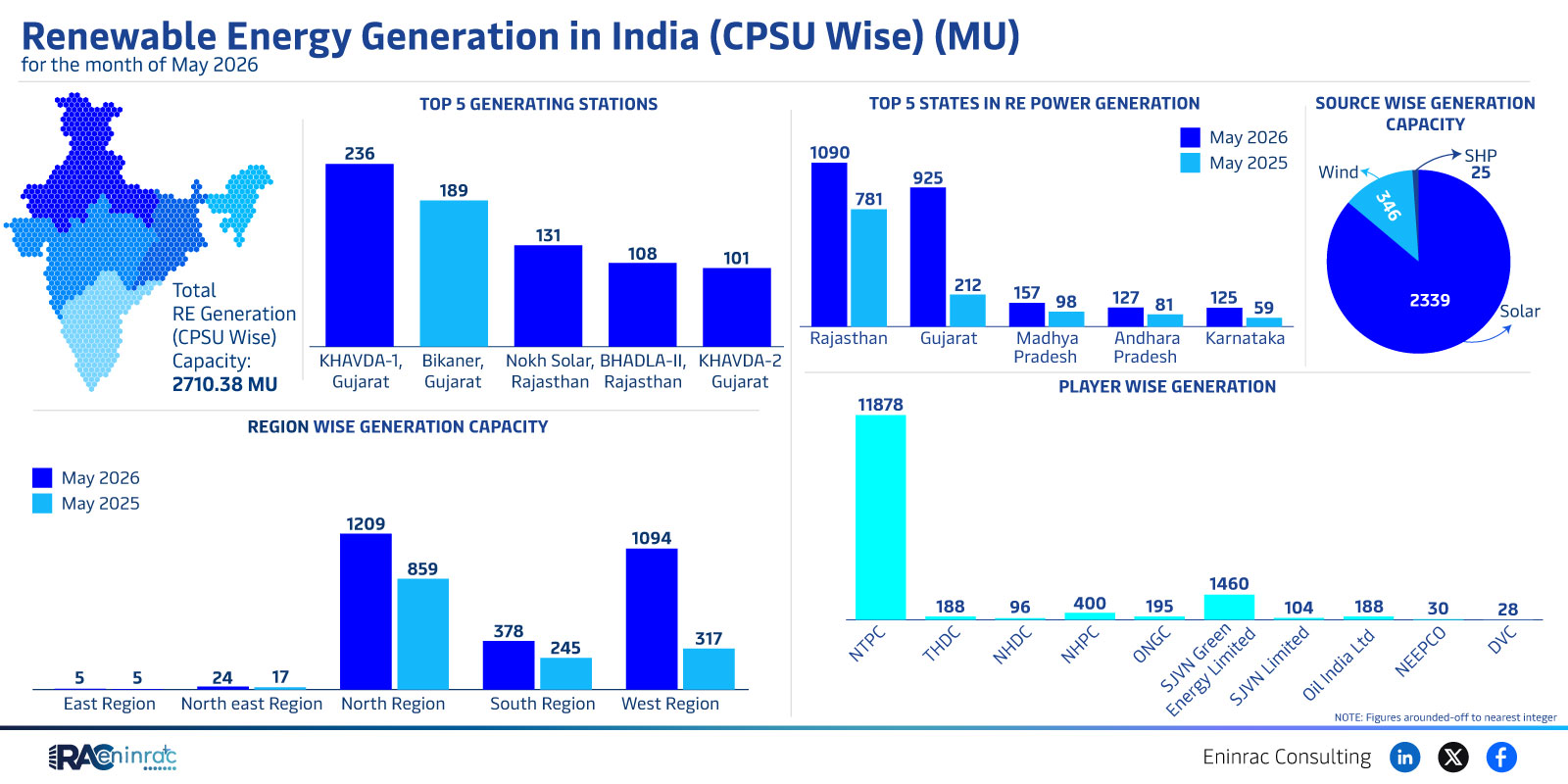
India’s renewable energy sector continues to accelerate, and the latest monthly figures for May 2026 give a clear picture of the momentum in Renewable Energy Generation India May 2026. The data, compiled by Eninrac Consulting, presents generation by Central Power Supply Undertakings (CPSU), highlighting the top five generating stations and the leading states contributing to the country’s clean power mix. Readers will discover which plants are delivering the largest output, how regional performance varies, and what these trends imply for future investment and policy decisions. By examining the numbers, stakeholders can gauge the health of solar and wind assets, understand state‑wise capacity utilisation, and anticipate where growth opportunities may arise.
What Does the Data Reveal About This Topic?
The May 2026 CPSU report shows a total renewable generation of 212 MU, with Gujarat and Rajasthan emerging as the two dominant contributors. Gujarat alone accounts for roughly 11,878 MU of player‑wise generation, while Rajasthan adds significant capacity through stations such as KHAVDA‑1 and BHADLA‑II. Solar installations like Nokh Solar and Bikaner also feature among the top five stations, illustrating the strong solar footprint in the western states. Region‑wise, the West leads with 1,209 MU, followed by the East with 1,094 MU, whereas the North‑East and North lag behind, reflecting uneven development across the country.
Regional Performance and Leading Power Stations
The data reveals a clear dominance of western regions, where Gujarat contributes the highest player‑wise generation and hosts multiple large solar farms. Rajasthan follows closely, driven by the KHAVDA‑1, KHAVDA‑2 and BHADLA‑II projects that together deliver a substantial share of the national total. In contrast, the North‑East records only about 30 MU and the North about 28 MU, highlighting a concentration of capacity in the west and south. Comparing May 2025 to May 2026, the overall renewable output shows modest growth, indicating that new capacity additions are gradually translating into higher generation.
Impact on Sectors and Industries
The observed patterns have direct implications for several sectors. Energy investors can target Gujarat and Rajasthan for higher returns, given their proven generation records. Equipment manufacturers, especially those supplying solar panels and wind turbines, stand to benefit from continued expansion in these regions. Policymakers may prioritize grid upgrades and storage solutions in the West to manage higher intermittent supply, while also designing incentives to stimulate growth in lagging areas such as the North‑East. Consumers in high‑generation states could see lower tariffs as renewable share rises.
Key Takeaways
- Gujarat leads Indian renewable generation in May 2026.
- Rajasthan ranks second with strong solar output.
- Top five stations are primarily solar projects.
- West region outperforms East, North‑East and North.
- Total renewable generation reached 212 MU nationwide.
- Growth may encourage further investment and policy support.
FAQs
Which states generated the most renewable energy in May 2026?
Gujarat topped the list, followed closely by Rajasthan, together accounting for the majority of the 212 MU total.
What are the top renewable power stations in India for May 2026?
The leading stations are KHAVDA‑1, Bikaner, Nokh Solar, BHADLA‑II and KHAVDA‑2, all located in Gujarat or Rajasthan.
How does regional generation vary across India?
The West produced about 1,209 MU, the East 1,094 MU, while the North‑East and North generated only around 30 MU and 28 MU respectively.
What does this data mean for investors?
High generation in Gujarat and Rajasthan signals stable revenue streams, making these states attractive for renewable project financing.
How can policymakers use this information?
They can focus on grid reinforcement in high‑output regions and create incentives to boost renewable capacity in under‑performing zones.