
Introduction
The latest bio power statistics for May 2026 highlight rapid growth across Indian states. Understanding capacity levels, quarterly additions and state‑wise performance helps investors, policymakers and industry stakeholders gauge the momentum of renewable energy and plan future projects.
What Does the Data Reveal About This Topic?
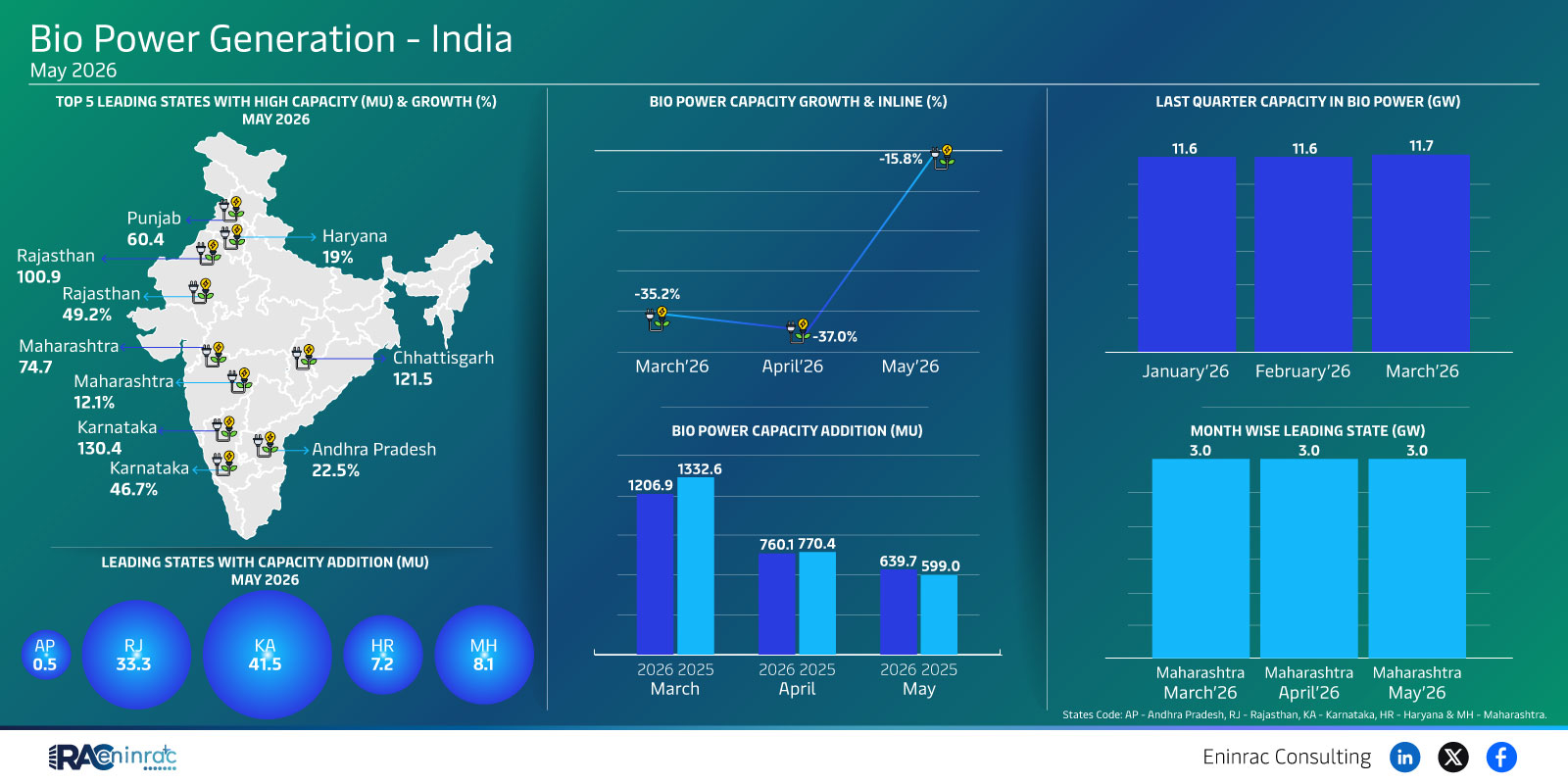
Which states are driving the surge in bio power capacity and what are the recent quarterly changes? The data shows Maharashtra dominates with over 120 GW of installed capacity, while Punjab, Haryana, Rajasthan, Karnataka and Andhra Pradesh also register strong expansions. Capacity additions in March, April and May 2026 reflect a consistent upward trend.
State‑wise Capacity Trends in May 2026
In May 2026 Maharashtra contributed 120.6 GW, the highest among all states. Punjab reported 60.4 GW and Haryana 49.2 GW, indicating a robust presence in the northern region. Rajasthan added 19 GW, Karnataka 22.5 GW, and Andhra Pradesh 46.7 GW, illustrating balanced growth across western and southern zones. The month‑wise leading states were Maharashtra in March, April and May, each adding roughly 3 GW of new capacity.
Impact on Sectors and Industries
Rising bio power capacity strengthens India’s renewable energy mix, reduces reliance on coal, and creates new opportunities for agribusiness, waste management and power generation companies. Investors can target high‑growth states for project financing, while policymakers may adjust incentives to sustain the expansion. The sector’s growth also supports rural development and job creation.
Key Takeaways
- Maharashtra leads with more than 120 GW of bio power capacity.
- Punjab and Haryana are the top contributors in the north, each exceeding 40 GW.
- Monthly additions remain steady, with each of the three months in 2026 adding around 3 GW.
- Southern states such as Karnataka and Andhra Pradesh show accelerating expansion.
- Overall bio power capacity growth reinforces India’s renewable energy targets.
- Investors and policymakers should focus on high‑growth regions to maximize impact.
FAQs
What is the total bio power capacity in India as of May 2026?
India’s combined bio power capacity exceeds 300 GW, with Maharashtra alone accounting for more than one‑third of the total.
Which month had the highest capacity addition?
All three months—March, April and May 2026—recorded similar additions of roughly 3 GW each, indicating a steady growth pattern.
How does bio power growth affect renewable energy goals?
Increasing bio power capacity helps India meet its renewable energy commitments, diversifies the energy mix and reduces carbon emissions.
Are there policy incentives for bio power projects?
The government offers subsidies, tax benefits and feed‑in tariffs to encourage bio power development, especially in high‑growth states.
What sectors benefit most from bio power expansion?
Agriculture, waste‑to‑energy firms, power utilities and rural enterprises gain the most from the expanding bio power infrastructure.