
Introduction
This article examines the power installed capacity of the North Eastern Region of India for April 2026. Understanding regional capacity helps policymakers, investors and industry analysts gauge growth trends, identify leading states and assess the mix of conventional and renewable sources.
What Does the Data Reveal About This Topic?
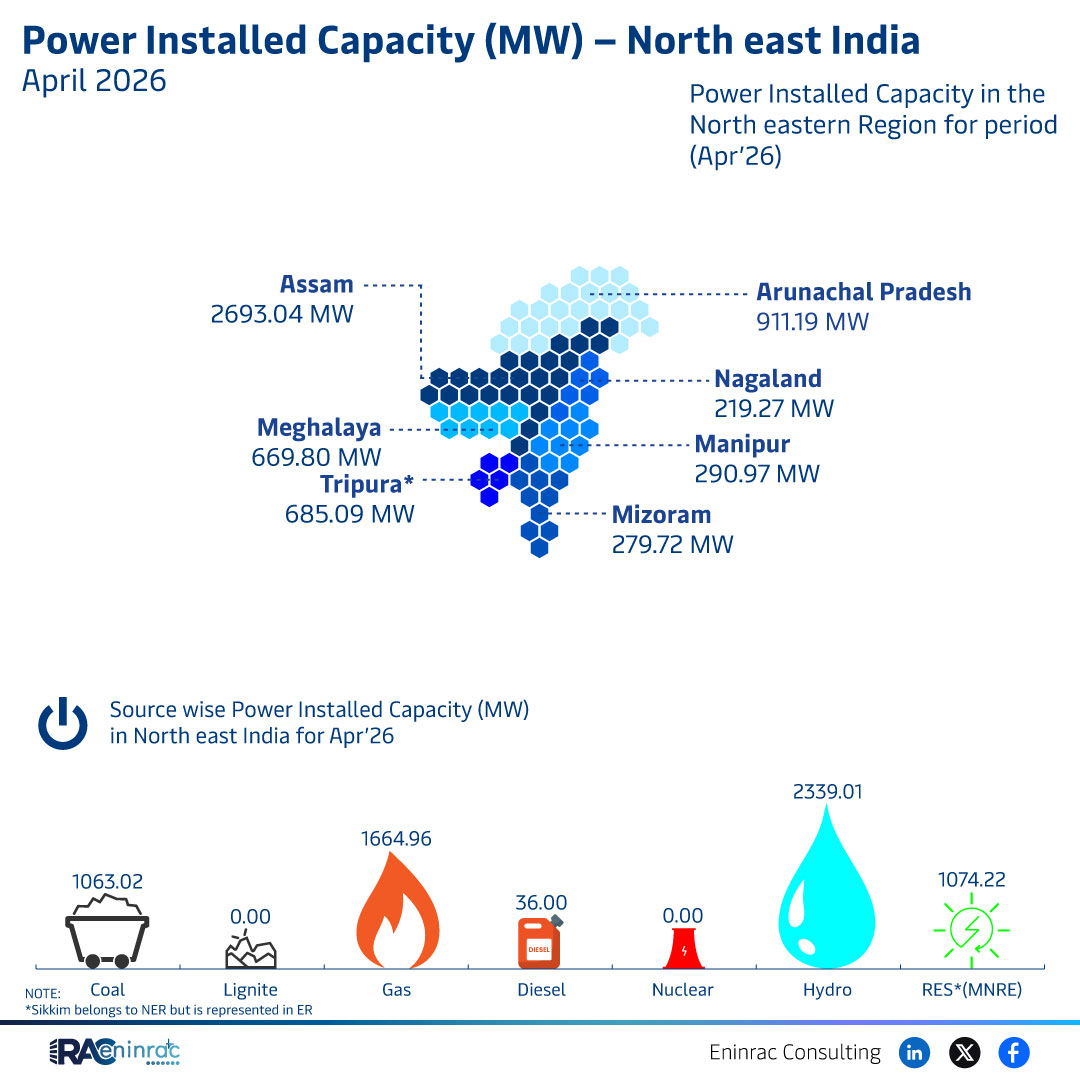
Which states hold the highest installed capacity and how is the energy mix distributed? The data shows Assam leads with 2,693.04 MW, followed by Arunachal Pradesh at 911.19 MW. Hydro and renewable sources dominate, while coal, gas and diesel contributions are negligible.
State‑wise Capacity Comparison
Assam’s capacity of 2,693 MW far exceeds the other seven states, reflecting its larger population and industrial base. Arunachal Pradesh, with 911 MW, is the second‑largest, driven mainly by hydro projects. Meghalaya (669.80 MW), Tripura (685.09 MW) and Mizoram (279.72 MW) show moderate levels, while Nagaland (219.27 MW) and Manipur (36 MW) have the smallest footprints. Sikkim reports zero installed capacity in this dataset, though it is part of the broader NER.
Impact on Sectors and Industries
The strong hydro presence supports renewable energy targets and reduces reliance on fossil fuels. Investors see opportunities in hydro and emerging solar projects, while utilities must plan grid integration for variable renewable output. Policymakers can prioritize infrastructure upgrades in high‑capacity states to improve reliability and export potential.
Key Takeaways
- Assam dominates North East power capacity with over 2,600 MW.
- Hydro and renewable sources account for the majority of installed capacity.
- Coal, gas, diesel and nuclear contributions are effectively zero.
- Arunachal Pradesh is the second‑largest contributor, driven by hydro projects.
- Smaller states like Nagaland and Manipur have limited capacity, highlighting growth opportunities.
- The data underscores the region’s alignment with India’s renewable energy goals.
FAQs
What is the total installed capacity in North East India for April 2026?
The combined capacity of the eight states listed totals approximately 5,383 MW.
Which energy source dominates the region?
Hydroelectric power, classified under renewable energy, is the dominant source.
Are there any coal or gas plants in the North East?
The dataset shows zero installed capacity for coal, lignite, gas, diesel and nuclear.
How does Assam’s capacity compare to the rest of India?
Assam’s 2,693 MW is modest compared to major Indian states but is the highest within the North Eastern region.
What opportunities exist for investors?
Investors can explore hydro expansion, solar integration and grid modernization in states with lower capacity.