
Introduction
This article examines the power installed capacity across North Indian states for April 2026. Understanding regional capacity helps investors, policymakers and industry analysts gauge growth trends, identify leading markets and assess the balance between conventional and renewable sources.
What Does the Data Reveal About This Topic?
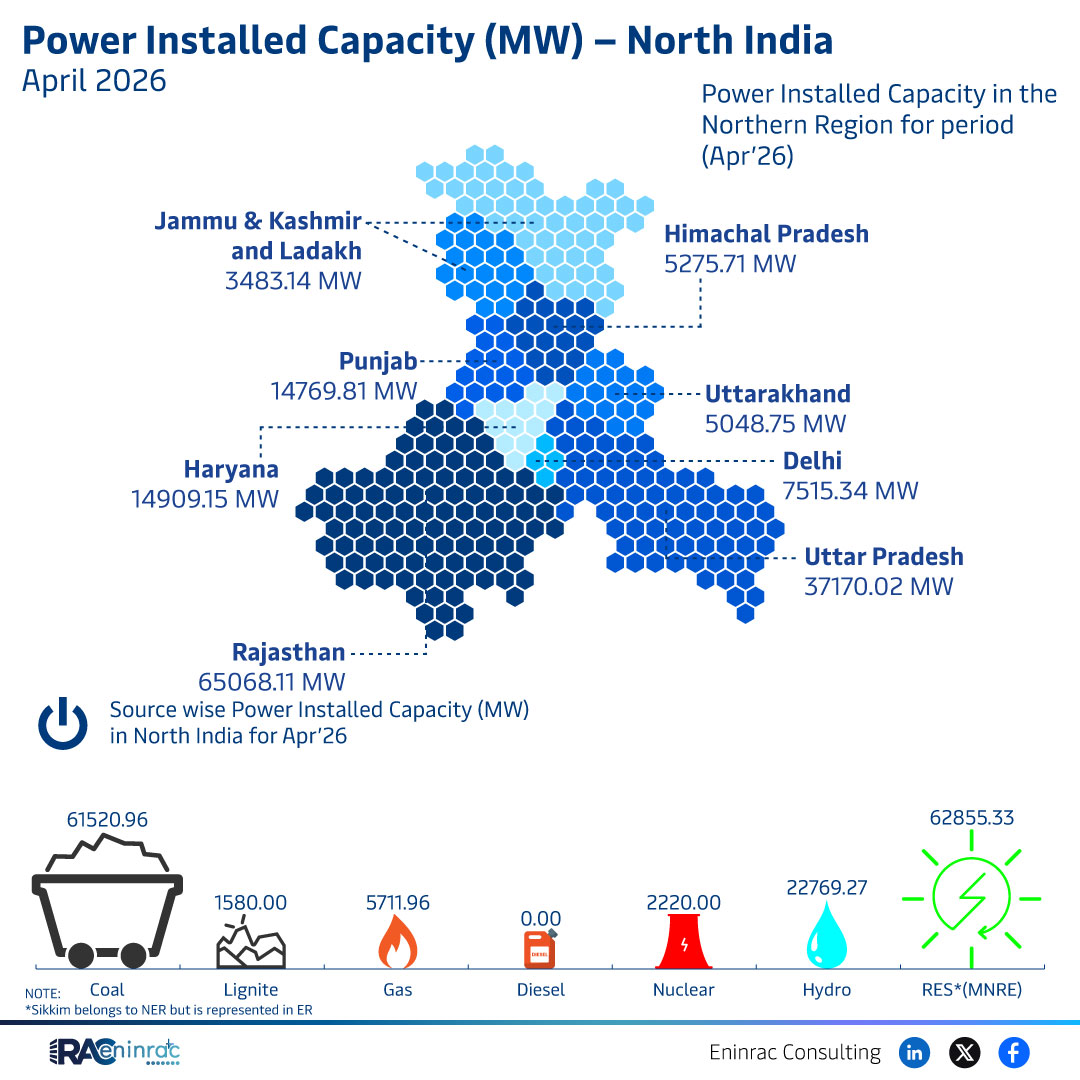
The data shows that Rajasthan leads with 65,068.11 MW, followed by Uttar Pradesh at 37,170.02 MW and Punjab at 14,769.81 MW. Renewable energy sources contribute a modest share while coal, lignite and gas dominate the mix.
Regional Capacity Comparison and Source Mix
Rajasthan’s capacity of over 65 GW far exceeds the next highest state, Uttar Pradesh, highlighting its strategic importance for future power projects. Haryana and Delhi report 14,909.15 MW and 7,515.34 MW respectively, reflecting dense demand centers. Source‑wise, coal accounts for roughly 61,521 MW, lignite 62,855 MW, gas 1,580 MW, diesel 5,712 MW, nuclear 2,220 MW, hydro 22,769 MW and renewable energy (solar, wind, biomass) about 0 MW in the presented figures, indicating a heavy reliance on fossil fuels.
Impact on Sectors and Industries
The dominance of coal and lignite influences emissions targets, fuel supply chains and pricing for industrial consumers. Renewable‑light capacity limits opportunities for clean‑tech investors but also signals a growth gap for policy incentives. Power‑intensive sectors such as manufacturing, mining and agriculture in Rajasthan and Uttar Pradesh benefit from abundant supply, while states with lower capacity may face higher procurement costs.
Key Takeaways
- Rajasthan holds the highest installed capacity in North India at 65,068 MW.
- Coal and lignite together represent over 124 GW, dominating the energy mix.
- Renewable energy capacity is negligible in the reported data, highlighting a need for policy focus.
- Uttar Pradesh and Punjab are the next largest contributors, supporting major industrial hubs.
- States with lower capacity like Himachal Pradesh and Ladakh rely heavily on external power imports.
- The current source distribution suggests significant carbon emission challenges for the region.
FAQs
Which North Indian state has the largest power capacity?
Rajasthan leads with 65,068.11 MW installed capacity as of April 2026.
What are the primary energy sources in North India?
Coal and lignite together account for more than 124 GW, making them the primary sources.
How much renewable energy is installed in the region?
The presented data shows virtually no renewable capacity, indicating a very low share.
Why is renewable capacity so low?
Policy incentives, financing gaps and existing infrastructure favor conventional sources, limiting renewable deployment.
What implications does this have for investors?
Investors may see opportunities in expanding renewable projects and modernizing fossil‑fuel plants to meet future regulations.