
Introduction
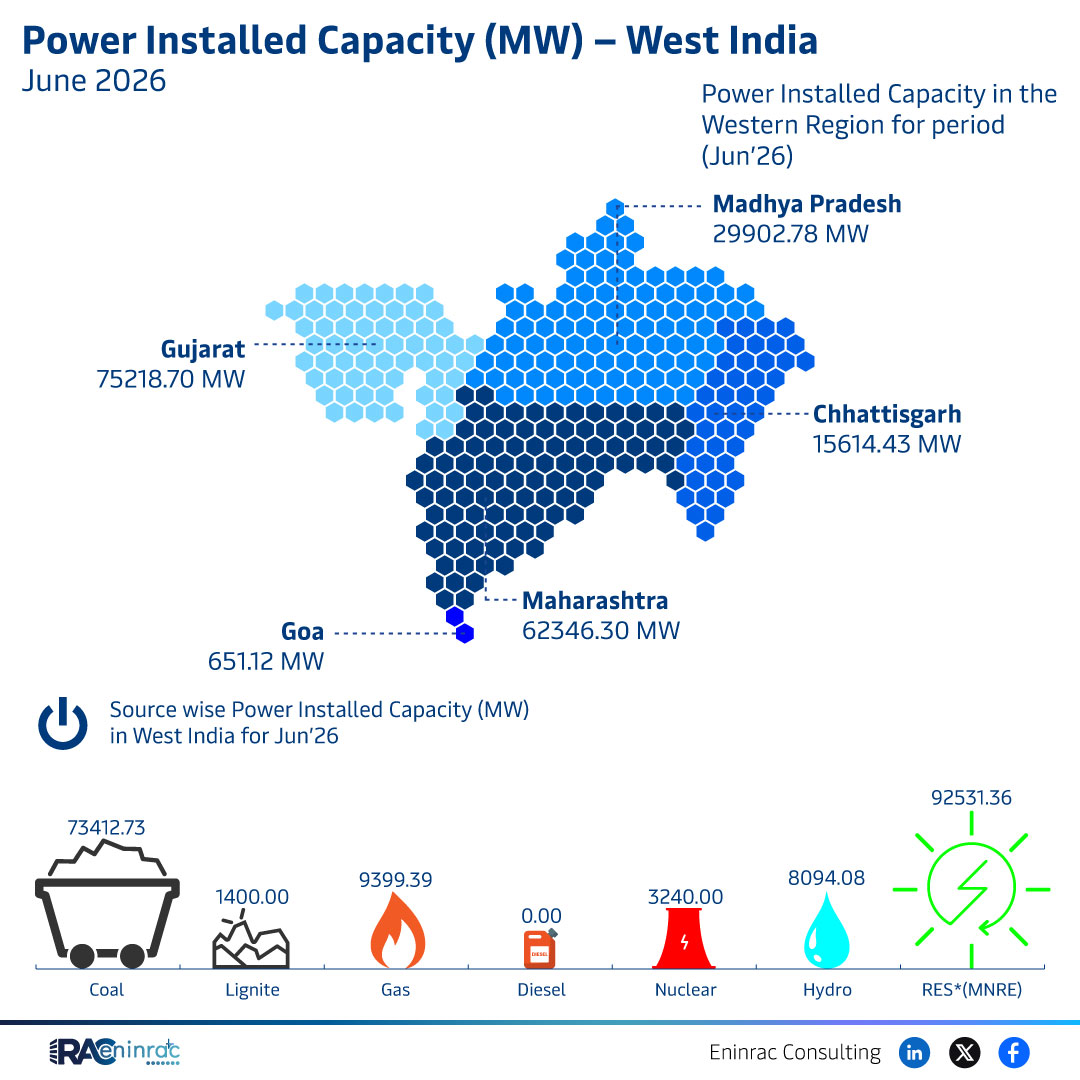
West India power installed capacity June 2026 provides a snapshot of how much electricity generation capability is available across the western states of India. The data, compiled by Enirac Consulting, lists capacity in megawatts (MW) for Madhya Pradesh, Gujarat, Chhattisgarh, Maharashtra and Goa, and also breaks down the mix by fuel source such as coal, lignite, gas, diesel, nuclear, hydro and renewable energy. Understanding this capacity is crucial for investors, policymakers and industry analysts who monitor energy supply, regional demand trends and the progress of India’s clean energy transition.
What Does the Data Reveal About This Topic?
The most striking insight is that Gujarat leads the western region with approximately 75,218 MW of installed capacity, followed by Maharashtra’s combined figure of about 62,346 MW for the state and Goa’s 651 MW. Madhya Pradesh contributes nearly 29,903 MW while Chhattisgarh adds 15,614 MW. On the fuel side, coal remains the dominant source, but hydro and renewable segments together account for a growing share, reflecting national goals to increase clean power generation.
Statewise Installed Capacity Comparison
Maharashtra’s total of 62,346 MW is split between conventional thermal plants and emerging renewable projects, whereas Gujarat’s 75,219 MW reflects a balanced portfolio with substantial coal‑based plants complemented by expanding solar and wind farms. Madhya Pradesh’s 29,903 MW shows a heavier reliance on lignite and gas, while Chhattisgarh’s 15,614 MW is driven primarily by coal and hydro resources. Goa, though much smaller at 651 MW, has a high proportion of hydro and small‑scale renewable installations, highlighting its niche role in the regional mix.
Impact on Sectors and Industries
The distribution of installed capacity influences several sectors. Power generators use the data for capacity planning and to assess the need for new projects. Investors evaluate the statewise mix to allocate capital toward high‑growth renewable zones or stable coal assets. Policymakers reference the figures when drafting state energy policies, grid reinforcement plans and subsidy schemes for clean energy. Utilities adjust procurement strategies based on the balance between thermal and renewable sources, and consumers ultimately feel the impact through electricity tariffs and reliability of supply.
Key Takeaways
- Gujarat holds the highest installed capacity in West India at over 75,000 MW.
- Maharashtra ranks second with more than 62,000 MW, driven by both thermal and renewable plants.
- Coal remains the largest single source across the region, though renewables are rapidly expanding.
- Hydro and renewable capacities together constitute a significant share, supporting India’s clean energy targets.
- Smaller states like Goa contribute niche hydro and renewable capacity despite low total MW.
- The data underscores the importance of diversified energy portfolios for regional energy security.
FAQs
Which western state has the greatest power installed capacity in June 2026?
Gujarat leads with approximately 75,218 MW of installed capacity.
How does renewable energy capacity compare to coal in West India?
Coal is still the dominant source, but renewables and hydro together form a growing portion of the mix.
What is the total installed capacity for the western region according to the data?
The combined capacity of the listed states totals roughly 183,000 MW.
Why is statewise capacity data important for investors?
It helps investors identify regions with growth potential, assess risk, and allocate funds to the most promising energy projects.
How might policymakers use the June 2026 capacity figures?
Policymakers can design targeted energy policies, plan grid upgrades, and set incentives to balance conventional and clean energy sources.