
Introduction
The July 2026 power installed capacity report for North India provides a comprehensive snapshot of electricity generation across the region. Understanding this data is crucial for policymakers, investors, and industry stakeholders who need to gauge the balance between conventional and renewable sources, assess regional energy security, and plan future infrastructure projects. In this article we break down the numbers by state and fuel type, explore the implications for the energy market, and highlight key takeaways for decision‑makers.
What Does the Data Reveal About This Topic?
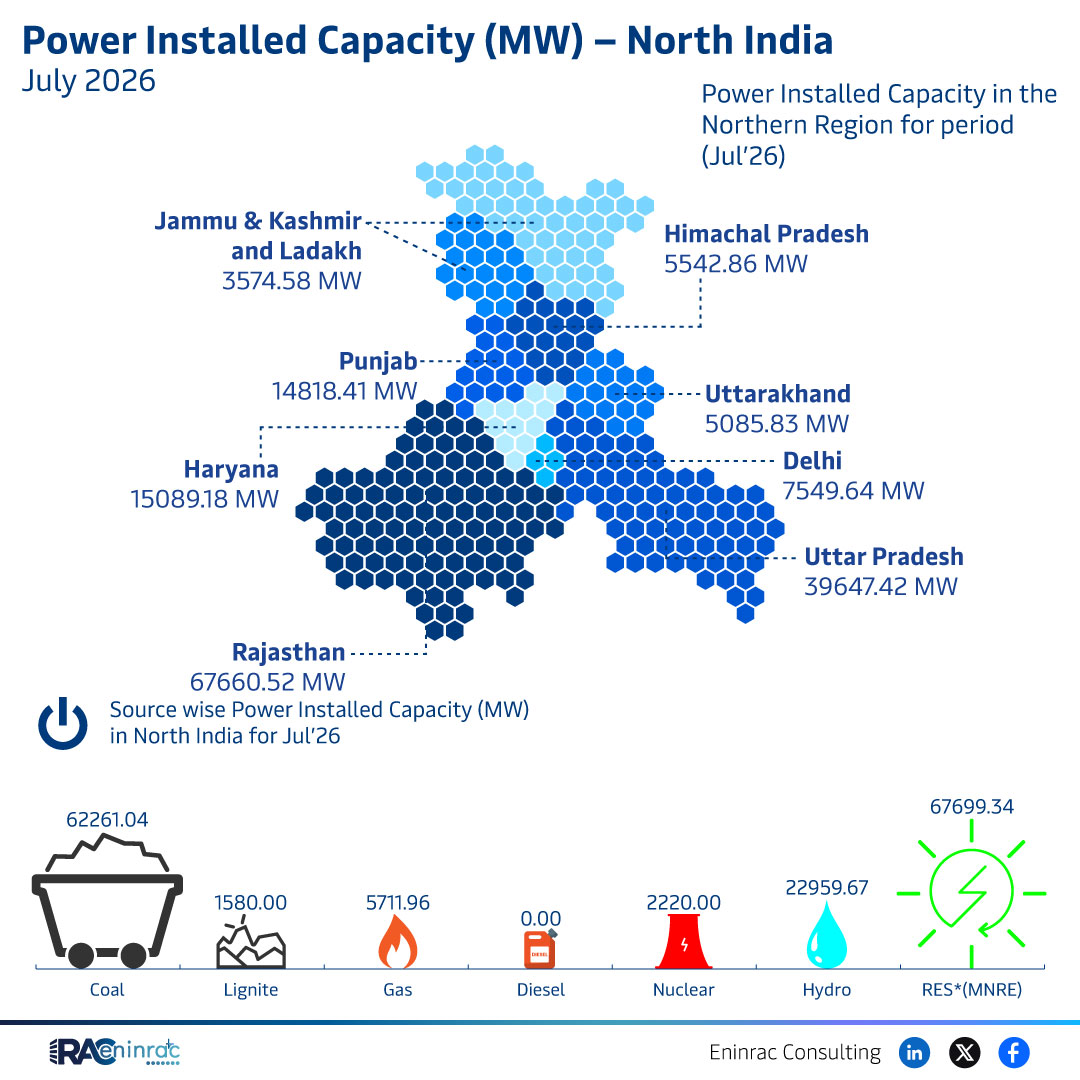
The core insight from the July 2026 dataset is the total North India power installed capacity of 177,777 MW, with Rajasthan contributing the largest share at 67,660 MW. The figures show a mixed generation portfolio that includes coal, lignite, gas, diesel, nuclear, hydro and other renewable sources, indicating that the region relies on both traditional and clean energy to meet demand.
Regional Power Capacity Distribution in North India
State‑wise capacity varies widely. Jammu & Kashmir and Ladakh together hold roughly 3,575 MW, while Himachal Pradesh adds about 1,460 MW. Punjab’s installed capacity stands at 14,818 MW, and Uttarakhand contributes 5,086 MW. Delhi, a major consumption hub, has 7,550 MW of capacity, whereas Haryana leads with 15,089 MW. Uttar Pradesh, the most populous state, reports 39,647 MW, and Rajasthan dominates the region with a massive 67,660 MW. This distribution reflects differing levels of industrialization, resource availability, and policy focus across the northern states.
Impact on Sectors and Industries
The composition of North India power installed capacity influences several sectors. Conventional energy sources such as coal, lignite, gas and diesel continue to underpin base‑load generation, supporting heavy‑industry and manufacturing. However, the notable presence of hydro, nuclear and renewable capacities signals growing investment in cleaner technologies, which benefits the renewable equipment market, financing institutions, and climate‑focused investors. Policymakers can leverage this data to balance grid stability with emissions targets, while utilities may prioritize upgrades to integrate intermittent renewable output.
Key Takeaways
- North India’s total installed capacity reached 177,777 MW in July 2026.
- Rajasthan leads the region with 67,660 MW, far exceeding other states.
- Coal and lignite together still dominate the generation mix.
- Renewable sources like hydro, nuclear and other renewables account for a growing share.
- States with high industrial activity, such as Punjab and Haryana, show substantial capacity.
- The diverse fuel mix presents both challenges and opportunities for grid management and investment.
FAQs
Which state has the highest power installed capacity in North India?
Rajasthan, with 67,660 MW, holds the top position.
What is the total power installed capacity for North India as of July 2026?
The region’s total capacity is 177,777 MW.
How much capacity is contributed by renewable sources?
Renewable sources such as hydro, nuclear and other renewables together contribute a significant portion, though exact MW values require detailed source breakdown.
Why does coal still play a major role in North India’s energy mix?
Coal provides reliable base‑load power essential for meeting continuous demand and supporting industrial processes.
How can investors use this data?
Investors can identify growth opportunities in emerging renewable projects, assess regional risks, and align portfolios with energy transition goals.