
Introduction
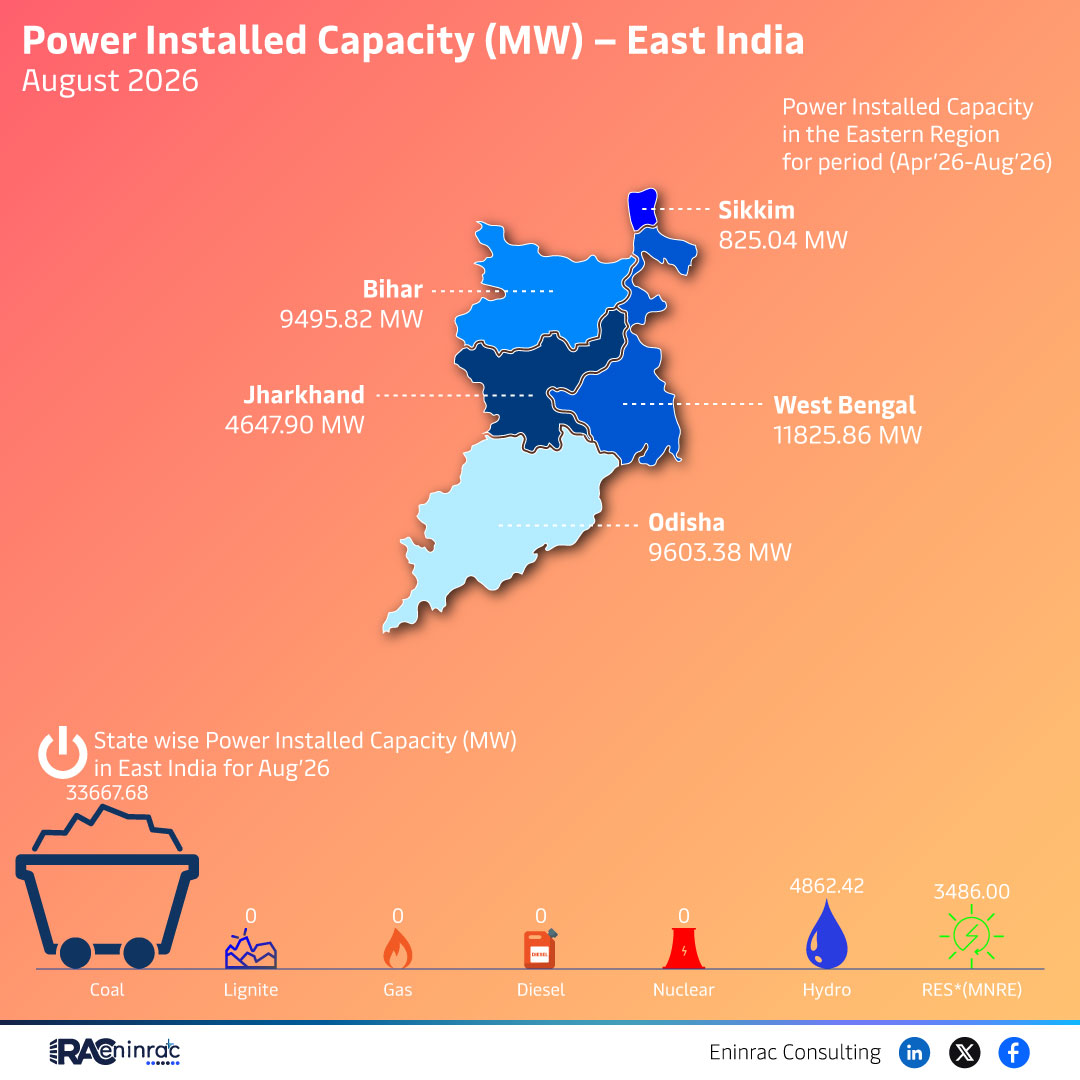
In August 2026 the Eastern region of India reported a total power installed capacity of 33,667.68 MW. This figure reflects contributions from coal, lignite, gas, diesel, nuclear, hydro and renewable energy sources across key states such as Bihar, West Bengal, Odisha and Sikkim. Understanding this capacity mix is essential for investors, policymakers and industry analysts who monitor regional energy security, grid reliability and future expansion plans. This article breaks down the state‑wise numbers, highlights the dominant fuel types, examines the impact on related sectors and offers practical takeaways for stakeholders interested in East India’s power landscape.
What Does the Data Reveal About This Topic?
The data shows that West Bengal leads with 11,825.86 MW, followed closely by Odisha at 9,603.38 MW and Bihar at 9,495.82 MW, while Sikkim contributes a modest 825.04 MW primarily from gas‑based plants. Combined, these states account for the bulk of the 33,667.68 MW installed capacity in East India. The mix indicates a heavy reliance on conventional sources, especially coal and lignite, but also a growing presence of gas and renewable energy (RES) projects as noted in the MNRE‑classified segment.
Statewise Power Capacity Comparison in East India
When comparing the four listed states, West Bengal’s capacity exceeds Bihar’s by roughly 330 MW, underscoring its extensive coal‑fired and hydro infrastructure. Odisha’s capacity is marginally higher than Bihar’s, reflecting significant investments in both thermal and renewable projects. Sikkim, although the smallest contributor, represents a strategic push toward gas‑based generation, which offers lower emissions than coal. The aggregate capacity of 33,667.68 MW includes additional contributions from other eastern states not itemised, indicating a broader regional grid that supports industrial hubs and rural electrification.
Impact on Sectors and Industries
The sizeable installed capacity in East India bolsters manufacturing, mining and agribusiness by providing a stable electricity supply. High coal‑based capacity supports steel plants and cement factories that demand continuous power, while the growing share of gas and RES helps utilities meet renewable purchase obligations and reduces carbon intensity. Investors view the region as a fertile ground for financing new gas‑fired combined‑cycle plants and solar parks, whereas policymakers use the data to plan transmission upgrades and implement state‑level energy subsidies.
Key Takeaways
- West Bengal holds the highest installed capacity in East India at 11,825.86 MW.
- Bihar and Odisha each contribute just under 10,000 MW, making them critical power hubs.
- Sikkim’s 825.04 MW is driven primarily by gas, highlighting a shift toward cleaner thermal sources.
- The total regional capacity of 33,667.68 MW is dominated by coal and lignite, but gas and RES are expanding.
- Strong capacity supports heavy‑industry growth and rural electrification across the eastern corridor.
- Future investment is likely to focus on gas‑based and renewable projects to balance the conventional mix.
FAQs
What is the total power installed capacity in East India for August 2026?
The region reported a total installed capacity of 33,667.68 MW.
Which state has the highest power capacity in the eastern region?
West Bengal leads with 11,825.86 MW of installed capacity.
How much capacity does Sikkim contribute and from which source?
Sikkim adds 825.04 MW, primarily from gas‑based generation.
Are renewable energy sources included in the East India capacity figure?
Yes, RES (MNRE‑classified) is part of the overall mix, though its share is smaller than coal and gas.
What sectors benefit most from the high power capacity in East India?
Manufacturing, mining, cement, steel and agribusiness sectors benefit from the reliable electricity supply.