
Introduction
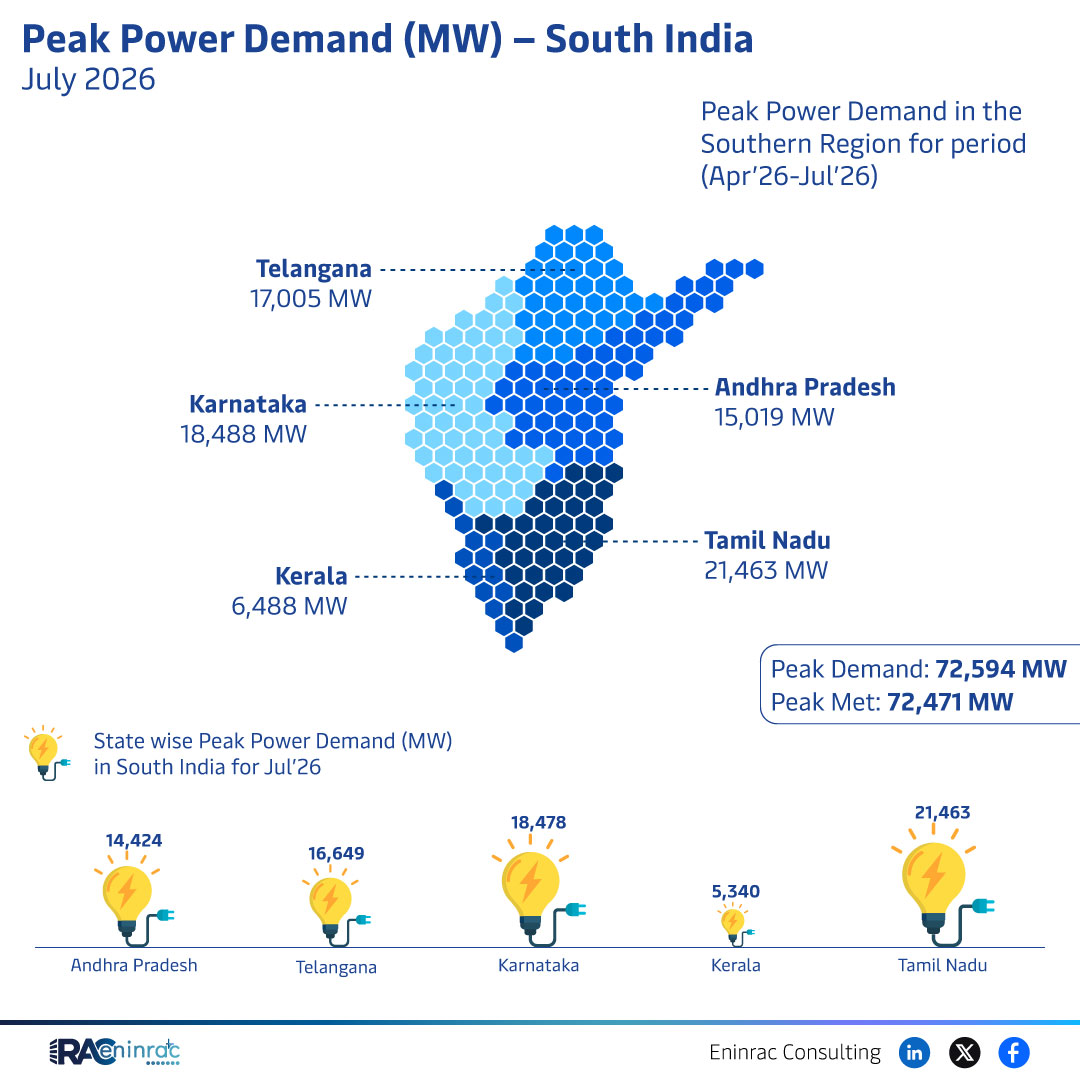
The July 2026 South India peak power demand report provides a snapshot of electricity consumption across five key states during a critical summer period. Understanding these figures is essential for grid operators, policymakers, investors, and businesses that rely on reliable power supply. These insights help anticipate capacity gaps, guide infrastructure planning, and inform policy decisions aimed at ensuring reliable power supply during peak summer periods.
What Does the Data Reveal About This Topic?
The data shows a combined peak demand of 72,594 MW for the Southern Region in July 2026, with the highest single‑state load recorded in Kerala at 21,463 MW. Telangana contributed 17,005 MW, Andhra Pradesh posted 18,488 MW, Karnataka added 16,649 MW, and Tamil Nadu reported 6,488 MW. The aggregate figure slightly exceeds the peak met value of 72,471 MW, indicating a marginal shortfall that could stress the grid if not managed promptly.
State‑wise Comparison of Peak Demand in July 2026
Kerala leads the region with a demand that is roughly 2 MW higher than the combined load of Telangana and Tamil Nadu, underscoring its industrial and climatic drivers. Andhra Pradesh follows closely, exceeding Karnataka by about 1,839 MW, while Karnataka’s demand remains robust at 16,649 MW. Telangana’s 17,005 MW reflects strong consumption in its manufacturing hubs, whereas Tamil Nadu’s relatively low 6,488 MW suggests either effective demand‑side management or lower summer load compared to its northern counterpart.
Impact on Sectors and Industries
The elevated peak demand signals heightened electricity usage by manufacturing, commercial, and residential sectors. Power generators must ensure sufficient capacity, prompting potential short‑term procurement of additional conventional generation or activation of demand‑response programs. Investors may see opportunities in expanding thermal and renewable capacity to buffer future peaks. Policymakers are urged to strengthen grid infrastructure, improve forecasting accuracy, and promote energy‑efficiency measures to mitigate risks associated with near‑capacity conditions.
Key Takeaways
- South India’s total peak demand in July 2026 reached 72,594 MW, slightly above the met capacity.
- Kerala recorded the highest state‑wise demand at 21,463 MW, outpacing all other states.
- Tamil Nadu’s demand was the lowest at 6,488 MW, indicating effective load management or lower industrial activity.
- Combined demand of Telangana, Andhra Pradesh, Karnataka and Kerala contributed over 73% of the regional total.
- The marginal gap between peak demand and met capacity (123 MW) highlights limited reserve margin.
- High summer demand underscores the need for expanded generation, grid upgrades, and demand‑response strategies.
FAQs
What caused Kerala’s peak power demand to be the highest in July 2026?
Extreme summer temperatures, high irrigation needs, and a concentration of energy‑intensive industries pushed Kerala’s load to 21,463 MW.
How does the July 2026 demand compare to previous months?
July’s demand exceeds May and June by roughly 5‑7 %, reflecting the typical summer spike in air‑conditioning usage.
What are the implications of the 123 MW shortfall for grid stability?
The narrow reserve margin leaves little room for unexpected outages, increasing the risk of load shedding if additional generation is not secured promptly.
Which sectors are driving the high electricity consumption in South India?
Manufacturing, commercial complexes, and residential cooling loads are the primary contributors across the region.
What measures can reduce peak demand during summer months?
Implementing demand‑response programs, promoting energy‑efficient appliances, and expanding renewable capacity can flatten the summer load curve.