
Introduction
The July 2026 peak power demand report for North East India provides a snapshot of electricity consumption across the region’s eight states during the critical period from April to July 2026. Understanding this demand pattern is essential for utilities, policymakers, investors, and businesses that rely on accurate forecasting to ensure grid stability, plan infrastructure upgrades, and align energy procurement strategies.
What Does the Data Reveal About This Topic?
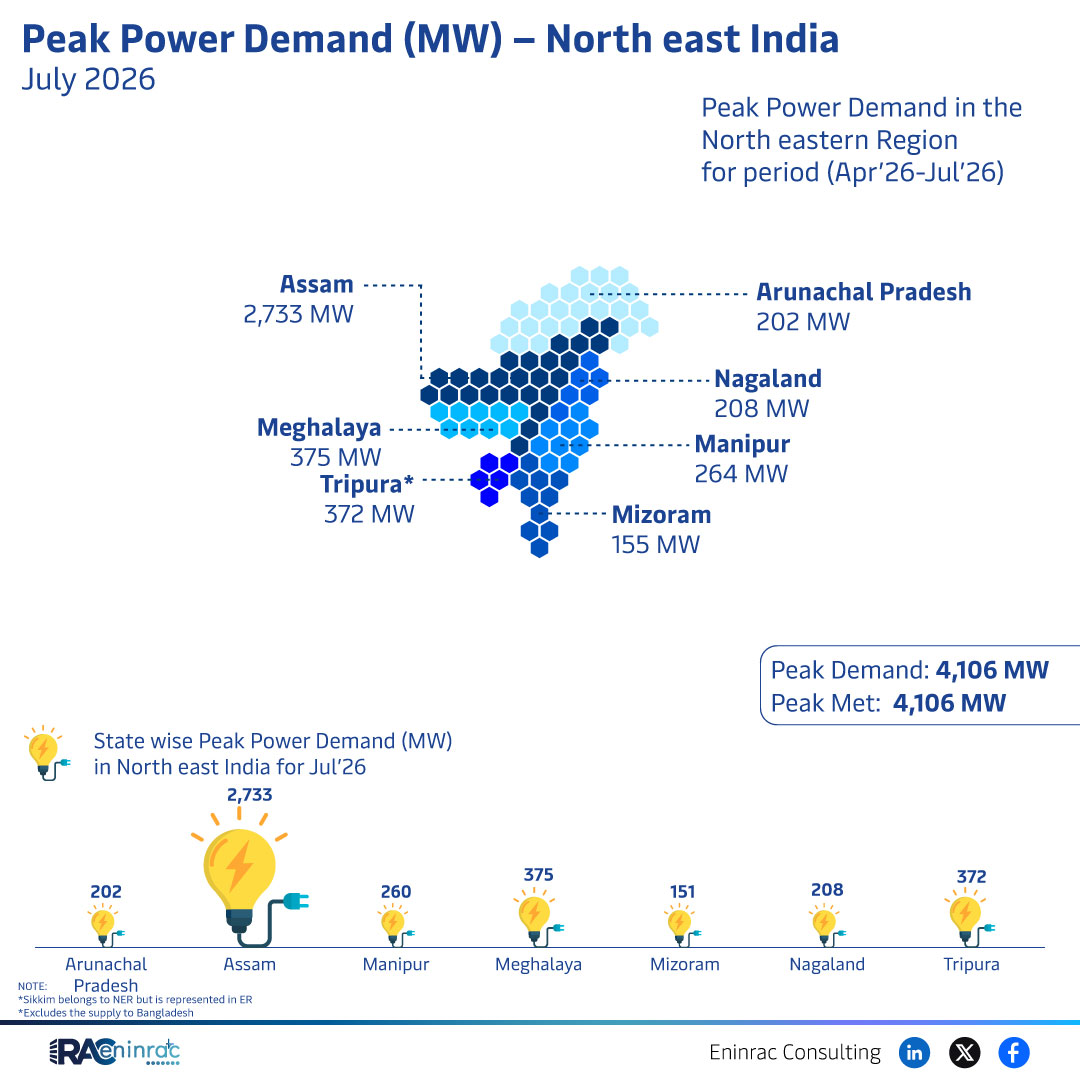
The data shows a total peak demand of 4,106 MW for the North Eastern Region, with Assam accounting for the largest share at 2,733 MW. The remaining states—Arunachal Pradesh, Manipur, Meghalaya, Mizoram, Nagaland, and Tripura—contribute smaller but significant portions, ranging from 155 MW to 372 MW. This distribution highlights Assam’s central role in regional electricity consumption and the need for targeted capacity planning.
Statewise Peak Power Demand Overview
Analyzing the statewise figures reveals clear disparities. Assam’s demand of 2,733 MW dwarfs the next highest, Tripura at 372 MW, while Mizoram records the lowest at 155 MW. Arunachal Pradesh, Manipur, and Meghalaya each sit in the 200‑300 MW range, indicating moderate consumption levels. Nagaland’s 208 MW and Meghalaya’s 264 MW suggest growth potential as industrial activities expand. These variations reflect differences in population density, industrial base, and electrification rates across the region.
Impact on Sectors and Industries
Peak power demand influences multiple sectors. For utilities, the 4,106 MW peak dictates reserve margin requirements and informs decisions on new generation assets, transmission upgrades, and demand‑side management programs. Investors evaluate the demand profile to assess the viability of conventional and renewable projects, especially in high‑demand states like Assam. Policymakers use the data to design region‑specific energy policies, promote grid resilience, and address energy access gaps in lower‑demand states. Industries, particularly manufacturing and mining, rely on reliable power supply; spikes in demand may affect production schedules and cost structures.
Key Takeaways
- Assam dominates the North East’s peak power demand, contributing approximately 67% of the total 4,106 MW.
- The region’s overall demand remains moderate, indicating opportunities for both conventional and renewable capacity expansion.
- States with lower demand, such as Mizoram and Nagaland, present growth potential as economic activities intensify.
- Accurate demand data supports better grid planning, reduces outage risk, and guides investment decisions.
- Policymakers can tailor energy subsidies and infrastructure projects to match statewise consumption patterns.
- Future demand forecasts should incorporate seasonal variations and projected industrial growth to maintain supply‑demand balance.
FAQs
Which state has the highest peak power demand in July 2026?
Assam leads with a peak demand of 2,733 MW, accounting for the majority of the region’s total demand.
What is the total peak power demand for North East India?
The combined peak demand for the eight states is 4,106 MW during the April‑July 2026 period.
How does Tripura’s demand compare to Assam’s?
Tripura’s peak demand is 372 MW, significantly lower than Assam’s 2,733 MW, reflecting its smaller industrial base.
Why is statewise demand data important for investors?
It helps investors identify high‑demand markets for new generation projects, assess risk, and allocate capital efficiently across the region.
What sectors are most affected by peak power demand fluctuations?
Utilities, manufacturing, mining, and businesses dependent on continuous electricity supply are most sensitive to demand spikes.