
Introduction
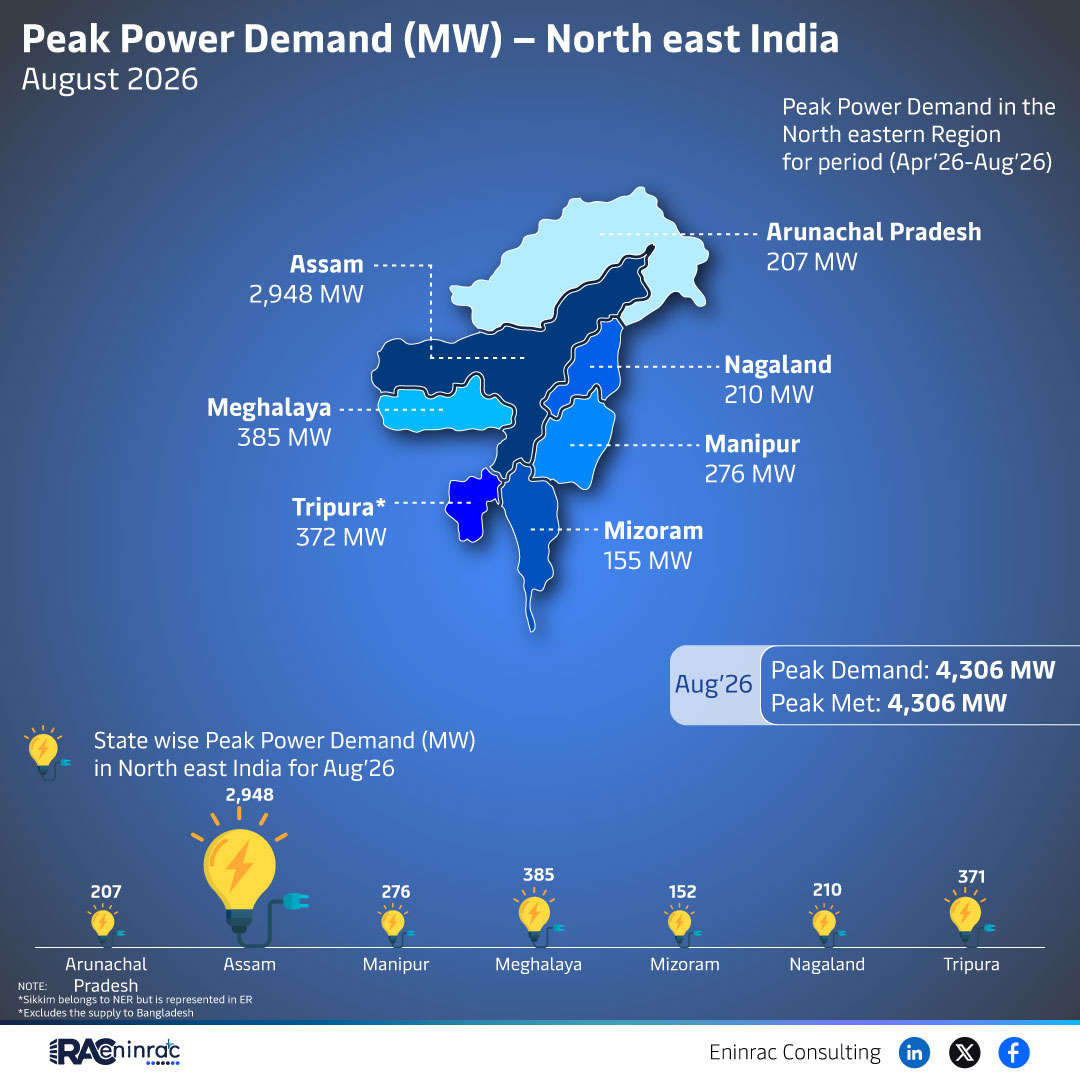
The North East India peak power demand for August 2026 reached a combined 4,306 MW, reflecting the region’s growing electricity needs during the pre‑monsoon period. Understanding how each state contributes to this total helps utilities, policymakers, and investors plan capacity upgrades, grid stability measures, and demand‑side management strategies.
What Does the Data Reveal About This Topic?
The primary question is whether any state stands out as a disproportionate driver of the region’s total electricity load. The data shows Meghalaya with 385 MW and Tripura with 372 MW are the largest contributors, while Mizoram’s 155 MW is the lowest among the listed states. Arunachal Pradesh records 207 MW, Manipur 276 MW, and Nagaland’s figure, though partially obscured, appears comparable to the mid‑range values. Together these figures sum to the reported 4,306 MW peak for August, confirming that the northeastern grid experiences significant variance across its states.
Statewise Comparison of August 2026 Power Demand
When the statewise numbers are placed side by side, a clear hierarchy emerges. Meghalaya leads with 385 MW, followed closely by Tripura at 372 MW, indicating higher industrial and residential consumption patterns in these states during the summer heat. Manipur’s 276 MW and Arunachal Pradesh’s 207 MW suggest moderate demand, likely driven by smaller urban centers and limited industrial activity. Mizoram records the smallest demand at 155 MW, highlighting its lower population density and lesser commercial load. The absence of explicit data for Assam—a major population hub—means the total regional figure may be higher than the reported 4,306 MW, underscoring the importance of comprehensive data collection for accurate forecasting.
Impact on Sectors and Industries
The varying demand levels influence planning across multiple sectors. Power generators must align capacity additions with the higher‑demand states to avoid over‑generation or shortages. Transmission operators need to reinforce inter‑state corridors, especially between Meghalaya, Tripura, and neighboring grids, to balance load fluctuations. Investors see opportunities in renewable projects that can serve high‑demand zones while reducing reliance on fossil‑fuel plants. Policymakers can tailor demand‑response programs, incentivize energy‑efficient appliances, and prioritize grid‑modernization funds where the load is most intense. Ultimately, accurate statewise demand insight supports a resilient, sustainable energy future for the northeast.
Key Takeaways
- North East India’s total August 2026 peak demand was 4,306 MW.
- Meghalaya (385 MW) and Tripura (372 MW) were the highest‑demand states.
- Mizoram contributed the lowest demand at 155 MW.
- Arunachal Pradesh, Manipur, and Nagaland showed moderate demand levels.
- Missing Assam data suggests the actual regional peak could be higher.
- Statewise demand patterns guide investments, grid upgrades, and policy decisions.
FAQs
What was the total peak power demand for North East India in August 2026?
The region recorded a combined peak demand of 4,306 MW for August 2026.
Which state had the highest peak demand?
Meghalaya led with the highest statewise demand at 385 MW.
Why is statewise power demand data important?
It helps utilities allocate generation resources, plan transmission upgrades, and design targeted demand‑side measures.
How can investors use this demand information?
Investors can identify high‑growth markets for new generation projects, renewable integration, and grid‑modernization investments.
What challenges does the region face in meeting peak demand?
Challenges include limited transmission capacity, dependence on seasonal hydro resources, and the need for reliable forecasting across diverse states.