
Introduction
India’s on‑river pumped storage projects are gaining attention as the country seeks flexible renewable energy solutions. The latest data compiled in June 2026 provides a snapshot of project capacities, status classifications, and geographic distribution. Readers will learn which states host the largest on‑river pumped storage facilities, how project phases differ—from concurred to under examination—and what these developments mean for India’s broader energy transition and investment climate.
What Does the Data Reveal About This Topic?
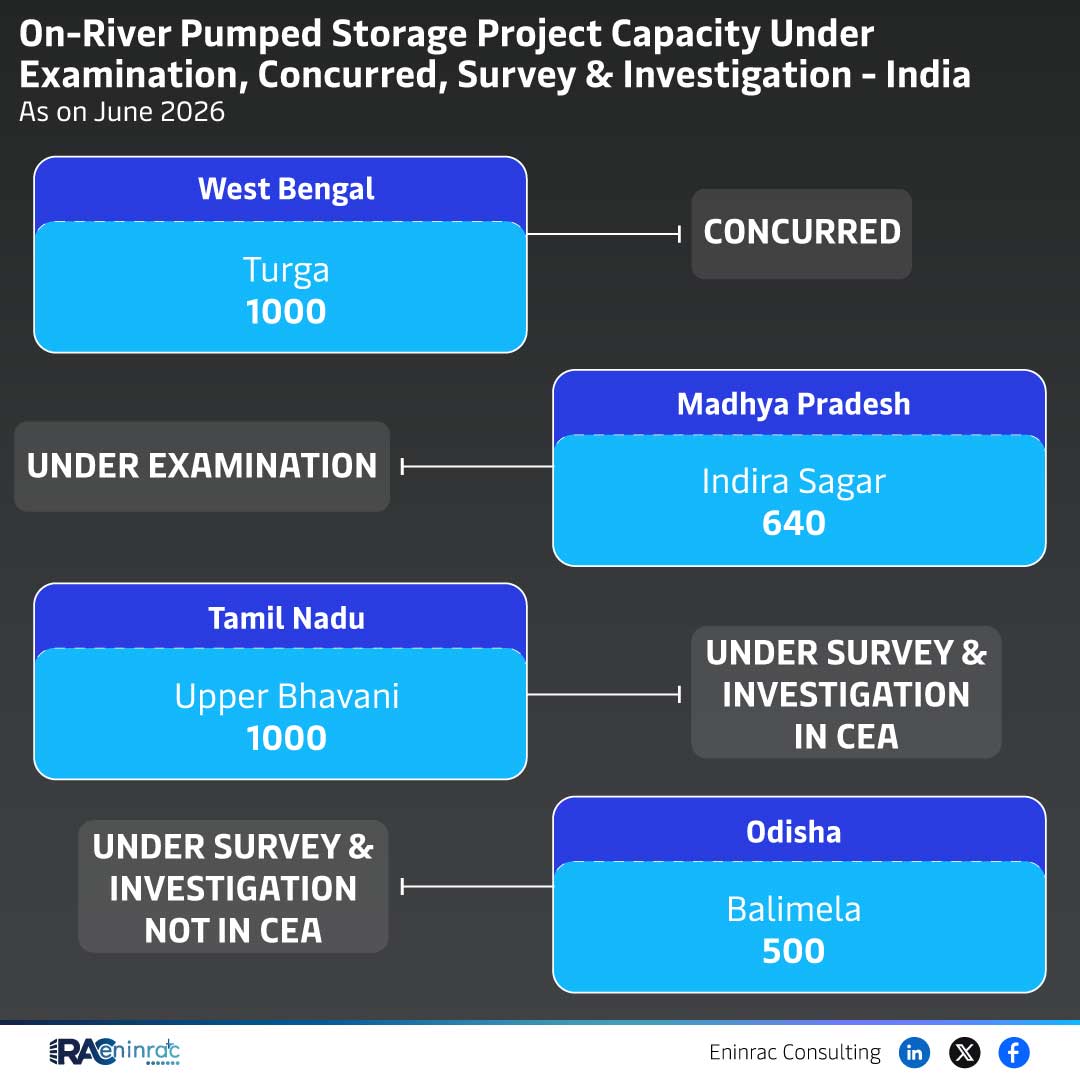
The raw data shows four distinct on‑river pumped storage projects across three Indian states, each labeled with a specific status. West Bengal’s Turga project is listed as "Concurred" with a capacity of 1,000 MW, indicating formal agreement and readiness to proceed. Madhya Pradesh’s Indira Sagar is "Under Examination" with 640 MW, suggesting regulatory review. Tamil Nadu’s Upper Bhavani is "Under Survey & Investigation," while Balimela’s status is also under investigation. The variation in status highlights differing stages of project development and regional focus.
Regional Status of On‑River Pumped Storage Projects
West Bengal leads the capacity chart with the Turga project at 1,000 MW, already concurred, which positions the state as a potential hub for large‑scale energy storage. Madhya Pradesh follows with the 640 MW Indira Sagar, still awaiting clearance, reflecting the central region’s interest in leveraging its river resources for storage. Tamil Nadu’s Upper Bhavani remains in the survey phase, indicating early feasibility work in the south. Balimela, though not tied to a specific state in the data, is also under investigation, underscoring a nationwide exploratory trend. These regional differences reveal where policy support and water resource availability are most aligned with pumped storage ambitions.
Impact on Sectors and Industries
The emergence of on‑river pumped storage projects influences multiple sectors. Renewable energy developers gain a new storage option that complements solar and wind generation, improving grid stability. Engineering and construction firms see increased demand for civil works, turbines, and water management systems. Financial institutions and investors receive clearer pipelines for capital allocation as projects move from investigation to concurred status. Policymakers can use the data to refine regulatory frameworks, while utilities benefit from higher dispatchable capacity, reducing reliance on fossil‑fuel peaking plants and supporting India’s carbon‑reduction targets.
Key Takeaways
- West Bengal hosts the largest concurred on‑river pumped storage capacity (1,000 MW).
- Madhya Pradesh’s Indira Sagar is sizable but still under examination (640 MW).
- Tamil Nadu’s Upper Bhavani remains in the survey stage, indicating early project development.
- Balimela’s investigation status reflects broader national interest in pumped storage.
- Varying project stages highlight regional policy and resource readiness differences.
- On‑river pumped storage offers crucial grid flexibility for India’s renewable growth.
FAQs
What is on‑river pumped storage?
It is a renewable energy technology that stores excess electricity by pumping water upstream in a river‑based reservoir, then releases it to generate power when needed.
Why is the Turga project important?
Turga’s 1,000 MW capacity makes it the largest concurred on‑river pumped storage project in India, signaling strong regional commitment.
How does project status affect investment?
Concurred projects attract immediate funding, while those under examination or investigation require additional risk assessment before capital is committed.
Can pumped storage replace fossil‑fuel peaking plants?
It can significantly reduce reliance on fossil peakers by providing fast‑responding, dispatchable power, but may complement rather than fully replace them.
What are the environmental considerations?
Projects must assess river ecosystem impacts, water flow alterations, and land use to ensure sustainable implementation.