
Introduction
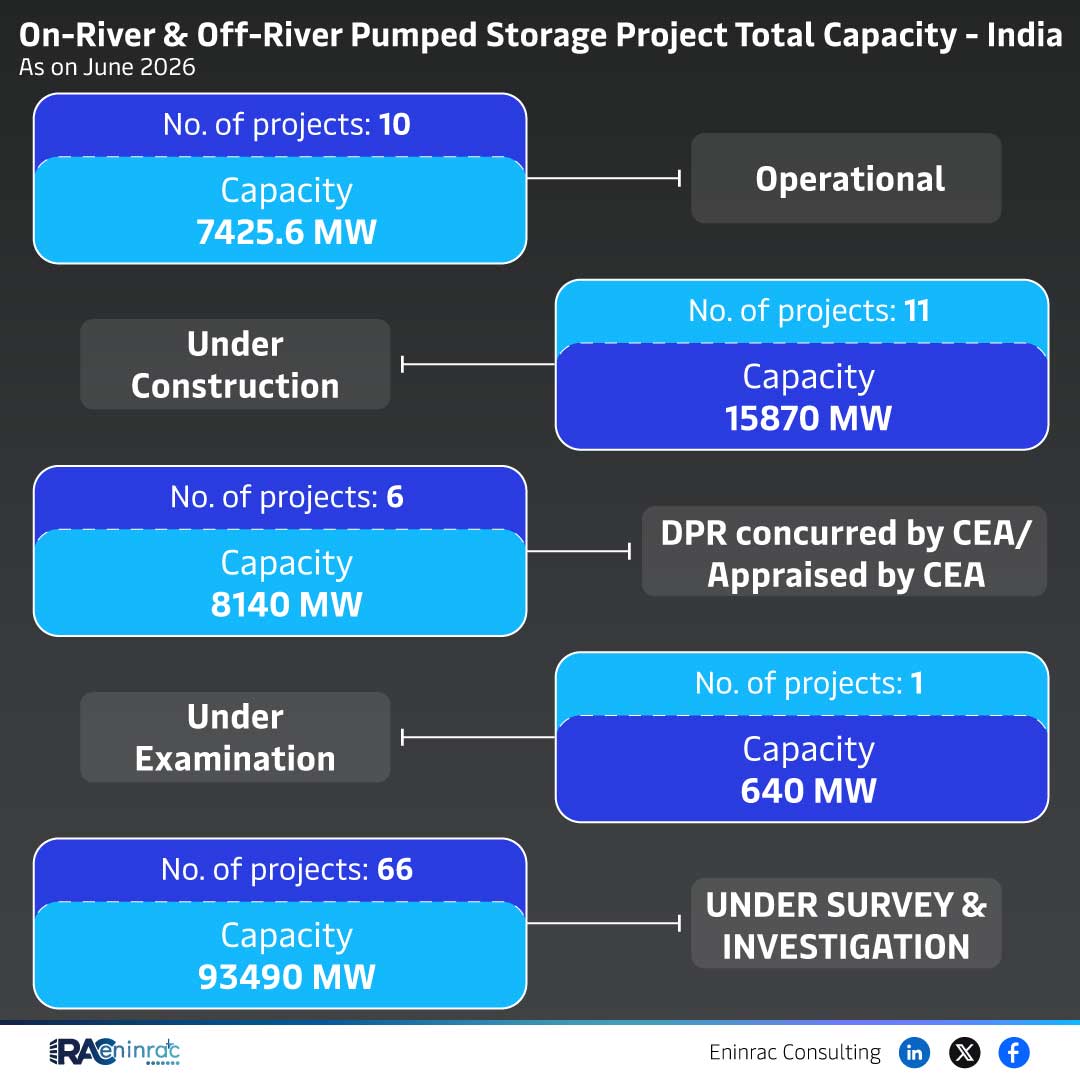
India’s ambition to strengthen its renewable energy mix has placed pumped‑storage hydro projects at the forefront of long‑term grid stability planning. As of June 2026 the country records a total of ten operational on‑river and off‑river pumped‑storage plants delivering 7,425.6 MW of clean, dispatchable power. The data also highlights a massive pipeline of under‑construction, examination and survey projects that could increase total installed capacity by more than 100 GW. This article breaks down the numbers, examines the trends, and explains why investors, policymakers and utilities should monitor India’s pumped‑storage capacity closely.
What Does the Data Reveal About This Topic?
Which stages of project development dominate the pumped‑storage landscape and how much capacity is attached to each stage? The raw figures show that operational capacity accounts for only about 7.4 GW, while projects under construction represent the largest single chunk at 15,870 MW. An additional 8,140 MW are in the DPR (Detailed Project Report) approval stage, 640 MW are awaiting final examination, and a staggering 93,490 MW are still under survey and investigation. The distribution signals a steep growth curve, with more than 116 GW poised to move beyond feasibility studies within the next decade.
Operational vs Planned Pumped‑Storage Capacity in India
Comparing the operational base with the planned pipeline reveals several key patterns. The 7,425.6 MW currently delivering power stems from mature sites that have already integrated with regional grids, providing peak‑shaving and load‑balancing services. In contrast, the 15,870 MW under construction indicates a concerted push by both public and private developers to expand storage near major load centres such as Delhi, Mumbai and the Southern grid hubs. The 8,140 MW of DPR‑approved projects suggest that regulatory clearance is accelerating, especially after the Central Electricity Authority (CEA) gave concurrence to multiple proposals. The modest 640 MW under examination reflects the final technical clearances required before construction can commence. Finally, the 93,490 MW in the survey stage underscores the strategic identification of new sites, many of which are located in river‑rich states like Himachal Pradesh, Uttarakhand and Karnataka, where elevation differences favor efficient pump‑storage cycles.
Impact on Sectors and Industries
The surge in pumped‑storage capacity influences several interconnected sectors. For the renewable energy industry, large‑scale storage mitigates intermittency of solar and wind farms, enabling higher renewable penetration without compromising grid reliability. Power transmission operators benefit from the ability to dispatch stored energy during peak demand, reducing the need for expensive peaking plants. Financial investors see a new asset class with long‑term power purchase agreements and attractive tariff structures, while the manufacturing sector gains orders for turbine generators, pumps, and control systems. Policymakers can leverage pumped storage to meet India’s 2030 renewable target of 500 GW, as storage aligns supply‑side incentives with demand‑side flexibility.
Key Takeaways
- Operational pumped‑storage capacity in India stands at 7,425.6 MW, representing less than 7 % of the total projected capacity.
- Under‑construction projects add 15,870 MW, more than doubling the current operational base.
- DPR‑approved projects contribute another 8,140 MW, signalling regulatory momentum.
- Only 640 MW are awaiting final examination, indicating that most pipeline projects are still early‑stage.
- A massive 93,490 MW remain under survey, highlighting the long‑term potential for site expansion.
- Collectively, the pipeline suggests India could reach over 115 GW of pumped‑storage capacity by the early 2030s, dramatically enhancing grid resilience.
FAQs
What is pumped‑storage hydro and why is it important for India?
Pumped‑storage hydro uses two reservoirs at different elevations to store energy by pumping water uphill during low demand and generating power when released downhill during peak demand, providing fast‑response, large‑scale electricity storage.
How much pumped‑storage capacity is currently operational in India?
As of June 2026, operational on‑river and off‑river pumped‑storage projects supply approximately 7,425.6 MW of power.
Which stage of development holds the most capacity in the pipeline?
The survey and investigation stage holds the largest capacity, with about 93,490 MW of projects still being assessed for feasibility.
What regions are most likely to host new pumped‑storage projects?
States with significant elevation differences and river networks—such as Himachal Pradesh, Uttarakhand, Karnataka and Maharashtra—are prime candidates for upcoming sites.
How does pumped‑storage support renewable energy goals?
By storing excess solar and wind generation and delivering it during peak periods, pumped‑storage smooths variability, allowing higher renewable penetration and reducing reliance on fossil‑fuel peaking plants.