
Introduction
India’s on‑river pumped storage projects are gaining momentum as the country seeks flexible, renewable power solutions. As of April 2026, several key facilities are under construction across Karnataka, Andhra Pradesh, and Tamil Nadu, each contributing significant megawatt capacity to the national grid. This article examines the latest capacity figures, compares regional contributions, and explains why these projects matter for investors, policymakers, and the energy sector.
What Does the Data Reveal About This Topic?
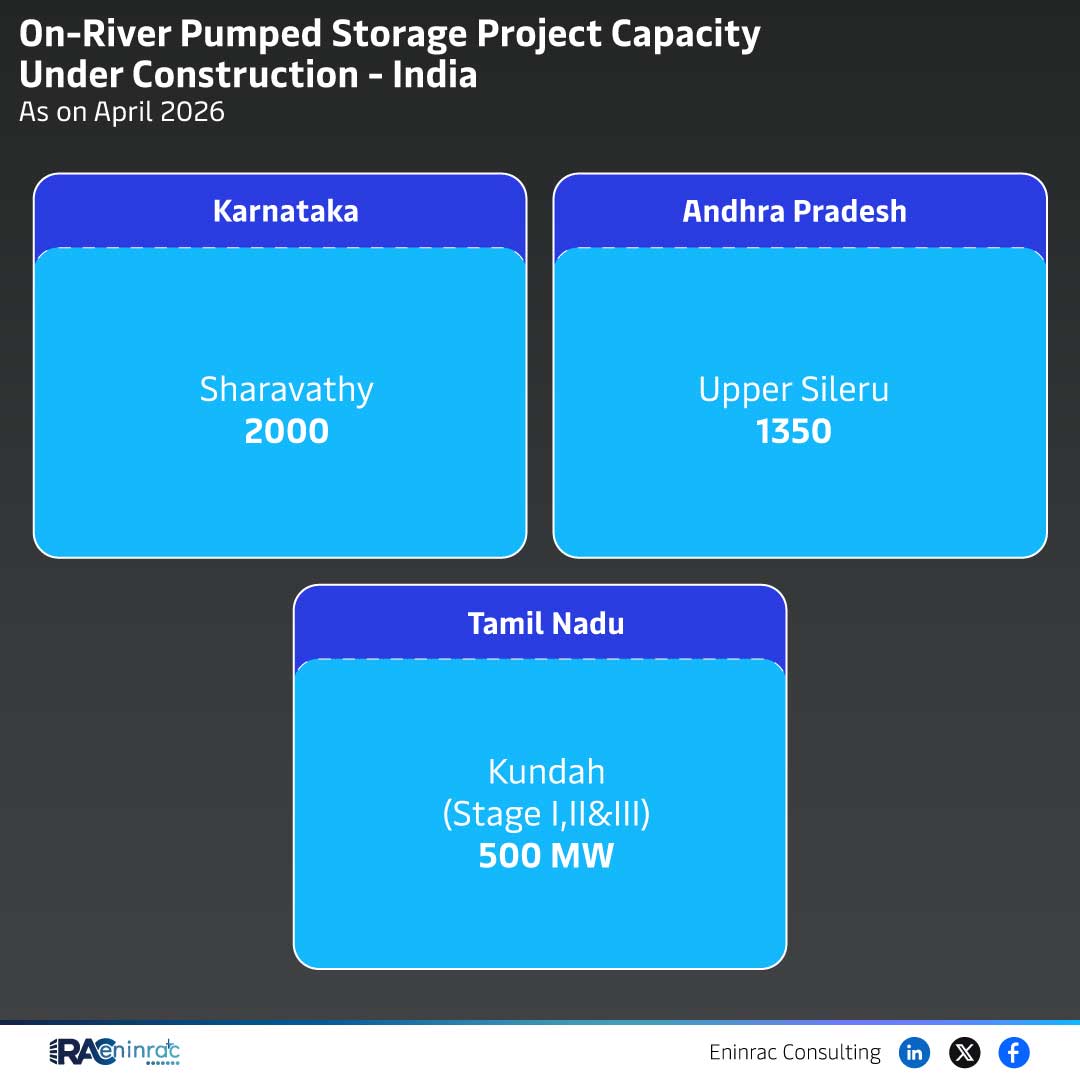
The raw data shows that Karnataka hosts two major projects—Sharavathy (2,000 MW) and Upper Sileru (1,350 MW)—while Tamil Nadu’s Kundah complex (Stage I, II & III) is also under development. The combined under‑construction capacity exceeds 3,350 MW, highlighting Karnataka’s leading role in on‑river pumped storage expansion.
Regional Capacity Comparison
Karnataka’s Sharavathy and Upper Sileru together provide a larger single‑state capacity than the combined projects in Andhra Pradesh and Tamil Nadu. Andhra Pradesh’s contribution is limited to the Upper Sileru site, whereas Tamil Nadu’s Kundah complex, spread across three stages, adds further depth but with a lower individual stage capacity. This distribution suggests a strategic focus on Karnataka’s river systems for large‑scale storage, while other states are developing complementary, smaller‑scale assets.
Impact on Sectors and Industries
On‑river pumped storage enhances grid stability, supports renewable integration, and reduces reliance on fossil‑fuel peaking plants. For the renewable energy sector, these projects provide a dispatchable resource that can store excess solar and wind generation. Investors benefit from long‑term power purchase agreements and government incentives, while policymakers gain a tool for meeting India’s 2030 clean energy targets. Equipment manufacturers, civil contractors, and local economies also experience job creation and technology transfer.
Key Takeaways
- Karnataka leads with 3,350 MW of under‑construction pumped storage capacity.
- Sharavathy (2,000 MW) is the largest single project in the dataset.
- Upper Sileru adds 1,350 MW, reinforcing Karnataka’s dominance.
- Tamil Nadu’s Kundah complex spans three stages, indicating phased development.
- These projects collectively improve grid flexibility and renewable integration.
- Investors see strong policy support and long‑term revenue potential.
FAQs
What is on‑river pumped storage?
It is a hydro‑electric system that uses river water to pump water to a higher reservoir during low demand and releases it to generate power during peak demand.
Why is Karnataka a focus for pumped storage?
Karnataka’s topography and river flow patterns provide ideal conditions for large‑scale storage, and state policies encourage renewable infrastructure.
How does pumped storage support renewable energy?
It stores excess solar or wind power and releases it when generation falls, smoothing variability and enhancing grid reliability.
What are the expected completion dates?
Most projects aim for commissioning between 2027 and 2029, subject to regulatory approvals and financing.
Are there environmental concerns?
Yes, river ecosystem impacts are evaluated, and mitigation measures such as fish passages and flow management are required.