
Introduction
India’s on‑river pumped storage capacity is a critical element of the nation’s evolving power landscape. Unlike traditional off‑river schemes, on‑river projects store electricity by moving water up a short elevation within the same river corridor, allowing rapid response to grid fluctuations. As of September 2026 the country operates a portfolio of projects spread across Gujarat, Telangana, Maharashtra, Uttarakhand and Tamil Nadu, together providing more than five gigawatts of flexible generation. This article examines the latest capacity figures, compares regional contributions, and discusses how these installations support renewable integration, enhance grid reliability and attract investment.
What Does the Data Reveal About This Topic?
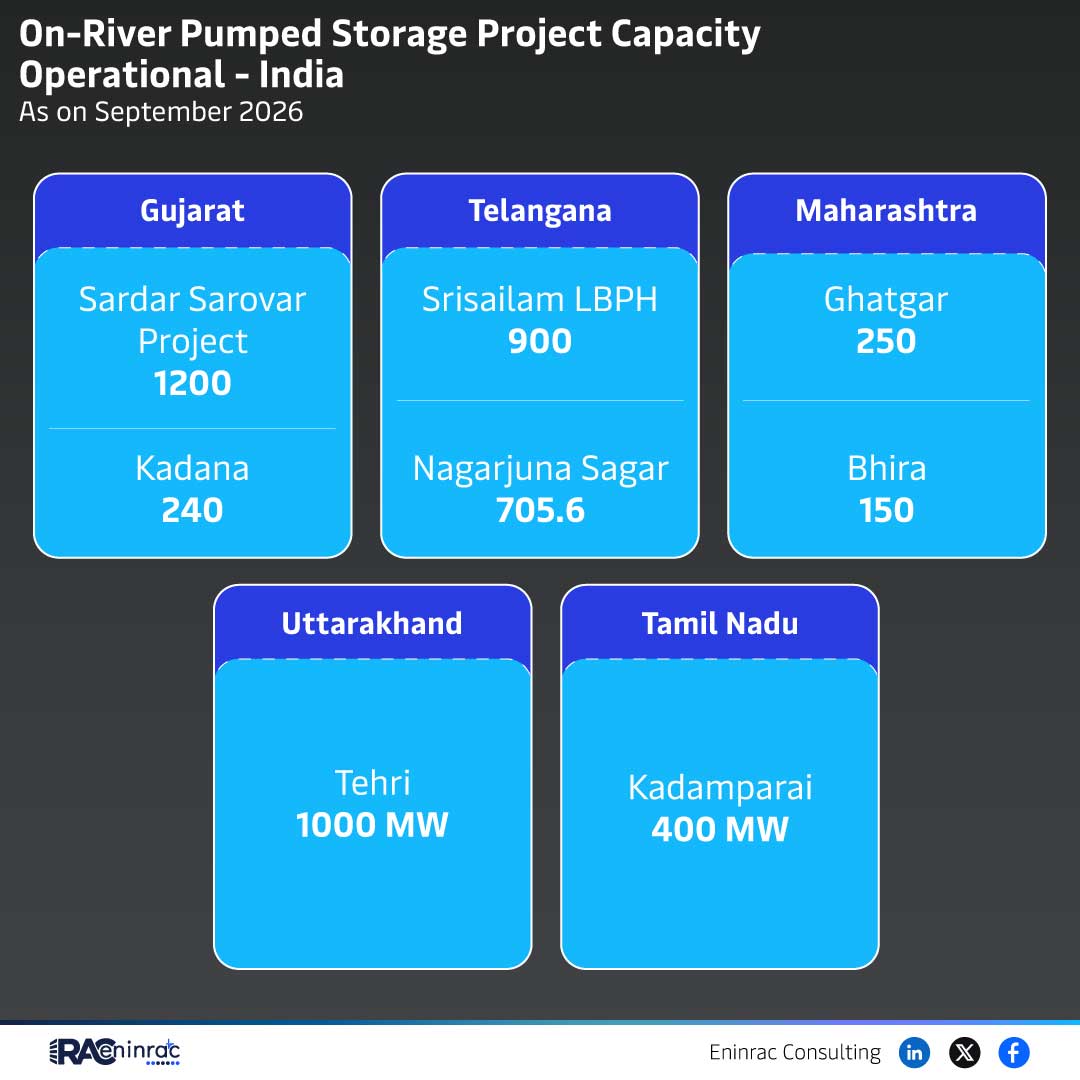
The raw numbers answer a simple question: how much on‑river pumped storage capacity is currently available and where is it concentrated? The data shows that Maharashtra leads with the 1,200 MW LBPH project, while Gujarat follows with the 900 MW Sardar Sarovar facility. Telangana contributes two significant plants – Srisailam (250 MW) and Nagarjuna Sagar (705.6 MW). Smaller yet strategic sites include Kadana in Gujarat (240 MW), Bhira in Maharashtra (150 MW), Tehri in Uttarakhand (1,000 MW) and Kadamparai in Tamil Nadu (400 MW). Together these assets total approximately 5.2 GW, illustrating a diversified geographic footprint that reduces transmission losses and boosts local grid stability.
Regional Capacity Comparison
The capacity profile reveals distinct regional patterns. Maharashtra’s cumulative on‑river storage reaches 1,350 MW when LBPH (1,200 MW) and Bhira (150 MW) are combined, making the state the single largest holder. Gujarat follows with 1,140 MW contributed by Sardar Sarovar (900 MW) and Kadana (240 MW), demonstrating strong state‑level commitment to water‑based storage. Telangana’s combined 955.6 MW derives from Srisailam and Nagarjuna Sagar, highlighting a focus on leveraging existing dam infrastructure. In the north, Uttarakhand’s Tehri project contributes a solid 1,000 MW despite only one installation, while Tamil Nadu’s Kadamparai adds 400 MW, reflecting emerging interest in southern states. The spread of capacities across five states reduces dependence on any single region and supports a more resilient national grid.
Impact on Sectors and Industries
The expanding on‑river pumped storage fleet influences multiple sectors. Power generators gain a reliable peaking resource that balances intermittent solar and wind output, reducing curtailment and improving market revenues. Grid operators benefit from fast‑ramp capabilities that help maintain frequency and reserve margins, especially during peak demand periods. Equipment manufacturers see rising demand for turbines, pumps, and control systems tailored to on‑river environments. Investors are attracted by the long‑term contracts and government incentives associated with clean energy storage, while policymakers can meet renewable‑energy targets without building new transmission lines. Consumers indirectly enjoy more stable electricity prices and fewer outages, as the stored energy can be dispatched when conventional generation is constrained.
Key Takeaways
- Maharashtra holds the highest on‑river pumped storage capacity at 1,350 MW.
- Gujarat follows with 1,140 MW, driven by Sardar Sarovar and Kadana.
- Total on‑river pumped storage capacity in India exceeds 5 GW as of September 2026.
- Projects are spread across five states, enhancing geographic diversity and grid resilience.
- The capacity mix supports renewable integration and reduces reliance on fossil peaking plants.
- Ongoing policy support suggests further expansion of on‑river storage in the next decade.
FAQs
What is on‑river pumped storage?
It is a type of hydropower where water is pumped uphill within the same river channel during low demand and released to generate electricity during peak demand.
Which Indian state has the highest on‑river pumped storage capacity?
Maharashtra, with the 1,200 MW LBPH project and the 150 MW Bhira plant, leads with a combined capacity of about 1,350 MW.
How does pumped storage support renewable energy integration?
It provides fast‑acting reserve power, absorbs excess generation from solar and wind, and releases it when the grid needs balancing, thereby lowering curtailment.
What are the major on‑river projects listed for 2026?
Key projects include LBPH (Maharashtra, 1,200 MW), Sardar Sarovar (Gujarat, 900 MW), Nagarjuna Sagar (Telangana, 705.6 MW), Tehri (Uttarakhand, 1,000 MW) and Kadamparai (Tamil Nadu, 400 MW).
Are there plans to expand on‑river pumped storage capacity?
Government policy and investor interest indicate that additional projects are under feasibility studies, aiming to add several hundred megawatts over the next decade.