
Introduction
India’s on‑river pumped storage capacity India is rapidly becoming a cornerstone of the nation’s renewable energy strategy. As of June 2026, multiple large‑scale projects across Gujarat, Telangana, Maharashtra, Uttarakhand and Tamil Nadu are operational, delivering crucial grid stability and energy storage solutions. This article examines the latest capacity figures, highlights regional differences, and explains why these developments matter to investors, policymakers and the broader energy market.
What Does the Data Reveal About This Topic?
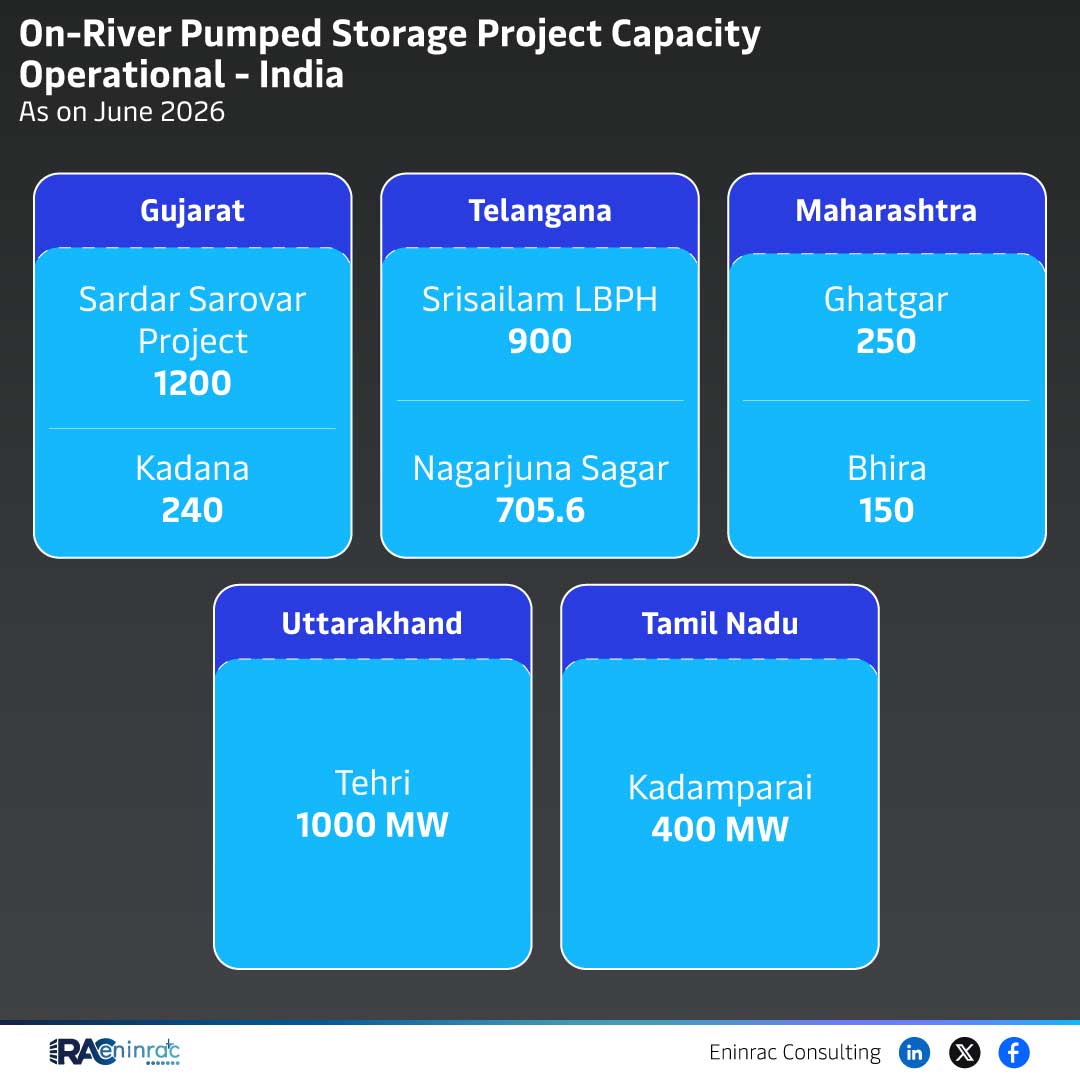
Which states lead India’s on‑river pumped storage landscape and how do their capacities compare? The data shows Gujarat hosts the largest cumulative capacity with the Sardar Sarovar (900 MW) and Kadana (240 MW) projects, while Telangana’s Srisailam contributes 1 200 MW. Maharashtra adds 250 MW from the LBPH project and 150 MW from the Bhira plant. In the north, Uttarakhand’s Tehri project provides 1 000 MW, and Tamil Nadu’s Kadamparai contributes 400 MW. These figures illustrate a clear north‑south and east‑west distribution of storage assets, reflecting both water resource availability and regional energy demand.
State‑wise Capacity Comparison of Indian Pumped Storage Projects
When comparing capacities, Gujarat leads with a combined 1 140 MW from Sardar Sarovar and Kadana, showcasing the state’s aggressive investment in water‑based energy storage. Telangana follows closely with a single 1 200 MW project at Srisailam, indicating strong hydro potential. Maharashtra’s two smaller facilities (total 400 MW) highlight a more diversified but lower‑scale approach. Uttarakhand’s Tehri plant, at 1 000 MW, rivals the top projects, underscoring the Himalayan region’s untapped storage capability. Tamil Nadu’s Kadamparai adds 400 MW, expanding storage options in the southern grid. Overall, the data points to a balanced national portfolio that reduces reliance on fossil‑fuel peaker plants and enhances renewable integration.
Impact on Sectors and Industries
The expansion of on‑river pumped storage influences several key sectors. Energy utilities gain flexible dispatch options, allowing them to store excess solar or wind generation and release power during peak demand, thereby improving grid reliability. Renewable project developers benefit from added storage that can secure financing and lower curtailment risks. Investors see reduced volatility in returns as storage assets provide steady revenue streams through ancillary services. Policymakers can meet national renewable targets more efficiently, leveraging storage to smooth intermittent supply. Additionally, equipment manufacturers – turbines, pumps, and control systems – experience heightened demand, spurring domestic industrial growth.
Key Takeaways
- Gujarat holds the highest combined on‑river pumped storage capacity at 1 140 MW.
- Telangana’s Srisailam project leads with a single 1 200 MW facility.
- Uttarakhand’s Tehri plant adds significant northern storage capacity (1 000 MW).
- Southern India’s contribution is growing, highlighted by Tamil Nadu’s 400 MW Kadamparai project.
- State‑wise diversity strengthens national grid resilience and supports renewable integration.
- Increasing storage capacity attracts investment, reduces renewable curtailment, and creates industrial opportunities.
FAQs
What is on‑river pumped storage?
It is a type of hydroelectric energy storage where water is pumped to a higher elevation during low‑demand periods and released to generate electricity when demand peaks.
Why is pumped storage important for India’s renewable goals?
Pumped storage balances intermittent solar and wind output, ensuring a reliable power supply and helping meet the country’s renewable energy targets.
Which Indian state has the most pumped storage capacity?
Gujarat leads with a combined capacity of 1 140 MW from the Sardar Sarovar and Kadana projects.
How does pumped storage benefit investors?
It provides stable revenue through energy arbitrage and ancillary services, reducing investment risk compared to standalone renewable projects.
Can new pumped storage projects be built in coastal regions?
Yes, provided suitable water resources and topography exist; coastal states are exploring such options to complement solar and wind farms.