
Introduction
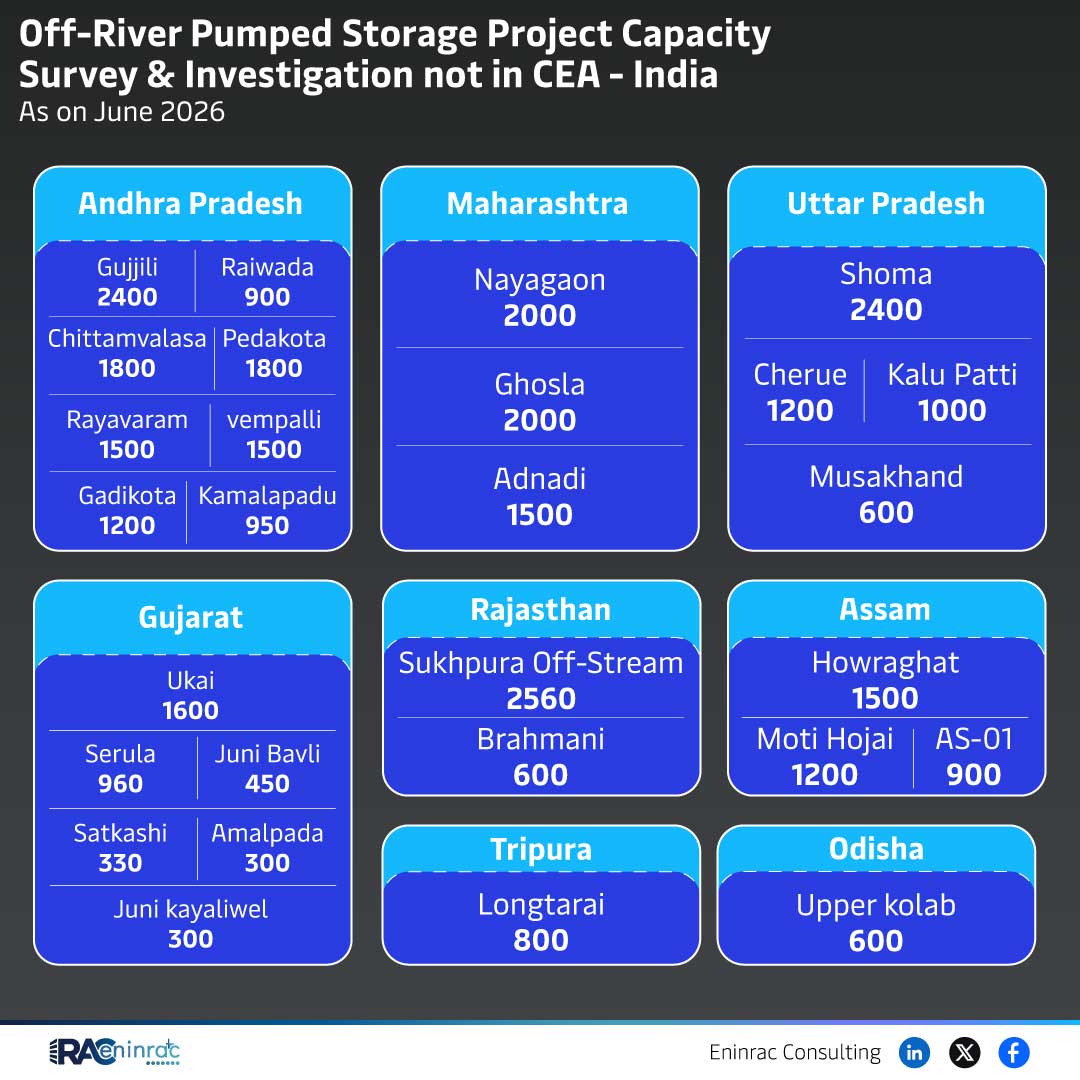
Off‑river pumped storage projects are emerging as critical assets for balancing India's growing renewable energy mix. The latest survey, compiled in June 2026, lists capacity figures for multiple states, highlighting where large‑scale storage is planned or under investigation. Readers will learn which regions host the highest megawatt potential, how capacity varies across states, and what the data suggests for investors and policymakers focused on reliable grid support.
What Does the Data Reveal About This Topic?
What does the capacity distribution tell us? The data shows a uneven spread of off‑river pumped storage potential, with several states reporting capacities above 2,000 MW while others list under 1,000 MW. This disparity points to regional differences in water resources, terrain suitability, and state‑level renewable energy priorities.
Regional Capacity Distribution Highlights
Andhra Pradesh leads with 2,400 MW, closely followed by Gujarat at 2,560 MW and Assam at 2,500 MW. Maharashtra and Uttar Pradesh each report 900 MW, indicating more modest projects. Rajasthan and Karnataka appear with capacities around 1,500 MW, while smaller entries such as Jharkhand and Odisha record figures between 300‑800 MW. The concentration of high‑capacity sites in southern and eastern states suggests favorable topography for off‑river reservoirs, whereas northern and central regions show fragmented development.
Impact on Sectors and Industries
The expanding off‑river pumped storage landscape influences several sectors. Renewable energy developers gain a reliable storage partner to smooth solar and wind intermittency, improving overall grid stability. Financial institutions see new investment avenues, with higher‑capacity projects attracting larger capital commitments. Policy makers can leverage the data to prioritize infrastructure funding and streamline clearances in high‑potential states, accelerating India's transition to a low‑carbon electricity system.
Key Takeaways
- Andhra Pradesh and Gujarat host the largest capacities.
- Southern and eastern states dominate high‑capacity projects.
- Capacity ranges from 300 MW to over 2,500 MW.
- Off‑river storage supports renewable grid integration.
- Investment interest aligns with regions showing >1,500 MW.
- Policy focus needed for lower‑capacity states.
FAQs
Which Indian state has the highest off‑river pumped storage capacity?
Gujarat leads with a reported 2,560 MW, closely followed by Andhra Pradesh at 2,400 MW.
Why do some states show much lower capacity figures?
Limited suitable terrain, water availability, and differing state energy policies result in lower project sizes.
How does off‑river pumped storage aid renewable energy integration?
It stores excess generation during low demand and releases power during peaks, smoothing variability from solar and wind sources.
What investors should consider when evaluating these projects?
Key factors include state‑level incentives, water resource security, proximity to transmission lines, and the scale of planned capacity.
Will the capacity numbers change after the survey?
Yes, as projects move from investigation to construction, capacities may be revised upward or downward based on feasibility studies.