
Introduction
Large hydro power generation in India remains a cornerstone of the country’s renewable energy strategy. The May 2026 snapshot provides a clear view of how each state contributes to the national hydro portfolio, the speed of new capacity additions, and the overall growth trajectory. Understanding these numbers helps policymakers, investors, and industry players gauge the health of hydro resources, anticipate future supply, and align projects with the nation’s clean‑energy goals. This article breaks down the key findings and highlights the implications for the broader energy market.
What Does the Data Reveal About This Topic?
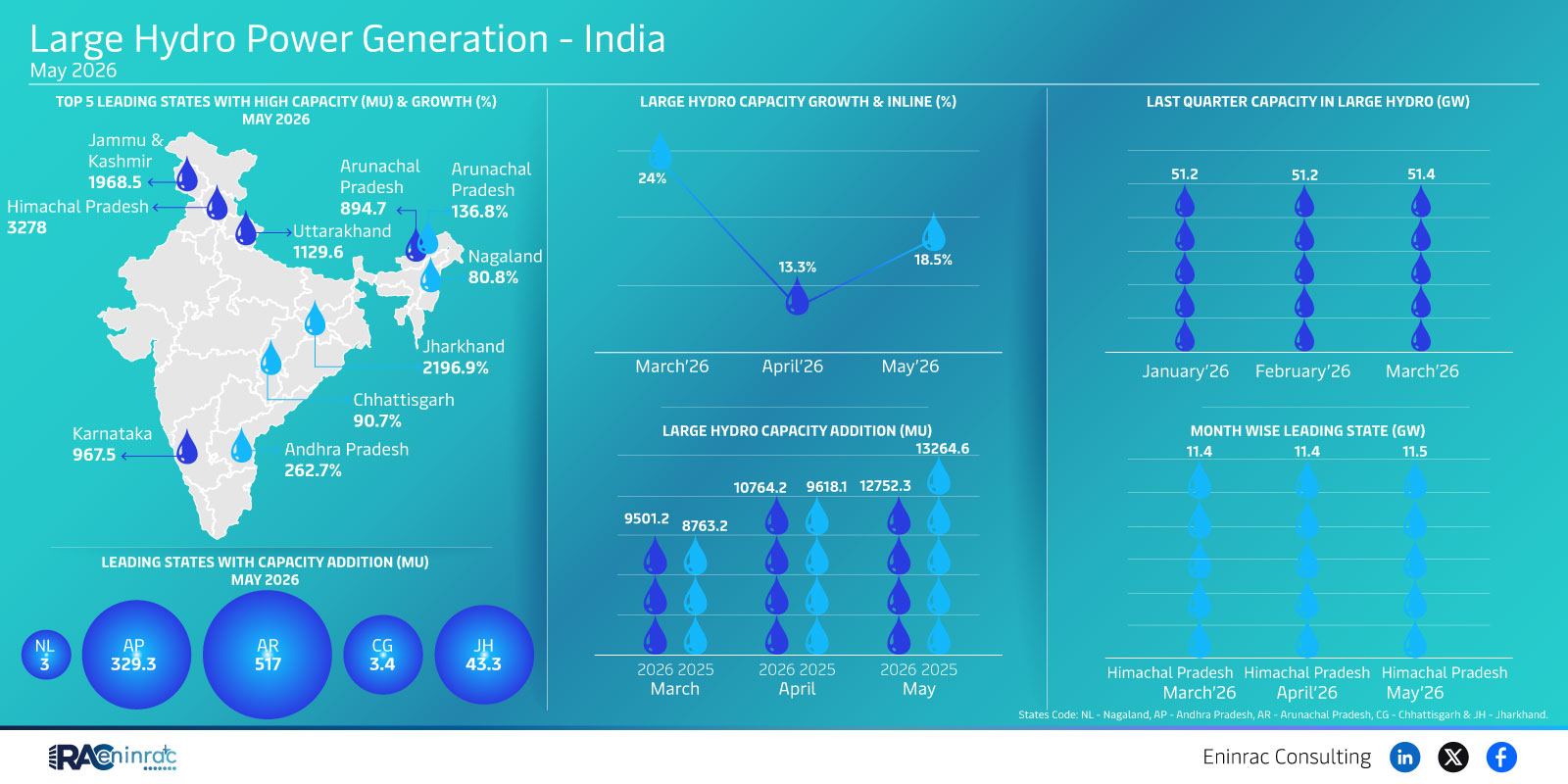
The data shows that Karnataka dominates the large hydro arena with 9,675 MU of installed capacity, far ahead of the next highest states. Himachal Pradesh, Uttarakhand, and Arunachal Pradesh also feature prominently, each contributing several hundred megawatts. Monthly capacity figures indicate a steady rise across the first quarter of 2026, with a notable 18.5% growth recorded in March. These trends suggest a robust expansion of large hydro assets despite seasonal and logistical challenges.
State‑wise Capacity and Growth Highlights
When comparing the top five states, Karnataka’s 9,675 MU dwarfs the capacities of Himachal Pradesh (894.7 MU), Uttarakhand (1,129.6 MU), Arunachal Pradesh (1,968.5 MU) and Andhra Pradesh (262.7 MU). The quarterly snapshots for January, February and March 2026 illustrate that Himachal Pradesh consistently led monthly capacity additions, contributing 1.4 GW in March alone. Overall, the nation added 13,264.6 MU of large hydro capacity in the last reporting period, reflecting both new projects coming online and upgrades to existing facilities.
Impact on Sectors and Industries
The expansion of large hydro capacity influences several sectors. Renewable energy firms gain new sites for investment, while construction and engineering companies benefit from increased project pipelines. Grid operators must integrate additional hydro output, enhancing stability and storage capabilities. Financial institutions see new financing opportunities, and state governments can leverage hydro growth to meet climate targets, improve water management, and stimulate regional development. The cumulative effect strengthens India’s commitment to a low‑carbon economy.
Key Takeaways
- Karnataka remains the clear leader in large hydro capacity with 9,675 MU.
- Himachal Pradesh, Uttarakhand and Arunachal Pradesh are the next strongest contributors.
- March 2026 recorded an 18.5% growth surge in large hydro capacity.
- The nation added over 13,000 MU of large hydro capacity in the latest quarter.
- Monthly capacity additions show a consistent upward trend across Q1 2026.
- Hydro growth supports renewable energy goals, grid stability, and regional economies.
FAQs
Which Indian state has the highest large hydro capacity?
Karnataka leads with 9,675 MU of installed large hydro capacity as of May 2026.
What was the growth rate for large hydro in March 2026?
Large hydro capacity grew by 18.5% in March 2026 compared to the previous month.
How much total capacity was added in the last quarter?
The last quarter saw an addition of approximately 13,264.6 MU of large hydro capacity nationwide.
Why is large hydro important for India’s energy mix?
Large hydro provides reliable, low‑carbon power, supports grid balancing, and aids water resource management, crucial for India’s renewable targets.
What states should investors watch for future hydro projects?
Beyond Karnataka, Himachal Pradesh, Uttarakhand, and Arunachal Pradesh demonstrate strong growth and present attractive investment opportunities.