
Introduction
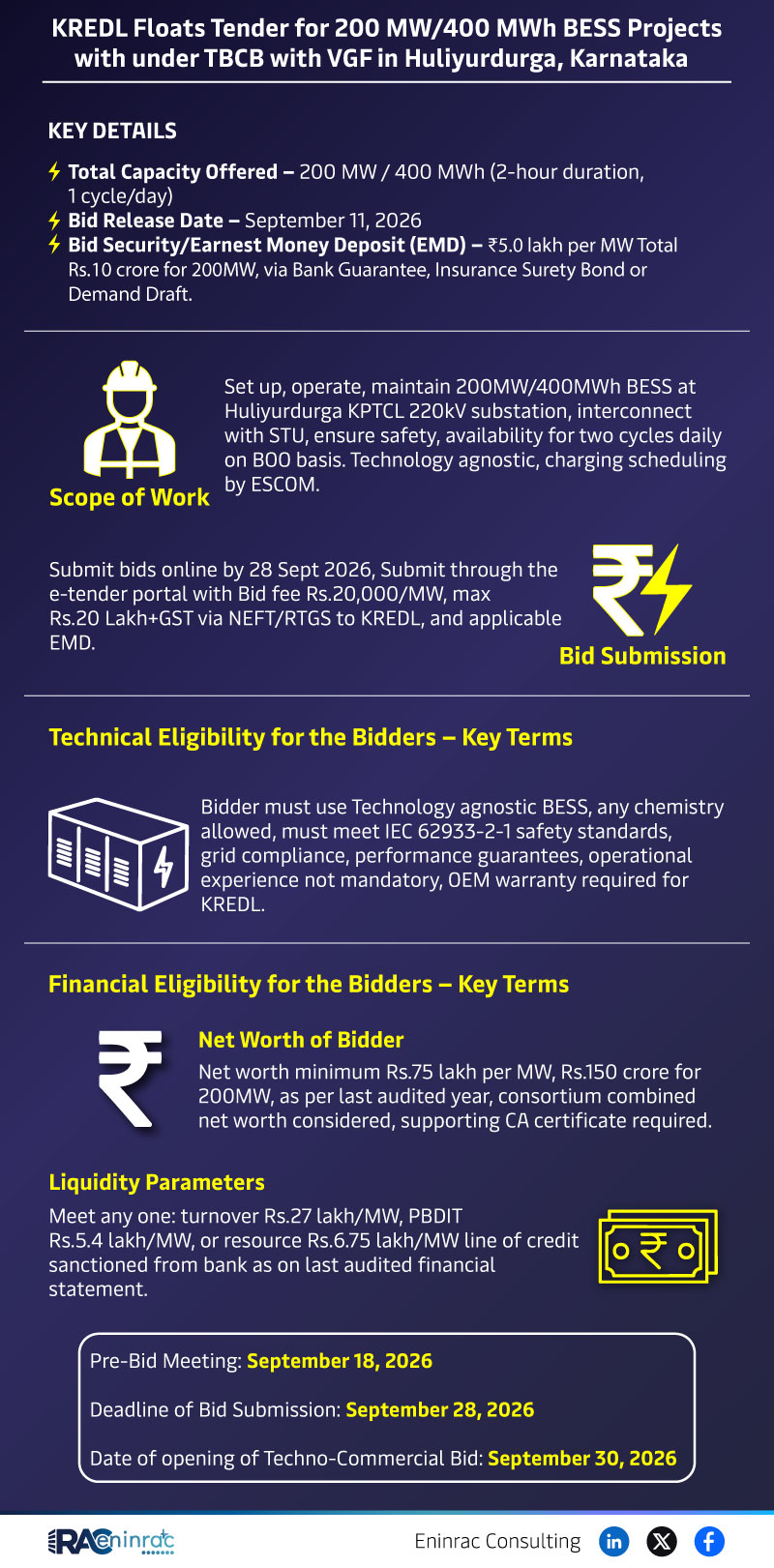
KREDL has issued a new tender for a 200 MW / 400 MWh battery energy storage system (BESS) located at the Huliyurdurga 220 kV sub‑station in Karnataka. The opportunity is offered on a build‑own‑operate (BOO) basis and is technology agnostic, meaning any approved battery chemistry that meets IEC 62933‑2‑1 safety standards can be used. Bidders are required to install, operate and maintain the system for two daily cycles, providing grid‑level services such as peak shaving, frequency regulation and renewable integration. The tender provides a rare chance for manufacturers, developers and financial consortia to enter India’s fast‑growing utility‑scale storage market while supporting Karnataka’s renewable energy goals.
What Does the Data Reveal About This Topic?
The raw data shows that KREDL is seeking a single 200 MW BESS with a 2‑hour duration and a total capacity of 400 MWh. The bid release is scheduled for 11 September 2026, with submission closing on 28 September 2026 and technical‑commercial evaluation on 30 September 2026. Financial eligibility is anchored on a minimum net‑worth of Rs 75 lakh per MW and a liquidity threshold that can be satisfied by turnover, PBDIT or a line of credit. The bid security is set at Rs 5 lakh per MW, payable via bank guarantee, surety bond or demand draft.
Tender Structure, Financial Guarantees and Technical Requirements
KREDL mandates a bid fee of Rs 20 000 per MW, with a maximum aggregate of Rs 20 lakh, payable through NEFT/RTGS. Earnest Money Deposit (EMD) must be provided as a bank guarantee, insurance surety bond, or demand draft equal to Rs 5 lakh per MW, resulting in a total of Rs 10 crore for the full 200 MW capacity. Technically, the system must adhere to IEC 62933‑2‑1 safety criteria, be grid‑compatible, and include OEM warranty coverage. No prior operational experience is required, but the bidder must guarantee performance and supply the necessary documentation such as a CA‑certified net‑worth statement.
Impact on Sectors and Industries
The tender is poised to influence several key sectors. For the renewable energy industry, the storage asset will smooth intermittency from solar and wind farms, enabling higher renewable penetration. Power utilities will gain flexible capacity to manage peak demand and improve grid stability. Financial institutions stand to benefit from financing large‑scale infrastructure projects, while technology providers can showcase advanced battery chemistries in a real‑world setting. Investors looking for green assets will find the BOO model attractive due to the long‑term revenue streams from ancillary services and capacity payments.
Key Takeaways
- 200 MW / 400 MWh BESS tender launched by KREDL for Karnataka.
- Bid deadline is 28 September 2026 with technical evaluation on 30 September 2026.
- Financial eligibility requires Rs 75 lakh net‑worth per MW and specific liquidity parameters.
- Bid security of Rs 5 lakh per MW can be submitted via bank guarantee, surety bond or demand draft.
- Technology agnostic approach allows any IEC 62933‑2‑1 compliant battery chemistry.
- Project will support grid stability, renewable integration and create investment opportunities.
FAQs
When is the deadline for bid submission?
The final date to submit bids is 28 September 2026.
What are the net‑worth requirements for bidders?
Applicants must demonstrate a minimum net‑worth of Rs 75 lakh per MW, equating to Rs 150 crore for the full 200 MW.
How can the Earnest Money Deposit be provided?
EMD can be submitted as a bank guarantee, an insurance surety bond, or a demand draft worth Rs 5 lakh per MW.
Is there a specific battery technology required?
No; the tender is technology agnostic as long as the solution complies with IEC 62933‑2‑1 safety standards.
Where will the BESS be installed?
The storage system will be connected to the Huliyurdurga KPTCL 220 kV sub‑station in Karnataka.