
Introduction
The latest July 2026 report on India CNG stations provides a detailed snapshot of the country’s compressed natural gas infrastructure. Understanding the geographic spread of CNG stations is essential for policymakers, investors, and industry stakeholders who are tracking the transition to cleaner fuels. This article breaks down the numbers for each major region, highlights key trends, and explains why this data matters for the broader energy landscape in India.
What Does the Data Reveal About This Topic?
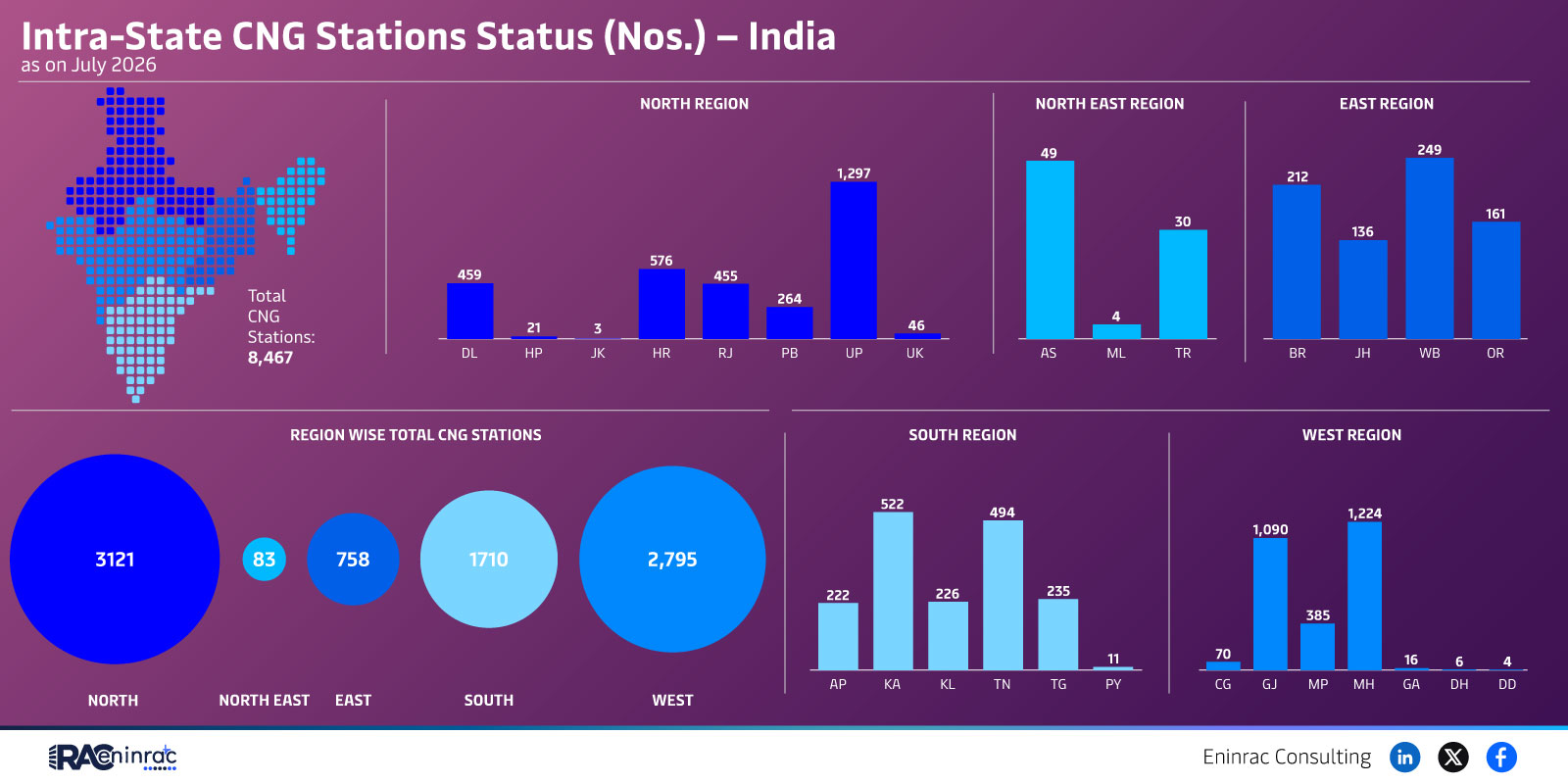
The raw numbers show a varied distribution of CNG stations across India. The North region hosts 249 stations, while the Northeast leads with a surprising 1,297 stations, reflecting strong regional policy support. The East records 161 stations, the South 494, and the West the highest count at 1,224 stations. Together these figures total roughly 3,461 active CNG stations nationwide as of July 2026, indicating steady growth in the alternative‑fuel network.
Regional Distribution Highlights
Comparing regions reveals distinct patterns. The West’s 1,224 stations outpace the South’s 494, suggesting higher adoption in states like Gujarat and Maharashtra where private fleet operators have embraced CNG. The Northeast’s 1,297 stations surpass even the West, driven by state‑level subsidies and a concentration of public transport fleets. In contrast, the East lags with only 161 stations, highlighting opportunities for infrastructure expansion. The North’s 249 stations reflect moderate growth, constrained by higher diesel usage and limited pipeline reach.
Impact on Sectors and Industries
The distribution of CNG stations influences several sectors. Transportation companies can lower operating costs and emissions by switching to CNG where stations are dense. Vehicle manufacturers see rising demand for CNG‑compatible models, especially in the West and Northeast. Investors monitor regional station density as an indicator of market potential for fuel‑service businesses, equipment suppliers, and financing firms. Policymakers use the data to target subsidies, plan pipeline extensions, and align climate goals with infrastructure development.
Key Takeaways
- The West and Northeast regions together hold more than two‑thirds of all CNG stations in India.
- The East region shows the lowest station count, highlighting a gap for future investment.
- Total CNG stations nationwide have reached approximately 3,461, confirming steady growth since the previous year.
- Regional policy incentives directly correlate with higher station density, as seen in the Northeast.
- Transportation fleets in high‑density regions can achieve notable cost savings and emission reductions.
- Investors should consider regional station density when evaluating opportunities in fuel‑service and related infrastructure.
FAQs
How many CNG stations were operational in India as of July 2026?
Approximately 3,461 CNG stations were active across the country.
Which Indian region has the highest number of CNG stations?
The Northeast region leads with about 1,297 stations.
Why does the West region have a high concentration of CNG stations?
Strong state policies, private fleet adoption, and better pipeline infrastructure have driven station growth in the West.
What challenges does the East region face in expanding CNG infrastructure?
Limited subsidies, slower pipeline development, and lower demand from commercial fleets hinder growth in the East.
How can investors use this regional data?
By targeting high‑density regions for fuel‑service businesses or supporting infrastructure projects in underserved areas.