
Introduction
The latest release of inter‑state domestic Piped Natural Gas (PNG) connection statistics for India, dated July 2026, provides a detailed snapshot of how gas distribution networks are expanding across state borders. Stakeholders ranging from policymakers and utility companies to investors and analysts can now assess the scale of connectivity, identify high‑performing corridors, and gauge the overall health of the domestic gas ecosystem. This article breaks down the numbers, explains what the data tells us about regional growth patterns, and discusses the broader implications for India’s energy transition and infrastructure planning.
What Does the Data Reveal About This Topic?
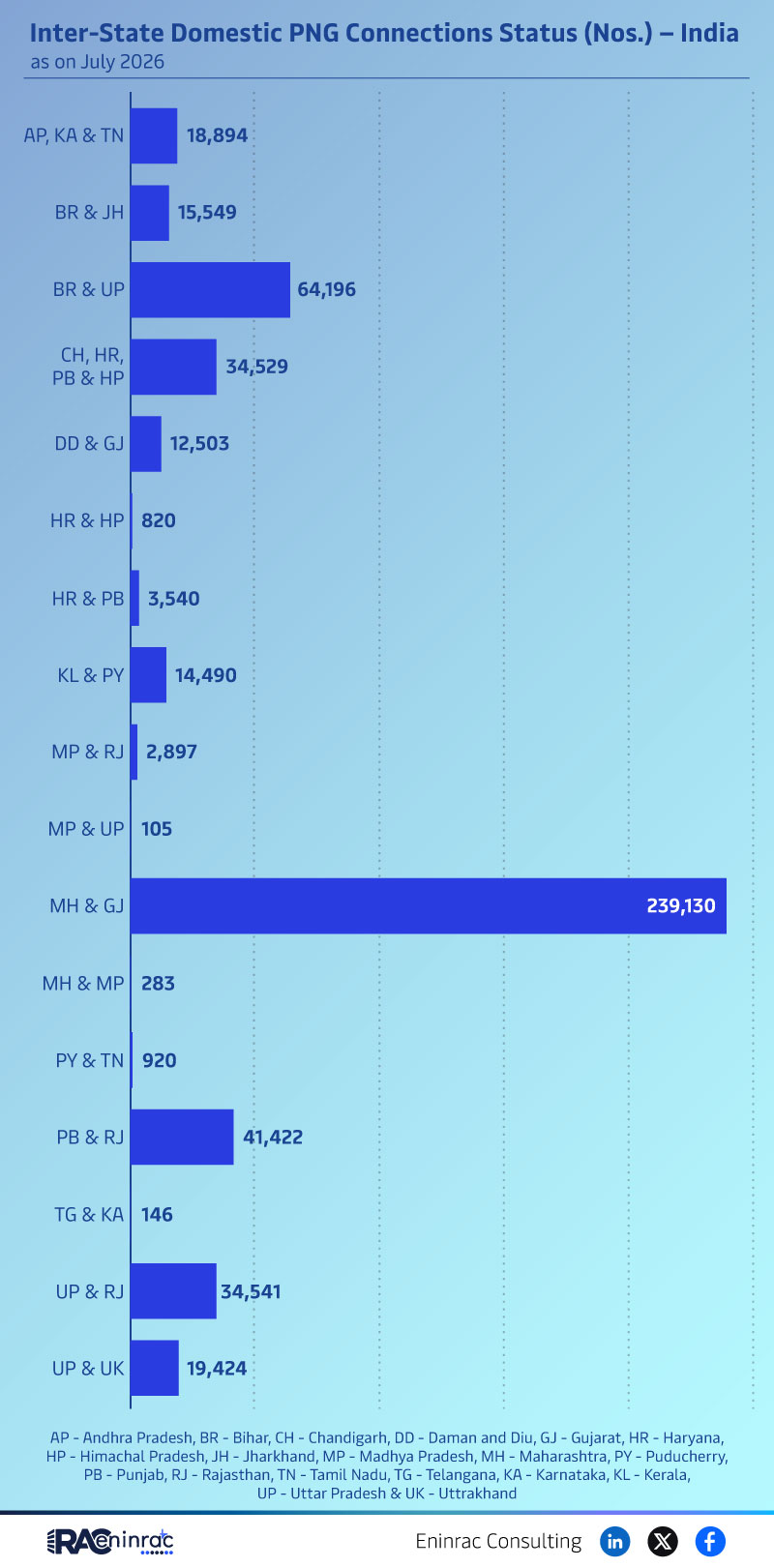
The data shows a total of 64,196 inter‑state domestic PNG connections as of July 2026, with the largest single corridor reported between Punjab and Rajasthan (PB & RJ) at 41,422 connections. Other notable pairings include DD & GJ with 12,503 connections, KL & PY with 14,490, and UP & UK with 19,424. Smaller linkages such as MP & UP account for only 105 connections, indicating varying degrees of infrastructure maturity across regions. This disparity raises questions about investment focus, pipeline availability, and state‑level policy support for gas distribution.
Regional Corridor Comparisons and Connection Volumes
When the numbers are compared side by side, the Punjab‑Rajasthan corridor dominates the landscape, contributing nearly two‑thirds of the total reported connections. The DD & GJ and KL & PY corridors follow, each exceeding ten thousand connections, reflecting strong demand in western and southern coastal zones. The UP & UK corridor, with 19,424 links, highlights the growing importance of northern hill states in the gas network. Conversely, the MP & UP pair, with just 105 connections, suggests either nascent infrastructure or logistical constraints limiting expansion. These contrasts illustrate how geography, industrial concentration, and state policies shape the distribution of PNG pipelines.
Impact on Sectors and Industries
Enhanced inter‑state PNG connectivity directly benefits sectors such as manufacturing, transportation, and residential heating by providing reliable, cleaner‑burning fuel. Utilities can leverage the expanded network to reduce reliance on coal‑based power generation, supporting India’s carbon‑reduction targets. Investors see clear signals of market potential in high‑growth corridors, prompting capital inflows into pipeline construction, compression stations, and downstream distribution. Policymakers can use the data to prioritize funding for under‑served routes, align state‑level incentives, and coordinate with central energy strategies to accelerate the nation’s transition to a diversified gas mix.
Key Takeaways
- The Punjab‑Rajasthan corridor accounts for over 40,000 of the 64,196 total connections.
- Western and southern coastal states show strong PNG growth with DD‑GJ and KL‑PY corridors.
- North‑central pair MP‑UP remains the weakest link, highlighting unmet demand.
- Overall inter‑state PNG connections have surpassed 64,000, indicating rapid network expansion.
- Investors are likely to target high‑volume corridors for infrastructure projects.
- Policymakers can use these insights to balance regional development and energy security.
FAQs
What is the total number of inter‑state domestic PNG connections in India as of July 2026?
The total reported inter‑state domestic PNG connections amount to 64,196.
Which state pair has the highest number of PNG connections?
Punjab and Rajasthan (PB & RJ) lead with 41,422 connections.
Why do some corridors like MP & UP have very few connections?
Low numbers may stem from early‑stage infrastructure, geographic challenges, or limited policy incentives.
How does increased PNG connectivity affect the energy sector?
It supports cleaner fuel use, reduces coal dependency, and creates investment opportunities in gas infrastructure.
What can policymakers do with this data?
They can identify under‑served regions, allocate resources strategically, and align state incentives with national energy goals.