
Introduction
The May 2026 report on inter-state domestic PNG connections in India provides a detailed snapshot of how power network links are distributed among the country’s states and union territories. Understanding these connections is crucial for policymakers, investors, and infrastructure planners because they reflect the capacity for electricity sharing, grid stability, and future expansion opportunities. This article walks through the raw numbers, highlights the most significant state pairings, compares regional performance, and explains what the data means for the broader energy sector and regional development strategies.
What Does the Data Reveal About This Topic?
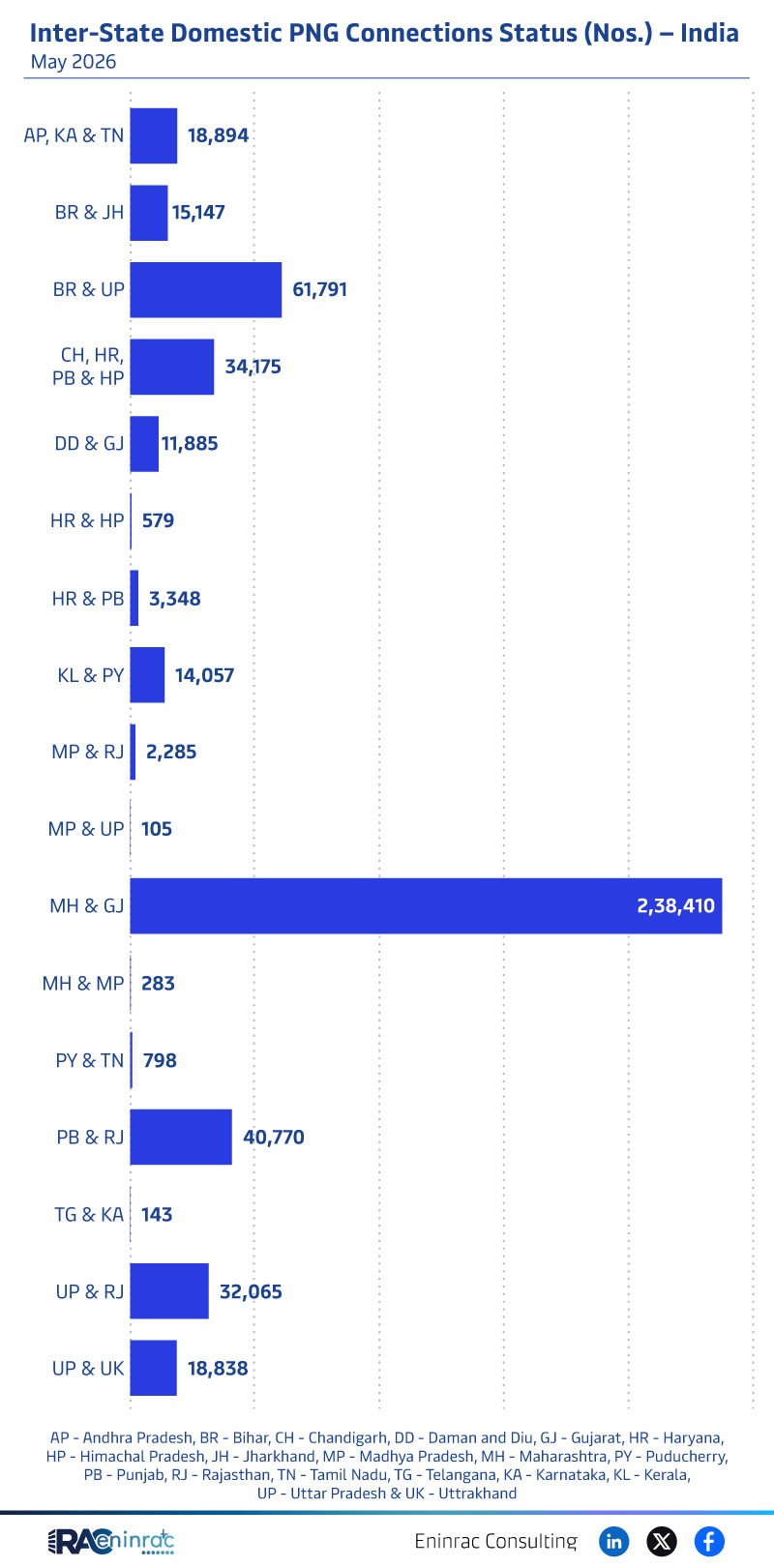
What does the data reveal about inter-state domestic PNG connections? The figures show a highly uneven distribution of connections, with certain corridors such as Punjab‑Rajasthan (40,770 connections) and Maharashtra‑Gujarat (approximately 238,410 connections) dominating the landscape, while others like Himachal Pradesh‑Punjab (3,348 connections) and Kerala‑Puducherry (14,057 connections) are comparatively modest. The data underscores strong linkage corridors in the north‑west and central regions, suggesting focused grid integration efforts in those zones.
State‑wise Comparison of PNG Connections
When we compare the state‑to‑state pairings, the most striking contrast is between high‑volume routes and low‑volume ones. Maharashtra‑Gujarat leads with over two hundred thirty‑eight thousand connections, indicating a major conduit for electricity flow between two industrial powerhouses. In contrast, the Haryana‑Punjab link records just over three thousand connections, reflecting either lower demand or limited infrastructure. The Uttar Pradesh‑Rajasthan corridor (32,065 connections) and Uttar Pradesh‑Uttarakhand corridor (18,838 connections) show substantial north‑central connectivity, while the Madhya Pradesh‑Rajasthan pair (2,285 connections) remains modest. These variations point to differing economic activities, grid capacity, and regional development priorities across the country.
Impact on Sectors and Industries
Inter‑state domestic PNG connections directly affect several critical sectors. For the power generation industry, robust connections enable better load balancing and reduce the risk of outages during peak demand. Investors view high‑volume corridors as attractive opportunities for financing new transmission lines or upgrading existing infrastructure. Policymakers can use the data to identify under‑served regions, prioritize investment, and design incentives for expanding the grid. Moreover, industries reliant on reliable electricity—such as manufacturing, information technology, and agriculture—benefit from improved inter‑state power flows, which can lower operating costs and enhance competitiveness.
Key Takeaways
- Maharashtra‑Gujarat is the leading corridor with over 238,000 PNG connections.
- Punjab‑Rajasthan follows with the highest recorded connections among northern states (40,770).
- Kerala‑Puducherry and Haryana‑Punjab represent lower‑volume links, highlighting regional gaps.
- Uttar Pradesh maintains strong connectivity with both Rajasthan and Uttarakhand, emphasizing its central grid role.
- The data reveals a concentration of connections in industrial and high‑demand zones.
- Policymakers can target lower‑volume corridors for future infrastructure development to improve national grid resilience.
FAQs
Which state pair has the highest number of PNG connections?
Maharashtra and Gujarat together account for the highest number, with roughly 238,410 inter‑state domestic PNG connections.
Why are some state corridors much smaller than others?
Differences stem from varying electricity demand, existing grid capacity, economic activity, and regional investment priorities.
How can this data help investors?
Investors can identify high‑traffic corridors for potential upgrades and locate underserved regions where new projects may offer strong returns.
What role do these connections play in grid stability?
Robust inter‑state PNG connections enable load balancing, reduce outage risks, and support the integration of renewable energy sources.
Will the government prioritize low‑volume corridors?
Policy focus often shifts to under‑connected regions to improve nationwide power reliability and foster balanced economic growth.