
Introduction
The Gujarat Urja Vikas Nigam Limited (GUVNL) recently concluded a high‑profile tender for a standalone Battery Energy Storage System (BESS) with a total capacity of 450 MW and 900 MWh. The auction, held in early 2024, attracted major renewable players such as NLC India Renewables Ltd and Sun Drops Energia Ltd, each submitting bids measured in Lacs per megawatt per month. Understanding the tender outcomes, pricing dynamics, and contract allocations is essential for investors, policymakers, and industry watchers who track the rapid growth of battery storage in India’s power sector.
What Does the Data Reveal About This Topic?
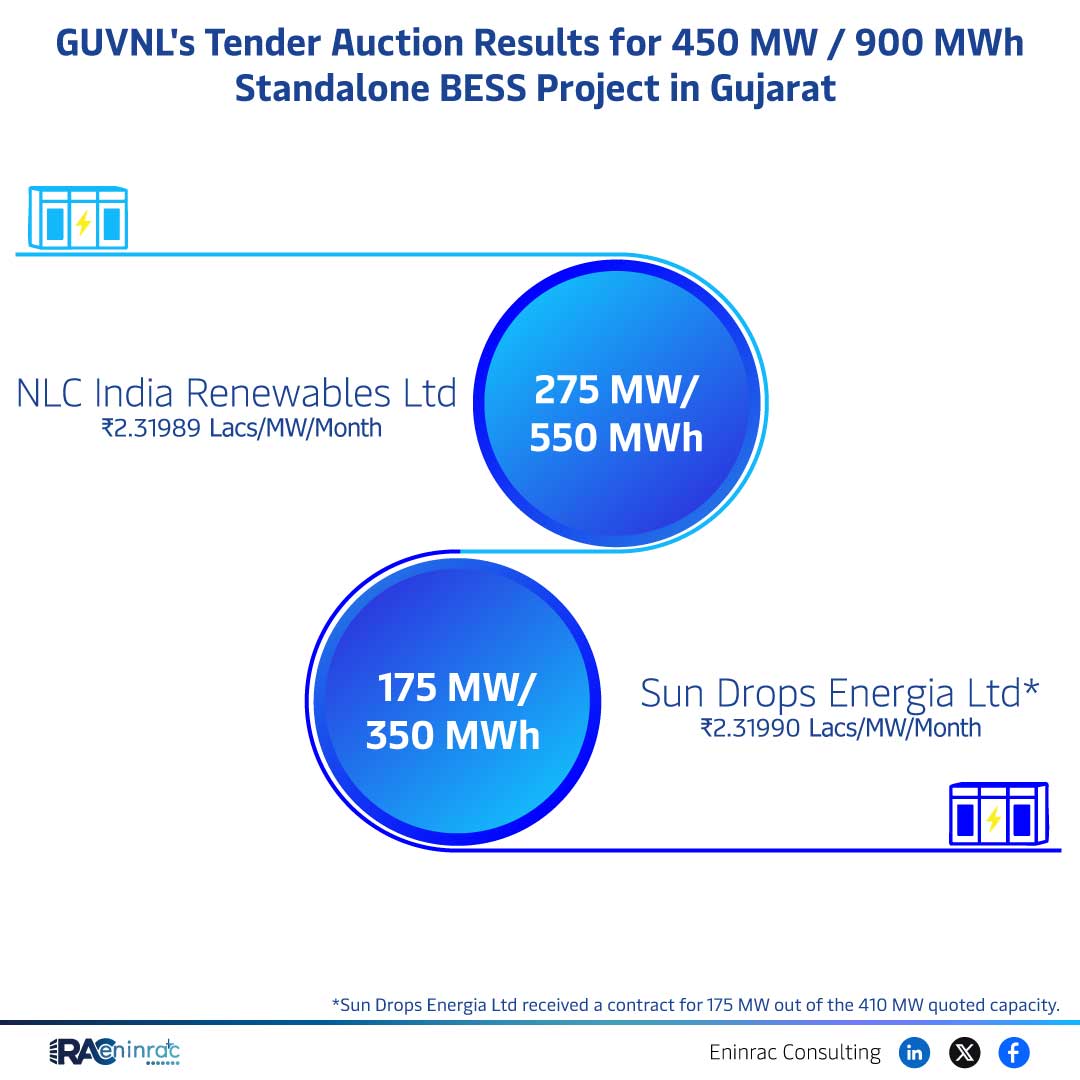
The raw data shows that both NLC India Renewables and Sun Drops Energia offered almost identical bid rates—2.31989 and 2.31990 Lacs per MW per month respectively—indicating a highly competitive price environment. Sun Drops Energia secured a contract for 175 MW out of the 410 MW it quoted, highlighting the importance of bid volume and strategic positioning. This result demonstrates that GUVNL’s tender mechanism rewards both price parity and the ability to deliver a significant share of the quoted capacity.
Price Comparison Between NLC India Renewables and Sun Drops Energia
When examining the bid figures, the difference between the two companies is merely one hundredth of a Lakh, underscoring a narrow margin that reflects market maturity. NLC India Renewables posted a bid of 2.31989 Lacs/MW/Month, while Sun Drops Energia submitted a slightly higher 2.31990 Lacs/MW/Month. Despite the marginally higher price, Sun Drops Energia’s ability to win 175 MW suggests that factors such as financial strength, project execution capability, and regional presence in Gujarat also influence award decisions beyond pure price.
Impact on Sectors and Industries
The successful completion of this standalone BESS tender has several implications. For the renewable energy sector, it provides a firm storage backbone that can smooth intermittency from solar and wind farms across Gujarat, encouraging further renewable project development. Financial investors see a clear signal that battery storage projects are now a viable asset class with transparent pricing mechanisms. Policymakers gain confidence that state‑run utilities can conduct competitive auctions, thereby accelerating India’s target of 450 GW of renewable capacity by 2030. Finally, equipment manufacturers and EPC firms anticipate increased demand for battery modules, power conversion systems, and integration services.
Key Takeaways
- GUVNL awarded 175 MW to Sun Drops Energia in a 450 MW BESS tender.
- Both NLC India Renewables and Sun Drops Energia submitted near‑identical bids.
- The price gap of 0.00001 Lacs/MW/Month reflects intense market competition.
- Contract allocation favoured the bidder with higher quoted capacity and execution readiness.
- Standalone BESS projects are critical for balancing Gujarat’s renewable generation.
- Successful auction boosts confidence for future storage tenders across India.
FAQs
What is the total capacity of the GUVNL BESS tender?
The tender covers a combined 450 MW of power capacity and 900 MWh of energy storage.
Which company won the largest contract in the auction?
Sun Drops Energia Ltd secured the largest single award, receiving a contract for 175 MW.
How close were the winning bids?
The bids were almost identical, differing by only 0.00001 Lacs per MW per month.
Why is standalone BESS important for Gujarat?
Standalone BESS provides grid stability, supports renewable integration, and reduces dependence on fossil‑fuel peaking plants.
What does this tender indicate for future energy storage projects in India?
The competitive pricing and transparent award process suggest a growing, investor‑friendly market for large‑scale battery storage nationwide.