
Introduction
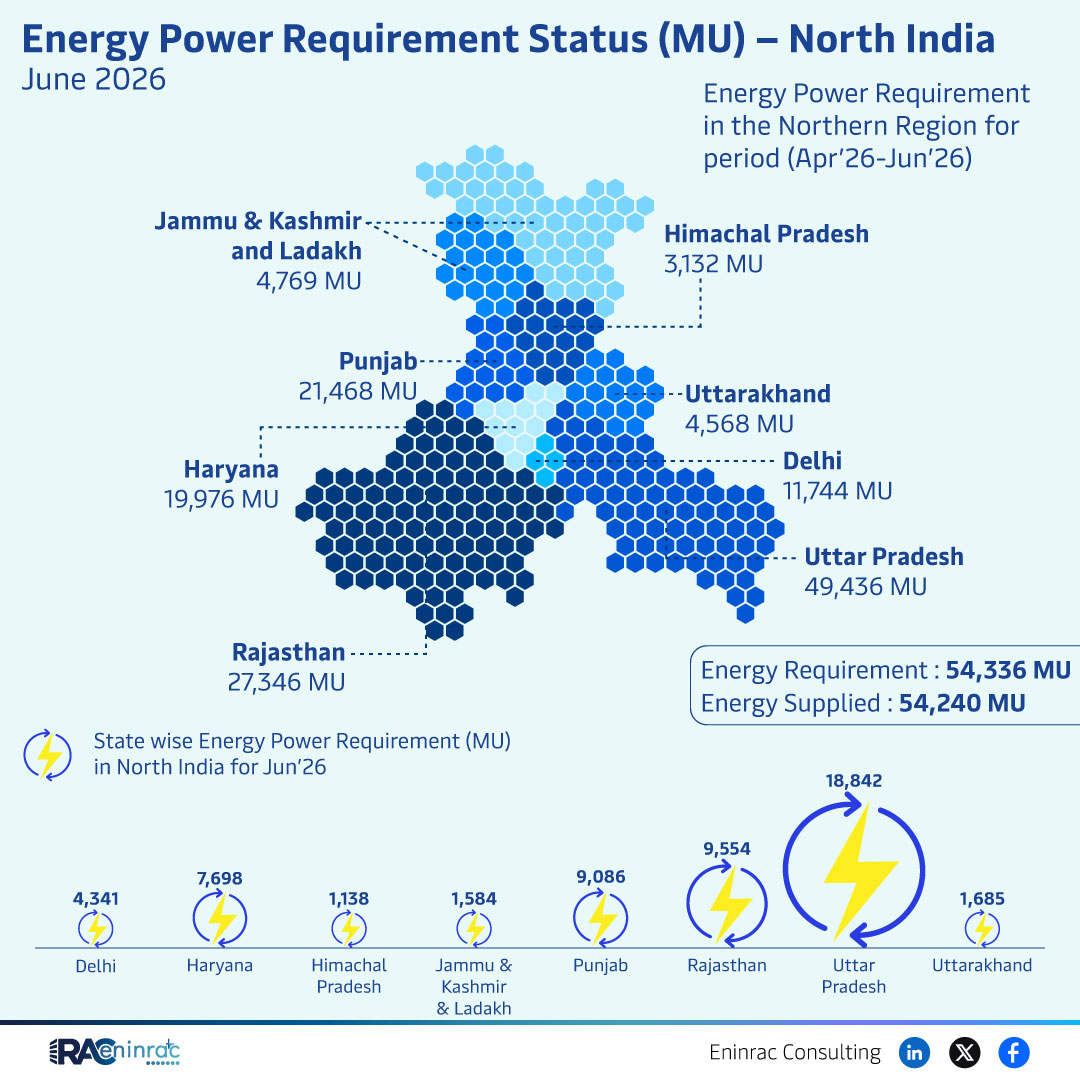
North India’s energy landscape in June 2026 is captured through a detailed power requirement and supply report. The data presents a statewise breakdown of megawatt units (MU) needed to meet consumer demand across the region. Understanding this information helps policymakers, investors, and industry stakeholders gauge supply‑demand balance, plan infrastructure upgrades, and identify regions where power shortages or surpluses may emerge.
What Does the Data Reveal About This Topic?
The report shows that the total energy requirement for the northern region amounts to 54,336 MU, while the supplied power stands at 54,240 MU, indicating a marginal shortfall of 96 MU. Uttar Pradesh alone accounts for the largest share with 49,436 MU, followed by Haryana (19,976 MU) and Punjab (21,468 MU). Smaller states such as Himachal Pradesh, Jammu & Kashmir‑Ladakh, and Uttarakhand each require between 4,500 and 5,000 MU.
Statewise Power Requirement Comparison for June 2026
When the numbers are examined side by side, Uttar Pradesh’s demand dwarfs all other states, representing over 90 % of the regional total. Haryana’s requirement of roughly 20 000 MU places it in second position, while Punjab’s 21 468 MU underscores its importance as an industrial and agricultural hub. Delhi’s 11 744 MU reflects its dense urban consumption, whereas the combined requirement of Jammu & Kashmir, Ladakh, Himachal Pradesh, and Uttarakhand remains under 5 000 MU each, highlighting the lower population and industrial activity in the Himalayan belt.
Impact on Sectors and Industries
The near‑balanced supply‑demand scenario supports continuity for manufacturing, agriculture, and services across North India. However, the slight deficit may pressure thermal and renewable power plants to operate at higher capacity factors, influencing fuel costs and emissions. Investors in conventional energy projects can view the data as a signal for stable cash flows, while renewable developers may target the high‑demand states to offset shortfalls with clean capacity. Policymakers must prioritize grid reinforcement in Uttar Pradesh and Haryana to avoid localized outages.
Key Takeaways
- The total power requirement for North India in June 2026 is 54,336 MU.
- Supplied power reaches 54,240 MU, leaving a brief shortfall of 96 MU.
- Uttar Pradesh dominates the demand profile with over 49 000 MU.
- Haryana and Punjab each require close to 20 000 MU, indicating strong industrial usage.
- Himalayan states such as Himachal Pradesh, Jammu & Kashmir‑Ladakh, and Uttarakhand each need less than 5 000 MU.
- Investors should focus on capacity expansion in high‑demand states to ensure reliability.
FAQs
What is the total energy requirement for North India in June 2026?
It is 54,336 megawatt units (MU) across all northern states.
How much power was actually supplied during the same period?
Supplied power was 54,240 MU, resulting in a shortfall of 96 MU.
Which state has the highest power demand?
Uttar Pradesh leads with approximately 49,436 MU, far above other regions.
Are Himalayan states significant consumers of power?
They consume less than 5,000 MU each, reflecting lower population and industrial activity.
What does the slight shortfall mean for investors?
It suggests a need for additional capacity, offering opportunities for both conventional and renewable energy projects.