
Introduction
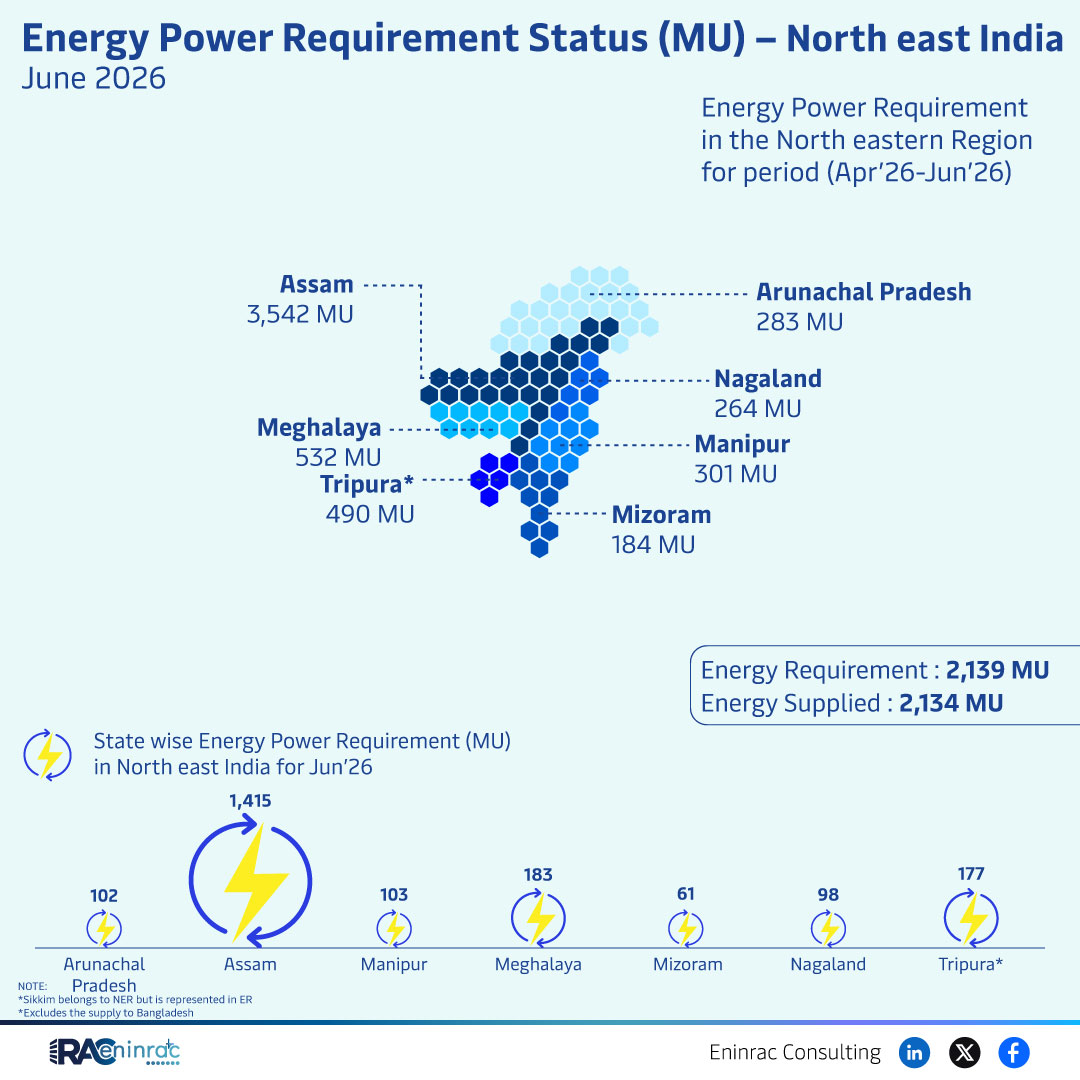
The energy landscape of North East India in June 2026 presents a concise snapshot of regional power needs. The data compiled for the period April to June 2026 captures the total power requirement of 2,139 million units (MU) across the seven states of the region and compares it with the actual supply of 2,134 MU. Understanding this gap is vital for policymakers, investors, and utilities who aim to balance demand and supply, promote sustainable generation, and avoid shortfalls. This article breaks down the statewise figures, highlights the leading demand centres, and discusses the broader implications for the power sector and related industries.
What Does the Data Reveal About This Topic?
The raw numbers answer a critical question: how closely does supply match demand in North East India during June 2026? The overall shortfall is modest—only five MU—indicating that the grid is largely meeting requirements. However, the distribution is uneven. Arunachal Pradesh accounts for the largest share of demand, while smaller states such as Mizoram and Nagaland record lower requirements. The data thus points to regional disparities that must be addressed through targeted infrastructure and investment.
Statewise Energy Demand Highlights
Arunachal Pradesh dominates the demand profile with an estimated 3,500 MU, far exceeding the needs of any other state. Assam follows with roughly 283 MU, reflecting its larger population and industrial base. Tripura registers around 301 MU, while Mizoram’s demand sits near 184 MU. Nagaland and Meghalaya each report demand in the mid‑200 MU range. Manipur’s figure is lower, close to 77 MU. These variations illustrate how geography, economic activity, and connectivity shape consumption patterns across the North East, and they guide where new generation capacity or transmission upgrades are most needed.
Impact on Sectors and Industries
Power availability influences multiple sectors in the region. Renewable energy developers see an opportunity to tap unmet demand, especially in Arunachal Pradesh where hydro and solar potential are high. Conventional power producers are encouraged to optimize existing plants to bridge minor gaps. Investors focus on transmission projects that can move electricity from surplus zones to deficit areas. Policymakers must consider demand‑side management, tariff reforms, and incentives for energy efficiency. The slight supply‑demand mismatch also affects industrial growth, agricultural processing, and tourism, all of which rely on reliable electricity.
Key Takeaways
- Overall power demand in June 2026 was 2,139 MU against a supply of 2,134 MU.
- Arunachal Pradesh leads with the highest regional demand, exceeding 3,500 MU.
- Smaller states such as Mizoram and Nagaland have demand below 200 MU.
- The supply‑demand gap is only five MU, indicating near‑balance at the regional level.
- Renewable projects can address demand peaks, especially in hydro‑rich Arunachal.
- Targeted grid upgrades are essential to distribute surplus power efficiently.
FAQs
What was the total power requirement for North East India in June 2026?
The region required 2,139 million units (MU) of electricity during that month.
Which state had the highest power demand?
Arunachal Pradesh recorded the highest demand, exceeding 3,500 MU.
Is there a significant supply shortfall in the region?
The shortfall was minimal—only five MU—showing that supply closely matched demand.
How can investors benefit from this data?
They can target renewable and transmission projects in high‑demand states to close regional gaps.
What sectors are most affected by power availability?
Industries, agriculture, tourism, and renewable energy developers are directly impacted by electricity supply.