
Introduction
North India energy power requirement data for July 2026 provides a snapshot of how much electricity is needed across key states during the peak April‑July period. The report lists megawatt‑units (MU) demanded by Jammu & Kashmir‑Ladakh, Himachal Pradesh, Uttarakhand, Delhi, Haryana, Uttar Pradesh, and Rajasthan. Understanding these figures helps utilities, investors, and policymakers assess supply adequacy, plan capacity additions, and anticipate market trends. This article breaks down the state‑wise numbers, highlights gaps between demand and supply, and explains the implications for the broader power sector in northern India.
What Does the Data Reveal About This Topic?
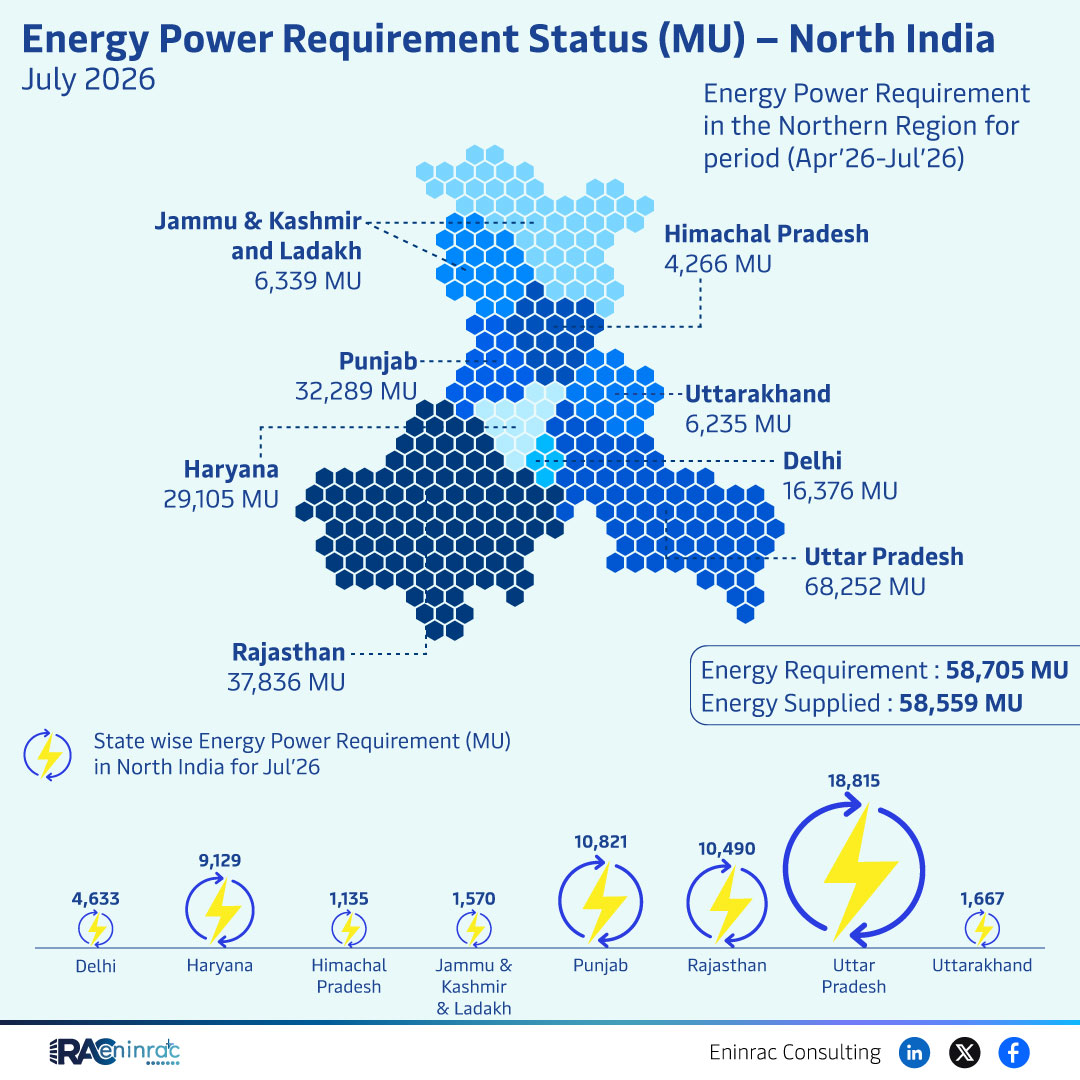
The data shows that Uttar Pradesh leads with a demand of 68,252 MU, while the overall requirement of the northern region sums to 58,705 MU, closely matched by an actual supply of 58,559 MU. The small shortfall indicates a marginal gap that could strain peak‑hour reliability if not addressed.
State‑wise MU Demand Comparison for July 2026
Uttar Pradesh dominates the landscape with 68,252 MU, far exceeding any other state. Rajasthan follows with 29,105 MU, showing a moderate load. Delhi records 16,376 MU, reflecting dense urban consumption. Haryana contributes 29,105 MU as well, indicating a strong regional demand. Himachal Pradesh (4,266 MU) and Uttarakhand (6,235 MU) together add over 10,000 MU, suggesting growing needs in the hill states. Jammu & Kashmir‑Ladakh’s 6,339 MU underscores the challenges of supplying power in mountainous terrain.
Impact on Sectors and Industries
The highlighted demand patterns affect multiple sectors. Power generators must align capacity projects with the high‑demand states, especially Uttar Pradesh and Rajasthan. Transmission operators need to reinforce grids to handle peak loads and minimize losses. Investors can target opportunities in renewable and conventional projects where demand outpaces supply. Policymakers are prompted to refine demand‑side strategies, encourage energy efficiency, and consider cross‑border electricity trade to bridge the slight shortfall.
Key Takeaways
- Uttar Pradesh accounts for the highest MU demand, exceeding 68,000 units.
- Rajasthan shows a modest requirement of roughly 29,000 MU, reflecting lower industrial load.
- Delhi’s demand of 16,376 MU underlines significant urban consumption within a compact area.
- Himachal Pradesh and Uttarakhand together contribute over 10,000 MU, indicating growing regional needs.
- Jammu & Kashmir‑Ladakh registers 6,339 MU, highlighting energy challenges in mountainous terrain.
- Total supplied MU (58,559) nearly matches the requirement (58,705), leaving a minimal shortfall.
FAQs
What is the total energy requirement for North India in July 2026?
The combined requirement across all listed states equals 58,705 megawatt‑units (MU).
Which state has the largest power demand in this period?
Uttar Pradesh leads with a demand of 68,252 MU, far above any other state.
Is the supplied electricity sufficient to meet the regional demand?
Supply stands at 58,559 MU, just 146 MU short of the total requirement, indicating a tight margin.
How does Delhi’s demand compare to its neighboring states?
Delhi requires 16,376 MU, which is higher than Himachal Pradesh and Uttarakhand but lower than Uttar Pradesh and Rajasthan.
What implications does the small supply gap have for policymakers?
The narrow shortfall urges immediate capacity planning, demand‑side management, and potential import arrangements to avoid reliability risks.