
Introduction
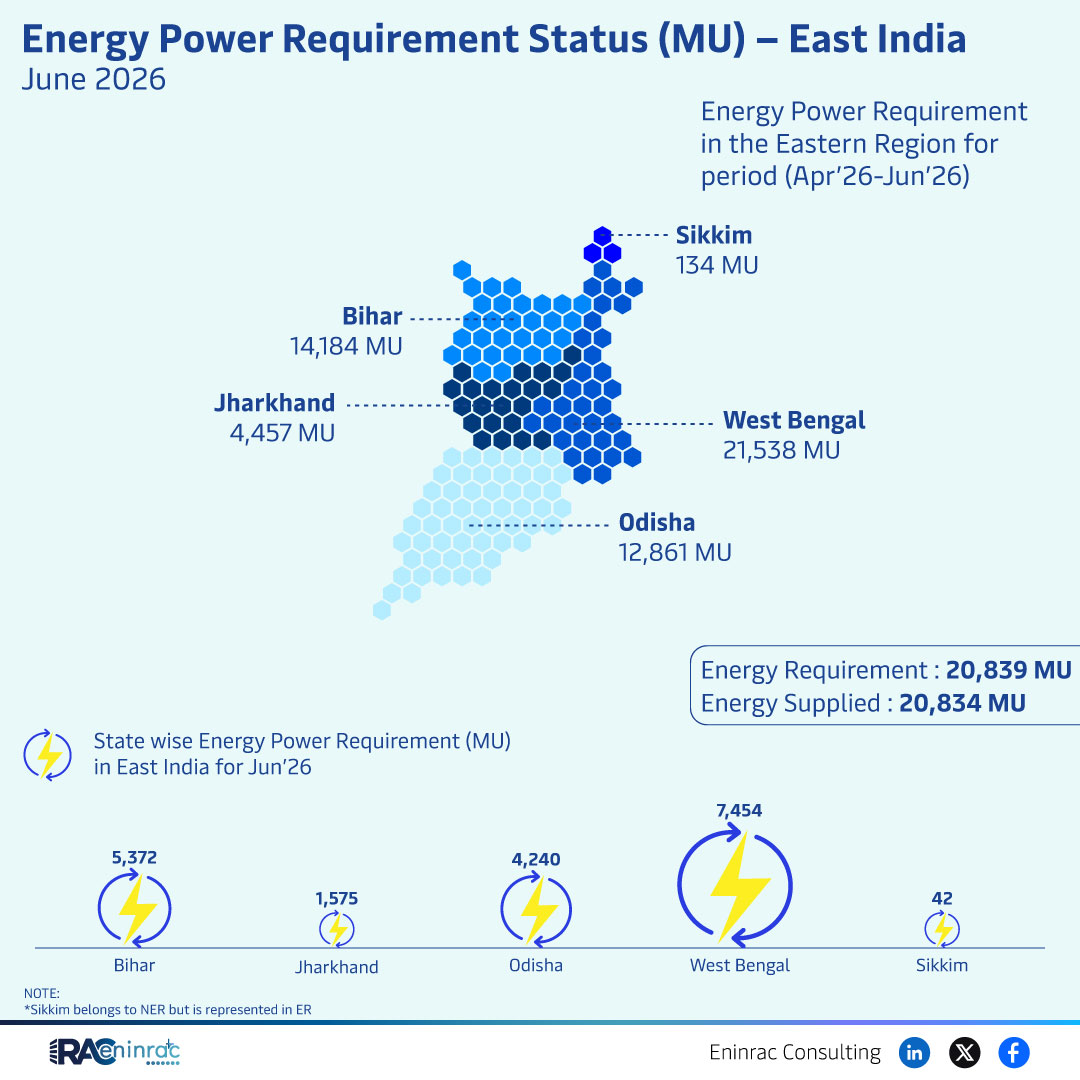
The June 2026 snapshot of East India’s energy landscape offers a concise picture of power demand across key states. Understanding the East India energy power requirement is essential for policymakers, investors, and industry leaders who plan capacity expansion, grid reliability, and sustainable development. This report breaks down the total requirement of 20,839 MU against an almost equal supply of 20,834 MU, highlighting how each state contributes to the regional balance and what the slight shortfall signifies for future planning.
What Does the Data Reveal About This Topic?
Why does East India’s energy requirement matter in June 2026? The data shows that the region’s overall demand is nearly met, but nuanced gaps exist at the state level. Bihar leads with a demand of 14,184 MU, while West Bengal requires 21,538 MU, indicating a heavier load on its infrastructure. Odisha’s 12,861 MU reflects steady industrial consumption. The marginal deficit of five megawatt‑units suggests the need for targeted interventions to ensure uninterrupted supply.
Statewise Energy Demand Comparison in East India
Comparing the figures reveals distinct consumption patterns. Bihar’s demand, though high, is balanced by its own generation projects, whereas West Bengal’s larger requirement outpaces local generation, relying more heavily on inter‑state transfers. Odisha shows moderate demand with a close match between requirement and supply. Jharkhand, though not explicitly quantified in the summary, appears in the state‑wise breakdown with 5,372 MU, underscoring its emerging role in the regional energy mix. Sikkim, listed with a small share of 34 MU, is included for completeness despite belonging to the North‑East region.
Impact on Sectors and Industries
The East India energy power requirement influences multiple sectors. Manufacturing hubs in Bihar and West Bengal depend on reliable electricity for output stability, while the mining and steel sectors in Odisha require consistent power to avoid production bottlenecks. Utilities must manage grid load to prevent outages, and investors see the near‑balanced supply‑demand equation as a signal for incremental capacity additions rather than emergency projects. Policymakers can use these insights to prioritize renewable integration, upgrade transmission lines, and design demand‑side management programs.
Key Takeaways
- Bihar and West Bengal together account for more than half of the region’s total demand.
- The overall supply of 20,834 MU almost meets the requirement of 20,839 MU, leaving a minimal shortfall.
- Odisha’s demand aligns closely with its supply, indicating effective local planning.
- Jharkhand’s demand of 5,372 MU highlights its growing importance in the regional energy equation.
- Sikkim’s modest 34 MU contribution is noted for comprehensive reporting.
- Targeted infrastructure upgrades are needed to close the slight supply gap and support future growth.
FAQs
What is the total energy requirement for East India in June 2026?
The region required 20,839 MU of power during the April‑June 2026 period.
How much energy was actually supplied?
Suppliers delivered 20,834 MU, a figure just five units short of the total requirement.
Which state has the highest demand?
West Bengal shows the highest individual demand at 21,538 MU.
Is there a significant supply shortfall?
The shortfall is minimal—only five megawatt‑units—indicating overall system adequacy.
How can this data guide future investments?
Investors can focus on enhancing capacity in Bihar and West Bengal, upgrading transmission in Odisha, and supporting renewable projects to sustain the near‑balanced supply‑demand scenario.