
Introduction
The August 2026 energy power requirement report for North East India presents a detailed snapshot of state‑wise demand and supply across the region. Understanding these figures is essential for investors, policymakers, and energy planners who need to address gaps, allocate resources, and anticipate future growth. This article breaks down the raw data, highlights key trends, and offers actionable insights for stakeholders.
What Does the Data Reveal About This Topic?
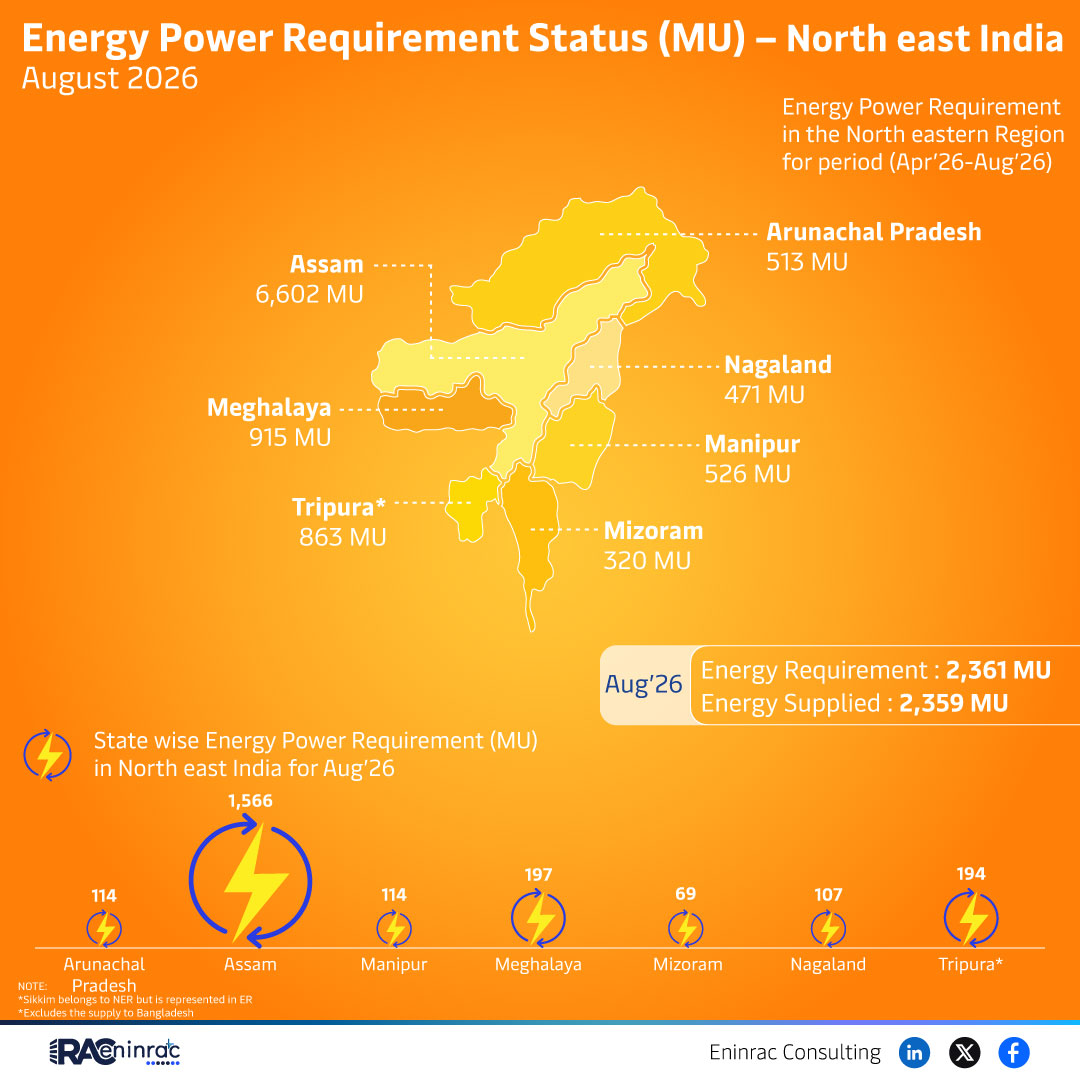
How does the August 2026 data illustrate the current balance between energy demand and supply in North East India? The numbers show that Assam leads with a staggering 6,602 MU requirement, while Arunachal Pradesh records 1,566 MU. Meghalaya’s demand sits at 915 MU, and Tripura requires 2,361 MU but has supplied 2,359 MU, indicating a narrow shortfall of 2 MU. Nagaland’s figures are not fully clear in the raw set, but the overall picture points to uneven distribution and a marginal supply deficit in specific states.
State‑wise Energy Demand and Supply Gaps
A comparative view of the five states underscores distinct patterns. Assam’s massive demand reflects its larger population and industrial activity, yet the data does not disclose its supply level, suggesting a potential vulnerability. Arunachal Pradesh, while smaller, shows a moderate requirement that could be met with targeted projects. Meghalaya’s demand remains under 1,000 MU, indicating a relatively modest load. Tripura’s near‑balanced supply demonstrates effective short‑term planning, whereas Nagaland’s missing values hint at data collection challenges that need resolution for accurate forecasting.
Impact on Sectors and Industries
The energy power requirement landscape influences several sectors. Power‑intensive industries in Assam may face higher operational costs if supply does not keep pace, prompting a push for new generation capacity or demand‑side management. Rural electrification initiatives in Arunachal Pradesh and Meghalaya could benefit from focused renewable projects, reducing reliance on external power sources. Investors eyeing the north‑eastern market must weigh the narrow supply gap in Tripura against the larger unmet demand in Assam, shaping decisions on thermal, hydro, or solar ventures. Policymakers can use these insights to prioritize grid upgrades and incentive schemes.
Key Takeaways
- Assam accounts for the highest energy power requirement in the region at 6,602 MU.
- Tripura’s supply almost matches its demand, with only a 2 MU shortfall.
- Arunachal Pradesh’s demand of 1,566 MU highlights growth potential for new projects.
- Meghalaya’s demand remains modest at 915 MU, indicating lower immediate pressure.
- Data gaps for Nagaland suggest a need for improved reporting mechanisms.
- Overall, the region exhibits a marginal supply deficit that could affect industrial productivity if not addressed.
FAQs
What is the total energy power requirement for North East India in August 2026?
The combined reported requirement across the highlighted states exceeds 11,000 MU, with Assam alone contributing 6,602 MU.
Which state has the smallest energy demand?
Meghalaya records the lowest demand among the listed states at 915 MU.
Is there any state where supply meets demand?
Tripura’s supply of 2,359 MU nearly meets its demand of 2,361 MU, showing a minimal shortfall.
Why are Nagaland’s figures incomplete?
The raw data does not provide clear values for Nagaland, indicating a reporting gap that requires further clarification.
How can investors use this data?
Investors can identify high‑demand zones like Assam for new capacity projects and assess near‑balanced markets like Tripura for low‑risk opportunities.