
Introduction
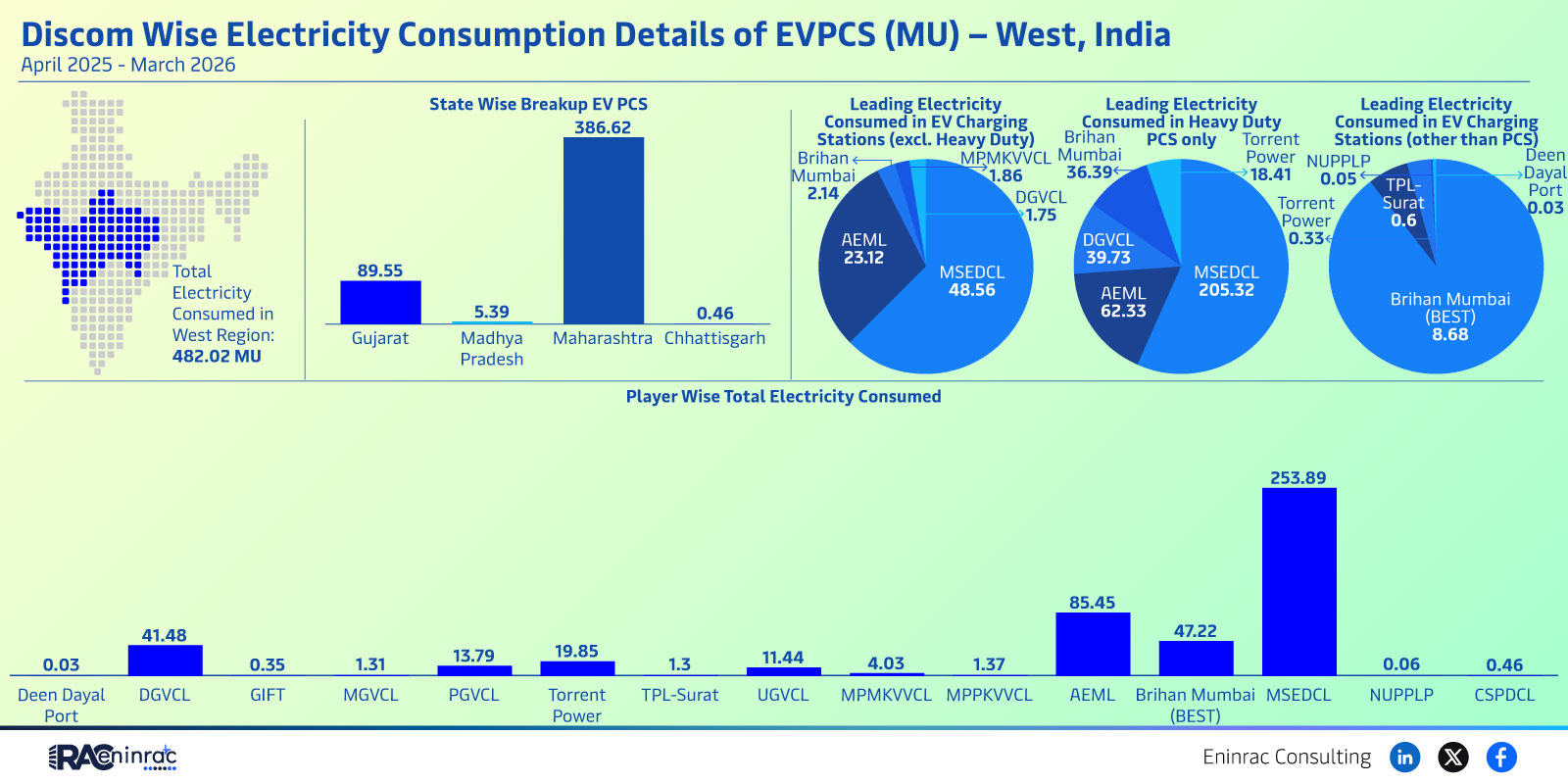
The West India region recorded detailed electricity consumption for electric‑vehicle public charging stations (EV PCS) between April 2025 and March 2026. The dataset breaks down total megawatt‑hours (MU) by state, by utility player, and distinguishes heavy‑duty vehicle charging from standard passenger EV charging. Understanding this consumption pattern helps policymakers, investors, and operators gauge demand growth, plan infrastructure upgrades, and align with national renewable energy targets.
What Does the Data Reveal About This Topic?
The primary question is whether any single state or utility dominates EV charging electricity use in the West region. The figures show Gujarat leads with roughly 386 MU, followed by Maharashtra, Madhya Pradesh and Chhattisgarh. Among utilities, MPPKVVCL and Mumbai’s Brihan Mahanagar contributed the highest shares, while smaller players such as Torrent and NUPPLP account for less than one percent each. Heavy‑duty charging represents a minor fraction, confirming that passenger EVs drive most consumption.
Statewise Comparison of EV Charging Electricity Use in West India
A closer look at the statewise breakdown highlights Gujarat’s consumption of 386 MU, which is more than double the combined total of the other three states. Maharashtra contributes approximately 86 MU, while Madhya Pradesh and Chhattisgarh each account for around 36 MU and 5 MU respectively. The disparity reflects Gujarat’s advanced EV policy incentives, higher number of commercial charging stations, and greater penetration of electric two‑wheelers. In contrast, the lower figures in Madhya Pradesh and Chhattisgarh suggest emerging markets that still require significant infrastructure investment.
Impact on Sectors and Industries
The consumption pattern of EV PCS directly influences the power generation sector, grid stability, and renewable integration plans. Utilities reporting higher loads must upgrade substations and consider time‑of‑use tariffs to smooth demand peaks. Investors in battery‑swap services and fast‑charging networks can prioritize Gujarat and Maharashtra for early deployment. Policymakers can use the data to design subsidies that encourage off‑peak charging, thereby reducing strain on conventional thermal plants and accelerating the shift toward solar‑powered EV infrastructure.
Key Takeaways
- Gujarat leads EV charging electricity consumption with over 386 MU, dominating West India.
- Maharashtra ranks second with roughly 86 MU, reflecting substantial urban charging infrastructure.
- Heavy‑duty vehicle charging accounts for less than one percent of total EV PCS usage.
- MPPKVVCL and Brihan Mahanagar utilities hold the largest shares among service providers.
- Smaller players such as Torrent and NUPPLP together contribute under 1 MU to the region's overall consumption.
- The data underscores a growing need for grid upgrades and renewable integration.
FAQs
Which state consumes the most electricity for EV charging in West India?
Gujarat, with about 386 MU, is the clear leader, accounting for more than half of the region’s total EV PCS electricity use.
How significant is heavy‑duty vehicle charging in the overall electricity consumption?
Heavy‑duty charging represents less than one percent of the total, indicating that passenger EVs drive the majority of electricity demand at public stations.
What implications does the data have for electricity utilities?
Utilities with higher loads must upgrade substations, manage peak demand with time‑of‑use tariffs, and accelerate integration of renewable sources to sustain reliable service.
Why are Gujarat and Maharashtra preferred for new charging investments?
Both states benefit from strong policy incentives, higher EV adoption rates, and denser networks of commercial charging points, making them attractive markets for investors.
How can policymakers encourage off‑peak EV charging?
By offering subsidies, implementing time‑of‑use pricing, and promoting renewable‑powered charging stations, policymakers can shift demand to lower‑load periods and reduce strain on the grid.