
Introduction
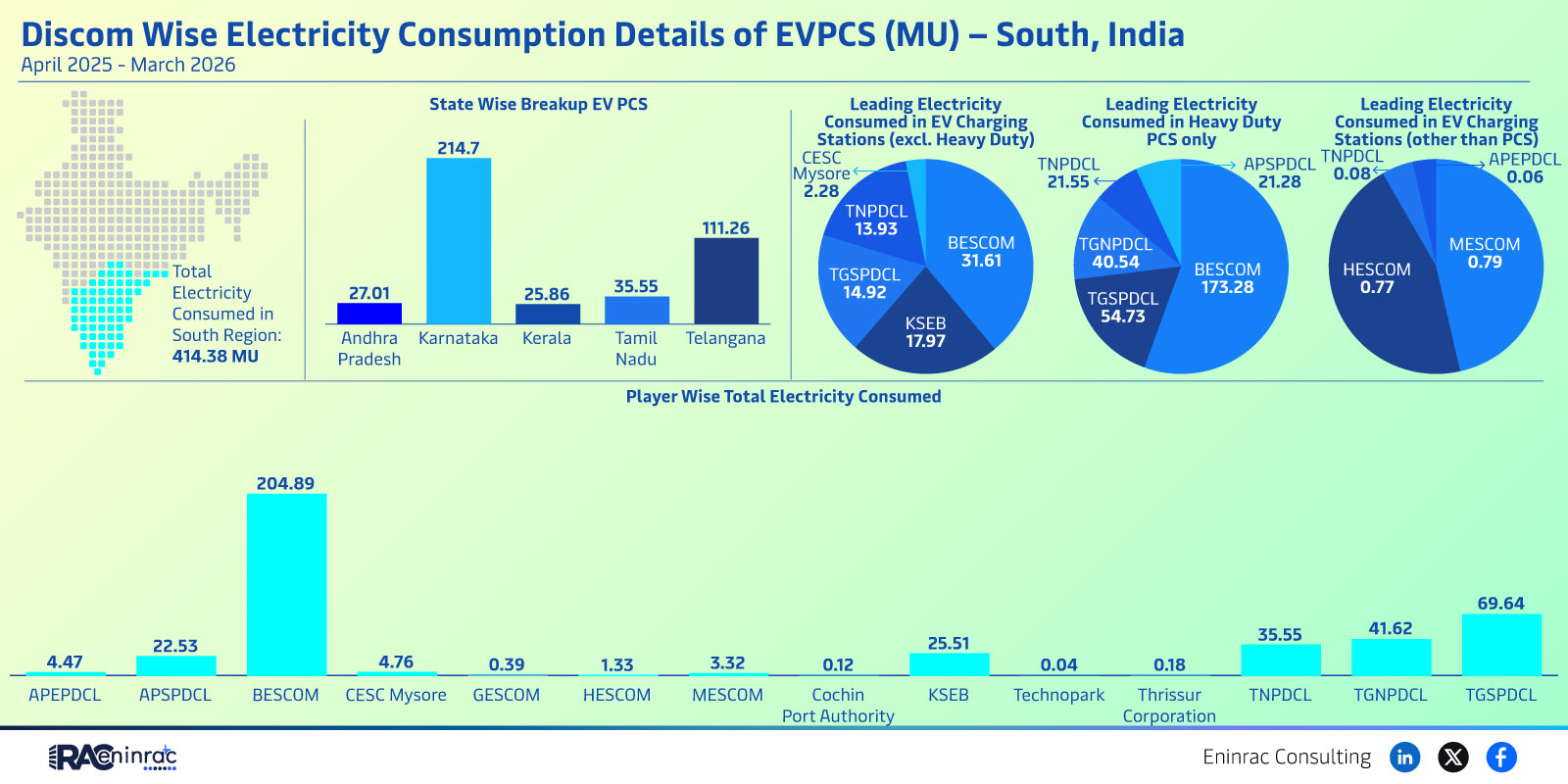
The table titled ‘Discom Wise Electricity Consumption Details of EVPCS (MU) South, India’ presents the total megawatt‑hours (MU) of electricity used by electric‑vehicle charging stations across the five major South Indian states for the fiscal year April 2025 to March 2026. It breaks the consumption down by state, by individual distribution company (discom) and by type of charging load, separating regular EV charging from heavy‑duty vehicle charging. Understanding where electricity demand is highest helps utilities plan capacity, informs policymakers about the pace of electric‑mobility adoption, and guides investors looking at the growth of EV infrastructure.
What Does the Data Reveal About This Topic?
What does the data reveal? It shows that the South region consumed a total of roughly 714 MU of electricity for EV charging, with Andhra Pradesh alone accounting for about 414 MU, nearly 58 % of the regional total. Karnataka follows with 205 MU, while Kerala, Tamil Nadu and Telangana contribute much smaller shares of 42 MU, 23 MU and 36 MU respectively. The discom‑wise breakdown indicates that state utilities such as APEPDCL, APSPDCL and TNPDCL are the primary providers, each handling between 0.04 MU and 3.32 MU for specific charging categories.
Statewise EV Charging Electricity Consumption in South India (FY 2025‑26)
A closer look at the statewise figures highlights a clear concentration of demand in the two largest economies. Andhra Pradesh’s 414 MU reflects both a higher number of charging points and a growing fleet of electric two‑wheelers and passenger cars. Karnataka’s 205 MU underscores its strong policy push for electric buses and commercial vehicles, which also explains the modest heavy‑duty consumption recorded. Kerala, Tamil Nadu and Telangana together account for less than 15 % of the total, suggesting slower infrastructure rollout or a higher reliance on public transport alternatives. Among discoms, APSPDCL and APEPDCL together serve the majority of the load, while smaller utilities such as TGSPDCL and TGNPDCL report marginal usage.
Impact on Sectors and Industries
The consumption patterns influence several sectors. Power utilities must upgrade substations and manage peak load spikes to avoid grid stress, especially in Andhra Pradesh and Karnataka. Renewable energy developers see an opportunity to couple solar or wind generation with EV charging hubs, reducing dependence on fossil‑fuel based power. Automotive manufacturers can gauge market readiness for new electric models, while investors in charging network operators gain insight into regions with the highest return potential. Policymakers can tailor subsidies and grid‑integration standards to align with the observed demand distribution.
Key Takeaways
- Andhra Pradesh consumes the largest share of EV charging electricity in South India, over half of the regional total.
- Karnataka is the second‑largest consumer, driven by aggressive EV bus and commercial vehicle policies.
- Kerala, Tamil Nadu and Telangana together contribute less than one‑sixth of total consumption.
- Major discoms APEPDCL, APSPDCL and TNPDCL dominate the supply landscape.
- Heavy‑duty EV charging remains a small but growing component of overall demand.
- Growth hotspots signal where renewable‑energy‑linked charging infrastructure should be prioritized.
FAQs
Which South Indian state used the most electricity for EV charging in FY 2025‑26?
Andhra Pradesh, with approximately 414 MU, leading the region.
How does Karnataka’s EV charging demand compare to Andhra Pradesh?
Karnataka consumed about 205 MU, roughly half of Andhra Pradesh’s usage.
What role do heavy‑duty vehicles play in overall EV charging consumption?
Heavy‑duty charging accounts for a small fraction of the total, indicating early‑stage adoption.
Which discoms are the primary electricity providers for EV charging?
APEPDCL, APSPDCL and TNPDCL together supply the majority of the load across the five states.
Why is renewable integration important for EV charging growth?
Coupling solar or wind with charging stations reduces grid strain and aligns with sustainability goals.