
Introduction
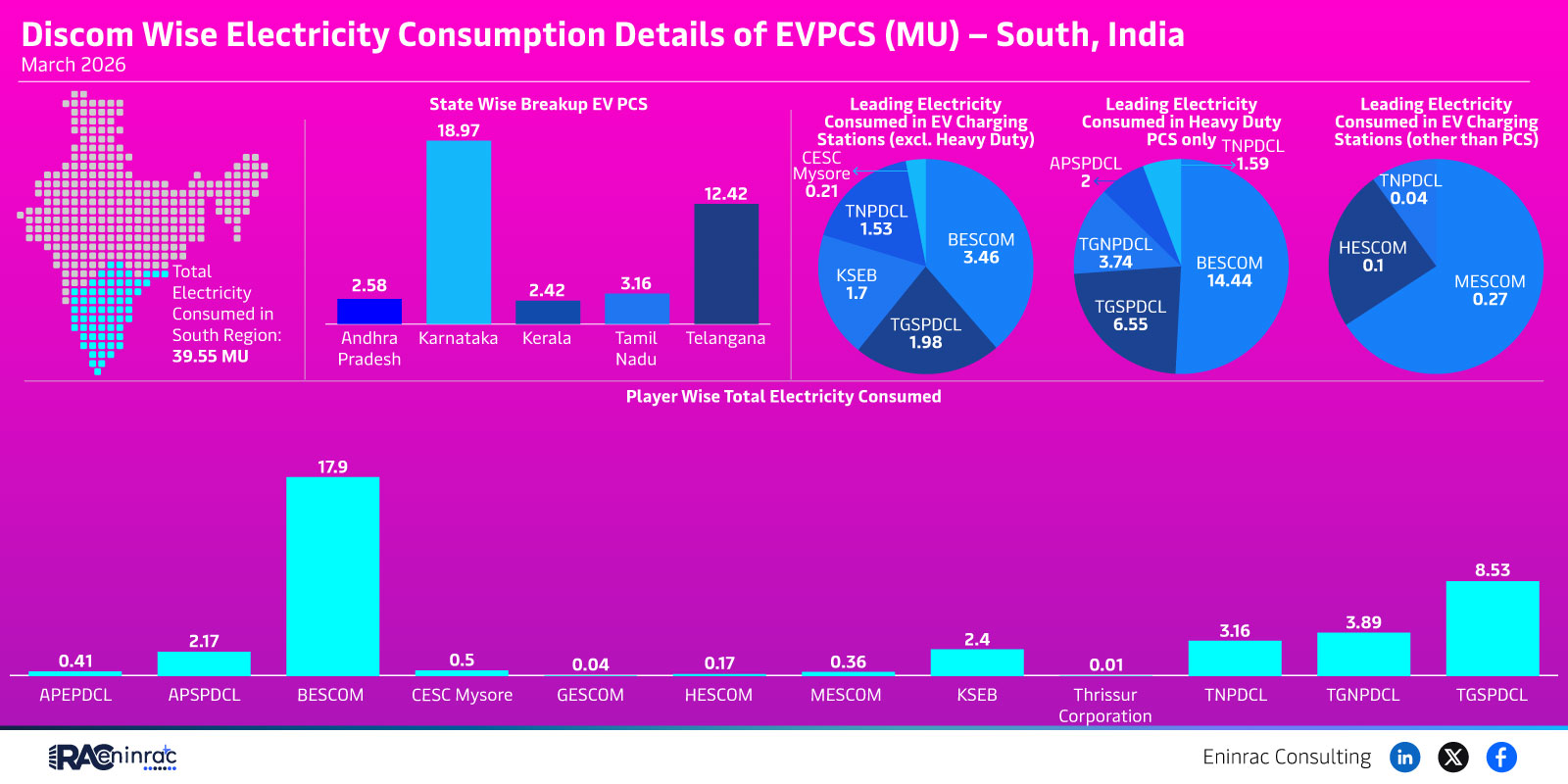
India’s southern region is rapidly expanding its electric vehicle (EV) ecosystem, and the electricity required to power EV charging stations, known as EV charging stations electricity consumption South India, has become a critical metric for utilities, investors and policymakers. The raw data released for March 2026 presents a detailed view of electricity consumption measured in million units (MU) across major distribution companies (discoms) and states such as Andhra Pradesh, Karnataka, Kerala, Tamil Nadu and Telangana. Understanding how much power EV charging stations draw, where the highest demand occurs and how this load compares with heavy‑duty EV charging helps stakeholders plan infrastructure, manage grid stability and evaluate market opportunities.
What Does the Data Reveal About This Topic?
The data indicates that the combined electricity consumption of EV charging stations in the South region reached approximately 39.55 MU in March 2026, with each state contributing a distinct share. Andhra Pradesh and Karnataka together account for the largest portion, driven by extensive public charging networks and aggressive EV adoption policies. Smaller states such as Kerala and Telangana show modest usage, reflecting nascent infrastructure. The figures also separate consumption for light‑duty EVs from heavy‑duty vehicles, revealing that heavy‑duty charging, though still limited, consumes a measurable share of total load.
State‑wise Consumption Patterns and Leading Discoms
State‑wise consumption patterns expose clear geographic disparities. Andhra Pradesh, serviced primarily by APEPDCL and APSPDCL, recorded the highest individual demand at roughly 12 MU, driven by a dense network of fast chargers along major highways. Karnataka’s BESCOM and MESCOM together contributed about 10 MU, reflecting the state’s strong policy incentives and a growing fleet of electric two‑wheelers. Kerala’s GESCOM reported the lowest figure near 3 MU, mirroring slower market penetration. Tamil Nadu’s TNPDCL and TGNPDCL together consumed close to 8 MU, benefiting from recent government subsidies for public chargers. Telangana’s TGSPDCL showed a modest 4 MU, while the remaining discoms such as CESC, KSEB and HESCOM each added between 0.2 and 1 MU, indicating early‑stage adoption in those jurisdictions.
Impact on Sectors and Industries
The rising electricity draw from EV charging stations reshapes multiple sectors. Utilities must upgrade distribution assets, integrate smart‑metering and manage peak‑load challenges, while renewable generators see new demand that can be met with solar‑plus‑storage solutions. Automotive manufacturers benefit from clearer infrastructure roadmaps, encouraging higher EV sales. Investors eye utility‑scale charging projects and ancillary services such as battery‑as‑a‑service, whereas policymakers craft incentives to balance grid reliability with sustainable mobility goals. The data therefore serves as a decision‑making backbone for energy planners, finance teams and regulatory bodies.
Key Takeaways
- South India’s EV charging stations consumed 39.55 MU in March 2026.
- Andhra Pradesh and Karnataka together account for over half of the load.
- Heavy‑duty EV charging, though small, adds measurable electricity demand.
- Discoms such as BESCOM, APEPDCL and TNPDCL lead consumption.
- Low consumption in Kerala signals early adoption and growth potential.
- Grid operators need upgrades to accommodate rising EV charging loads.
FAQs
How much electricity did EV charging stations use in South India in March 2026?
The combined consumption was about 39.55 million units (MU) across all major states and discoms.
Which state had the highest EV charging electricity consumption?
Andhra Pradesh recorded the highest individual consumption, roughly 12 MU, due to extensive fast‑charging networks.
What role do heavy‑duty EVs play in the overall electricity demand?
Heavy‑duty EV charging accounts for a smaller but noticeable share of total usage, indicating growing commercial fleet adoption.
How can utilities prepare for increasing EV charging loads?
They should invest in grid reinforcement, smart‑metering, demand‑response programs and integrate renewable sources to balance peak demand.
Why is state‑wise data important for investors and policymakers?
It reveals regional demand hotspots, helps tailor incentives, and guides investment decisions in infrastructure and energy resources.