
Introduction
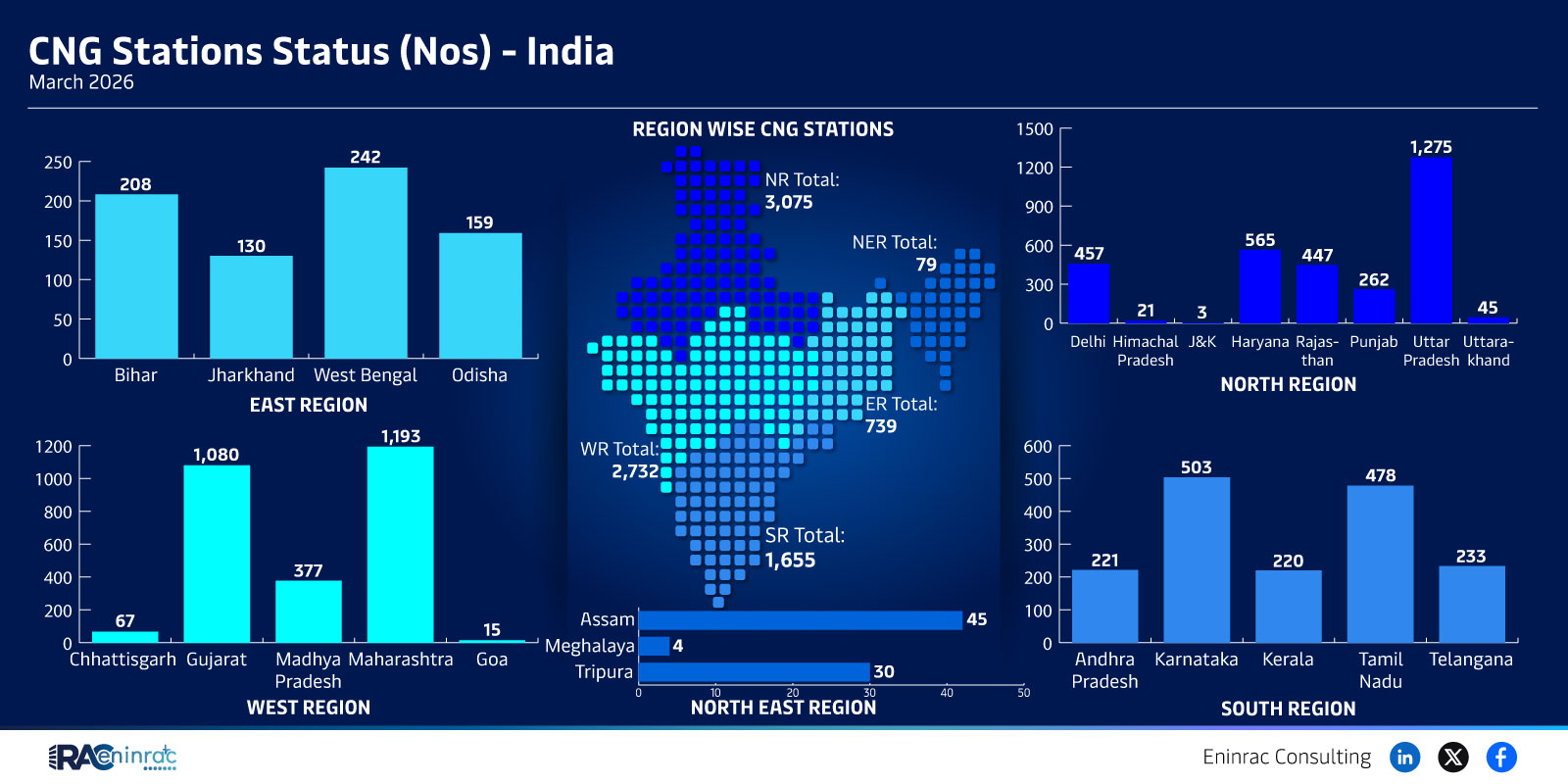
India’s compressed natural gas (CNG) network is expanding rapidly, and the March 2026 snapshot shows how stations are distributed across the country. Understanding where CNG stations are concentrated helps policymakers, investors, and consumers gauge market maturity, plan infrastructure investments, and assess regional fuel accessibility.
What Does the Data Reveal About This Topic?
The data indicates that the North region leads with the highest number of CNG stations, followed by the West and South regions, while the North‑East lags behind. This geographic disparity highlights where demand is strongest and where future expansion is needed.
Regional Distribution of CNG Stations
In the North, states such as Delhi, Haryana, Punjab, and Uttar Pradesh together account for over 1,200 stations, making the region the clear leader. The West region, including Gujarat, Maharashtra, and Goa, hosts roughly 600 stations, showing solid growth but still trailing the North. The South region, with Karnataka, Kerala, Tamil Nadu, and Telangana, contributes around 500 stations, reflecting steady adoption in high‑density urban areas. The East region, covering West Bengal, Odisha, Bihar, and Jharkhand, holds about 400 stations, while the North‑East region records only 70‑100 stations, indicating significant untapped potential.
Impact on Sectors and Industries
These station counts affect several sectors. Transportation companies can plan fleet conversions to CNG where infrastructure is dense, reducing fuel costs and emissions. Real‑estate developers may prioritize projects near CNG hubs to attract eco‑conscious tenants. Investors see the North’s robust network as a low‑risk entry point, while the North‑East offers high‑growth opportunities for early‑stage capital. Policymakers can target subsidies and incentives to lagging regions to balance national fuel distribution.
Key Takeaways
- The North region dominates CNG station deployment with over 1,200 locations.
- The West and South regions show moderate growth, each hosting 500‑600 stations.
- The East region lags behind but still maintains a notable presence of around 400 stations.
- The North‑East region has the fewest stations, highlighting a major expansion gap.
- High station density correlates with larger urban populations and stronger policy support.
- Investors should consider regional disparities when allocating capital to CNG infrastructure projects.
FAQs
Which Indian region has the most CNG stations?
The North region, led by Delhi, Haryana, Punjab, and Uttar Pradesh, has the highest concentration of CNG stations.
Why does the North‑East have so few CNG stations?
Geographic challenges, lower vehicle density, and limited policy incentives have slowed CNG infrastructure growth in the North‑East.
How can investors benefit from the CNG station data?
Investors can target high‑density regions for stable returns and consider the North‑East for high‑growth, early‑stage opportunities.
What impact does CNG station density have on emissions?
Higher CNG station density encourages fuel switching from diesel and petrol, leading to lower greenhouse gas emissions and improved air quality.
Will the government increase CNG stations in under‑served areas?
Policy trends suggest future subsidies and incentives aimed at expanding CNG networks in the East and North‑East to promote balanced regional development.