
Introduction
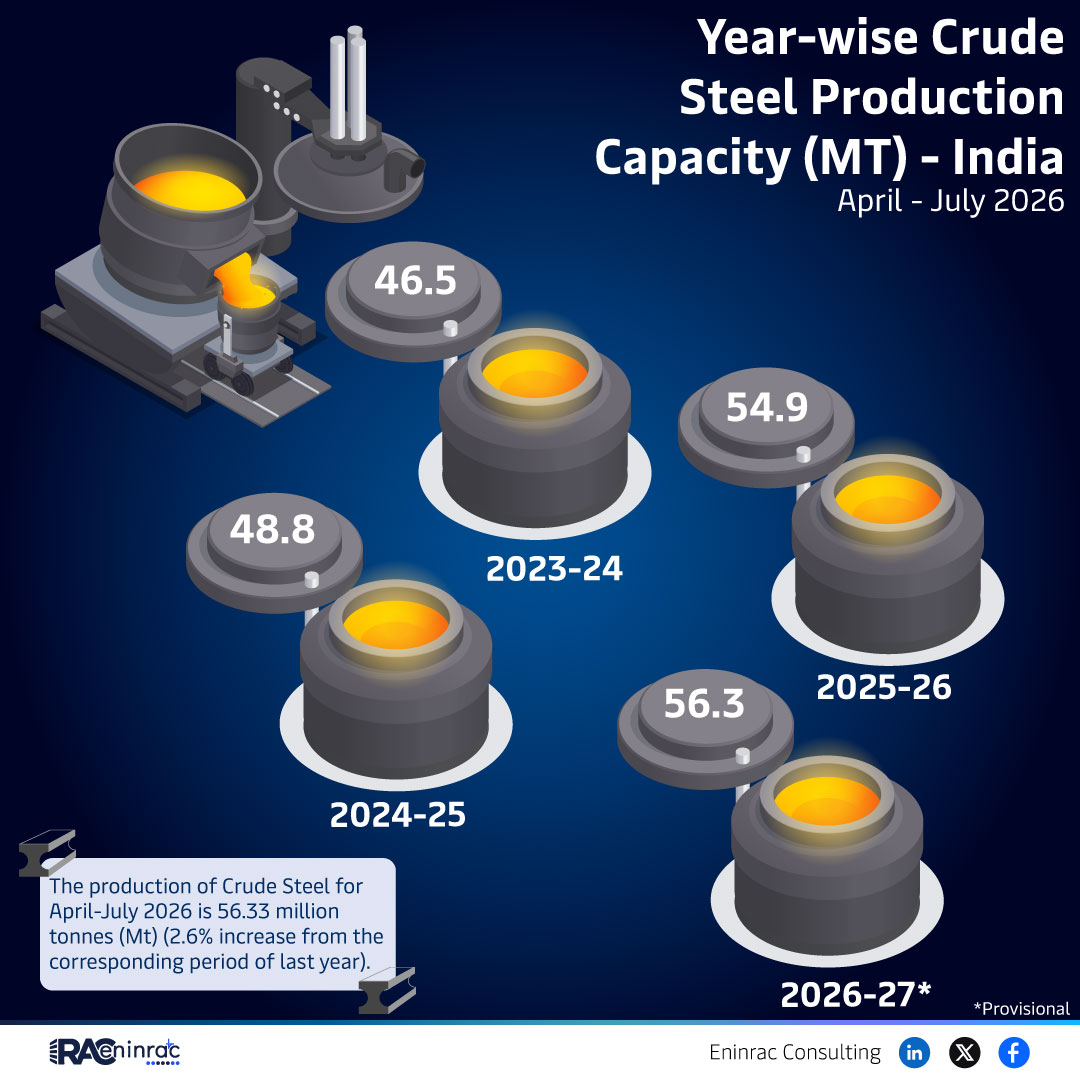
India’s crude steel production is a bellwether for the country’s industrial health and a critical driver of infrastructure development. The latest provisional figures for the April‑July 2026 reporting period show that output reached 56.33 million tonnes, representing a 2.6 % increase compared with the same four‑month window in the previous year. Understanding these numbers helps policymakers, investors, and industry players gauge the pace of capacity expansion, assess market balance, and anticipate future supply‑demand dynamics in the global steel arena. The data also aligns with the government’s push for a 100 Mt annual steel target by 2030, underscoring the strategic importance of this sector.
What Does the Data Reveal About This Topic?
The central insight from the April‑July 2026 data is that India’s crude steel production continued its upward trajectory, breaking the 56 million‑tonne barrier for the first time in this quarter. This rise confirms that recent capacity additions and efficiency gains are translating into tangible output growth. The 2.6 % year‑on‑year improvement also signals resilience amid fluctuating raw‑material costs and shifting export markets, suggesting that the sector can sustain expansion without severe bottlenecks.
Year‑to‑Year Growth in India’s Crude Steel Output
When juxtaposed with the April‑July 2025 period, which recorded approximately 54.86 Mt of crude steel, the 2026 figure reflects a modest but meaningful climb. The gain aligns with the broader trend observed across the 2023‑24 and 2025‑26 fiscal windows, where capacity utilisation has hovered around 78‑82 % of installed capability. Leading steel manufacturers such as Tata Steel, JSW Steel, and Steel Authority of India Limited (SAIL) have reported higher furnace productivity and incremental capacity commissions, contributing to the aggregate lift. Regionally, the western and eastern steel hubs displayed the strongest increases, while southern plants maintained steady output levels.
Impact on Sectors and Industries
The surge in India crude steel production has ripple effects across multiple domains. Construction firms benefit from a more reliable supply of structural steel, potentially lowering project timelines and costs. Automotive manufacturers see steadier availability of high‑strength steel grades essential for lightweighting initiatives. In the energy sector, increased steel output supports the fabrication of pipelines, turbines, and renewable‑energy infrastructure. From an investment perspective, the growth trajectory encourages both domestic and foreign capital inflows into steel plants, downstream processing units, and logistics networks, while policymakers may consider incentives to sustain capacity expansion and export competitiveness. Furthermore, the increased output reduces dependency on imported billet, improving trade balance and strengthening domestic supply chains.
Key Takeaways
- April‑July 2026 crude steel output reached 56.33 Mt.
- Year‑on‑year growth was 2.6 % versus the prior period.
- Capacity utilisation remains above 78 % across major plants.
- Western and eastern regions led the production increase.
- Higher output supports construction, automotive, and energy sectors.
- Positive outlook encourages further investment and export potential.
FAQs
What was India’s crude steel production in April‑July 2026?
The provisional figure was 56.33 million tonnes, a 2.6 % rise from the same period last year.
How does this compare with the April‑July 2025 output?
The 2025 period produced roughly 54.86 Mt, so the increase is about 1.47 Mt.
Which regions contributed most to the growth?
Western and eastern steel hubs recorded the strongest gains, driven by expanded furnace capacity.
What impact does higher steel production have on the construction sector?
It improves material availability, potentially lowering costs and accelerating project schedules.
Will this growth affect India’s steel export outlook?
Increased domestic output provides a platform for higher export volumes, assuming global demand remains robust.