
Introduction
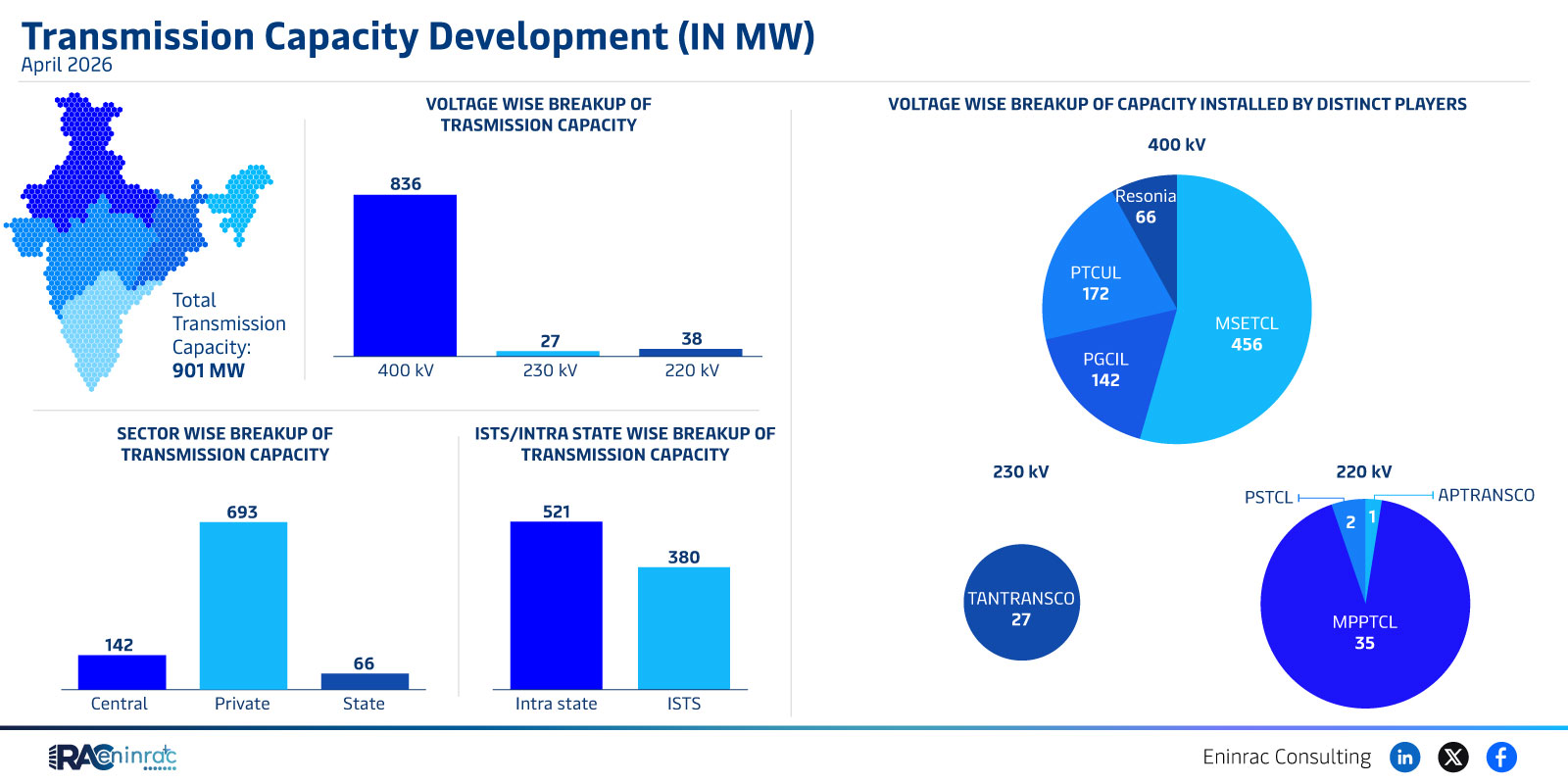
This article examines the April 2026 transmission capacity data for India, breaking down installed megawatt (MW) capacity by voltage level and major transmission players. Understanding how capacity is distributed across 400 kV, 230 kV and 220 kV lines helps stakeholders assess grid robustness, investment opportunities, and policy impacts.
What Does the Data Reveal About This Topic?
The data shows that the 400 kV network, managed primarily by MSETCL, holds the largest single‑line capacity at 27 MW, while 230 kV and 220 kV lines are split among APTRANSCO, TANTRANSCO and private entities. This distribution indicates a concentration of high‑voltage infrastructure under state utilities, with emerging private participation in lower voltage segments.
Voltage‑Level Capacity Distribution and Player Contributions
At 400 kV, MSETCL dominates with a total of 27 MW, reflecting its role in long‑distance bulk power transfer. The 230 kV tier shows APTRANSCO contributing 693 MW and TANTRANSCO 521 MW, highlighting the importance of regional utilities in medium‑voltage corridors. The 220 kV segment records a modest 380 MW, primarily from TANTRANSCO, suggesting limited expansion at this level during the reporting period. Private consultants such as Eninrac Consulting appear with minimal capacity, indicating early‑stage involvement.
Impact on Sectors and Industries
Robust transmission capacity underpins renewable energy integration, industrial power reliability, and rural electrification. Investors can gauge where grid upgrades are needed, policymakers can target incentives for private participation, and utilities can plan maintenance schedules based on voltage‑specific loads.
Key Takeaways
- MSETCL holds the majority of 400 kV capacity, emphasizing its strategic grid role.
- APTRANSCO and TANTRANSCO together account for over 1,200 MW at 230 kV, showing strong state‑level medium‑voltage infrastructure.
- 220 kV capacity remains limited, pointing to potential growth opportunities.
- Private sector presence is minimal but emerging, suggesting future diversification.
- The data highlights the need for coordinated investment to balance high‑voltage and medium‑voltage expansion.
- Policymakers should consider incentives to boost private participation in lower voltage segments.
FAQs
Which utility has the highest 400 kV capacity?
MSETCL leads with 27 MW of 400 kV capacity.
How much 230 kV capacity do APTRANSCO and TANTRANSCO provide?
APTRANSCO provides 693 MW and TANTRANSCO 521 MW.
Is private participation significant in the April 2026 data?
Private involvement is limited, with only small entries like Eninrac Consulting.
What does the limited 220 kV capacity imply?
It suggests a gap in medium‑voltage infrastructure that could be targeted for future upgrades.
How can investors use this transmission data?
Investors can identify regions and voltage levels where grid expansion is needed, guiding capital allocation.