
Introduction
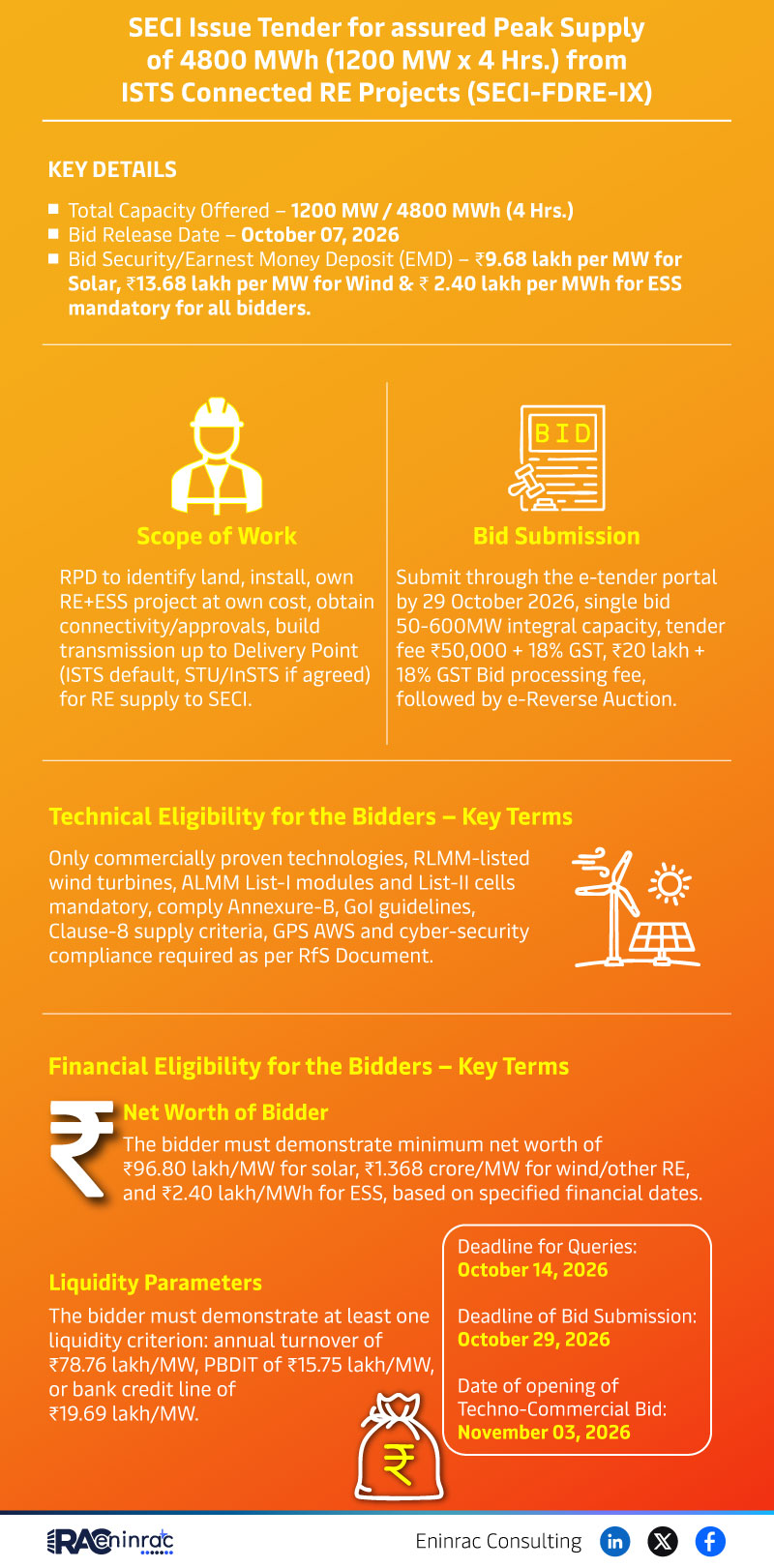
The SECI Float Tender announced on 7 October 2026 offers a guaranteed peak supply of 1200 MW, equivalent to 4800 MWh over four hours, from interconnected renewable energy projects. This tender represents a major step in India’s push for clean power, providing a clear pathway for developers to contribute solar, wind and energy storage solutions to the national grid. Readers will learn about the capacity offered, the financial and technical eligibility criteria, bid security requirements, and the timeline for submission, helping stakeholders assess whether they can participate in this high‑value opportunity.
What Does the Data Reveal About This Topic?
The data reveals that SECI is seeking a single, integrated bid ranging from 50 MW to 600 MW that can deliver a fixed four‑hour peak supply. The tender emphasizes commercially proven technologies, mandatory RLMM‑listed wind turbines, ALMM‑approved solar modules and cells, and strict cyber‑security compliance. Financial eligibility hinges on substantial net‑worth and liquidity metrics, while bid security is set at 9.68 lakh per MW for solar and 13.68 lakh per MW for wind, plus a rate per MWh for energy storage. The timeline is tight, with queries due by 14 October, bid submission by 29 October, and technical‑commercial opening on 3 November.
Eligibility and Financial Commitment for Bidders
Technical eligibility requires bidders to use only proven renewable technologies listed in the RLMM and ALMM catalogs, comply with Annexure‑B and government‑issued guidelines, and meet GPS, AWS and cyber‑security standards outlined in the RfS document. Financially, bidders must demonstrate a minimum net worth of 96.80 lakh per MW for solar projects, 21.368 crore per MW for wind or other renewable assets, and 2.40 lakh per MWh for energy storage systems. Additionally, at least one liquidity criterion must be satisfied: an annual turnover of 278.76 lakh per MW, a PBDIT of 215.75 lakh per MW, or a bank credit line of 219.69 lakh per MW. These stringent thresholds ensure that only financially robust developers can secure the peak supply contract.
Impact on Sectors and Industries
The tender will stimulate investment in solar, wind and battery storage infrastructure, creating opportunities for equipment manufacturers, EPC contractors, land owners and financial institutions. By securing a firm peak supply, SECI reduces grid volatility and supports the integration of intermittent renewables, benefiting utilities and large‑scale consumers. Policymakers gain a reliable mechanism to meet renewable energy targets, while investors receive clarity on revenue streams linked to guaranteed dispatch. The requirement for developers to own, install and connect projects also encourages private sector ownership of critical renewable assets, accelerating the transition to a low‑carbon energy mix.
Key Takeaways
- SECI offers 1200 MW peak supply over four hours.
- Bid security ranges from 9.68‑13.68 lakh per MW.
- Technical eligibility mandates RLMM and ALMM compliance.
- Financial eligibility requires high net‑worth and liquidity.
- Submission deadline is 29 October 2026.
- Successful bids must own and operate the RE project.
FAQs
What is the total capacity offered in the SECI Float Tender?
The tender provides a total capacity of 1200 MW, delivering 4800 MWh of energy over a four‑hour peak window.
Which technologies are mandatory for eligibility?
Bidders must use commercially proven technologies, RLMM‑listed wind turbines, and ALMM‑approved solar modules and cells as specified in the annexures.
How is bid security calculated for solar and wind projects?
Bid security is set at 9.68 lakh per MW for solar projects and 13.68 lakh per MW for wind projects, payable as an earnest money deposit.
What are the key financial thresholds a bidder must meet?
Bidders need a minimum net worth of 96.80 lakh per MW for solar, 21.368 crore per MW for wind, and must satisfy at least one liquidity metric such as turnover, PBDIT or bank credit line.
When are the technical and commercial bids opened?
The techno‑commercial bids will be opened on 3 November 2026 after the e‑reverse auction process concludes.