
Introduction
This article examines the peak power demand recorded in May 2026 for the Eastern Region of India. Understanding regional electricity consumption helps utilities, policymakers, and investors plan capacity, manage grid stability, and assess future energy needs. Readers will learn the demand figures for each state, the overall regional peak, and the implications for the power sector.
What Does the Data Reveal About This Topic?
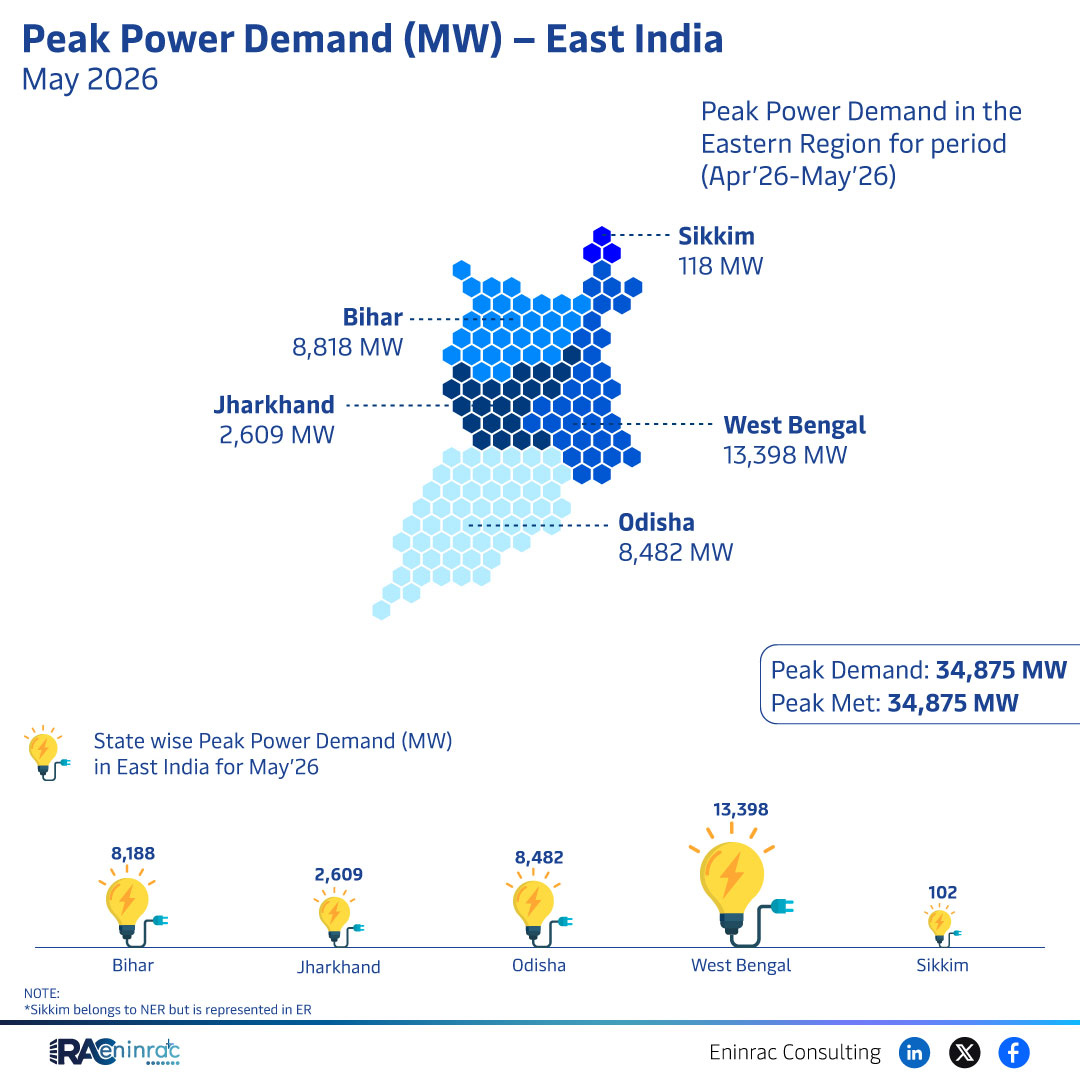
The data shows that West Bengal led the region with a peak demand of 13,398 MW, followed by Bihar at 8,818 MW and Odisha at 8,482 MW. Jharkhand contributed 2,609 MW and Sikkim, though part of the North‑Eastern Region, reported 118 MW. The combined peak for East India reached 34,875 MW, indicating a substantial load that must be met by both conventional and renewable generation sources.
State‑Level Comparison of Peak Power Demand
When comparing the states, West Bengal’s demand is roughly 1.5 times that of Bihar and nearly three times Jharkhand’s. Odisha’s demand is close to Bihar’s, reflecting its industrial base and growing urban population. Sikkim’s modest figure highlights its smaller grid and lower industrial activity, yet its inclusion underscores the need for integrated regional planning across traditional geographic boundaries.
Impact on Sectors and Industries
High peak demand influences several sectors. Power generators must ensure sufficient capacity, prompting investments in both coal‑based plants and renewable projects such as solar and wind farms. Transmission operators face pressure to upgrade lines to avoid bottlenecks. Industries, especially manufacturing and mining in West Bengal, Bihar, and Odisha, rely on reliable supply to avoid production losses. Policymakers can use these insights to prioritize grid reinforcement, demand‑side management, and renewable integration to meet future growth.
Key Takeaways
- West Bengal recorded the highest peak demand in East India at 13,398 MW.
- Bihar and Odisha each contributed over 8,000 MW, together accounting for nearly half of the regional peak.
- Jharkhand’s demand of 2,609 MW shows a moderate load compared with its neighbors.
- Sikkim’s 118 MW highlights the disparity between North‑Eastern and Eastern states.
- The total regional peak of 34,875 MW underscores the need for robust generation and transmission capacity.
- Investors and policymakers should focus on balanced growth of conventional and renewable energy to meet peak loads.
FAQs
Which state had the highest peak power demand in May 2026?
West Bengal, with a peak demand of 13,398 MW.
How does Bihar’s demand compare to Odisha’s?
Bihar’s demand was 8,818 MW, slightly higher than Odisha’s 8,482 MW.
Why is Sikkim included in the Eastern Region data?
Sikkim belongs to the North‑Eastern Region but is represented here for comprehensive regional analysis.
What is the total peak demand for East India?
The combined peak demand for the region was 34,875 MW.
What implications does this demand have for renewable energy investment?
High peak loads encourage investment in flexible renewable sources and storage to complement conventional generation and ensure grid reliability.