
Introduction
The May 2026 energy report for East India provides a detailed snapshot of power demand and supply across six states. Understanding these figures is crucial for utilities, investors, and policymakers who need to balance regional growth with reliable electricity delivery. This article breaks down the numbers, highlights key trends, and explains what they mean for the energy landscape.
What Does the Data Reveal About This Topic?
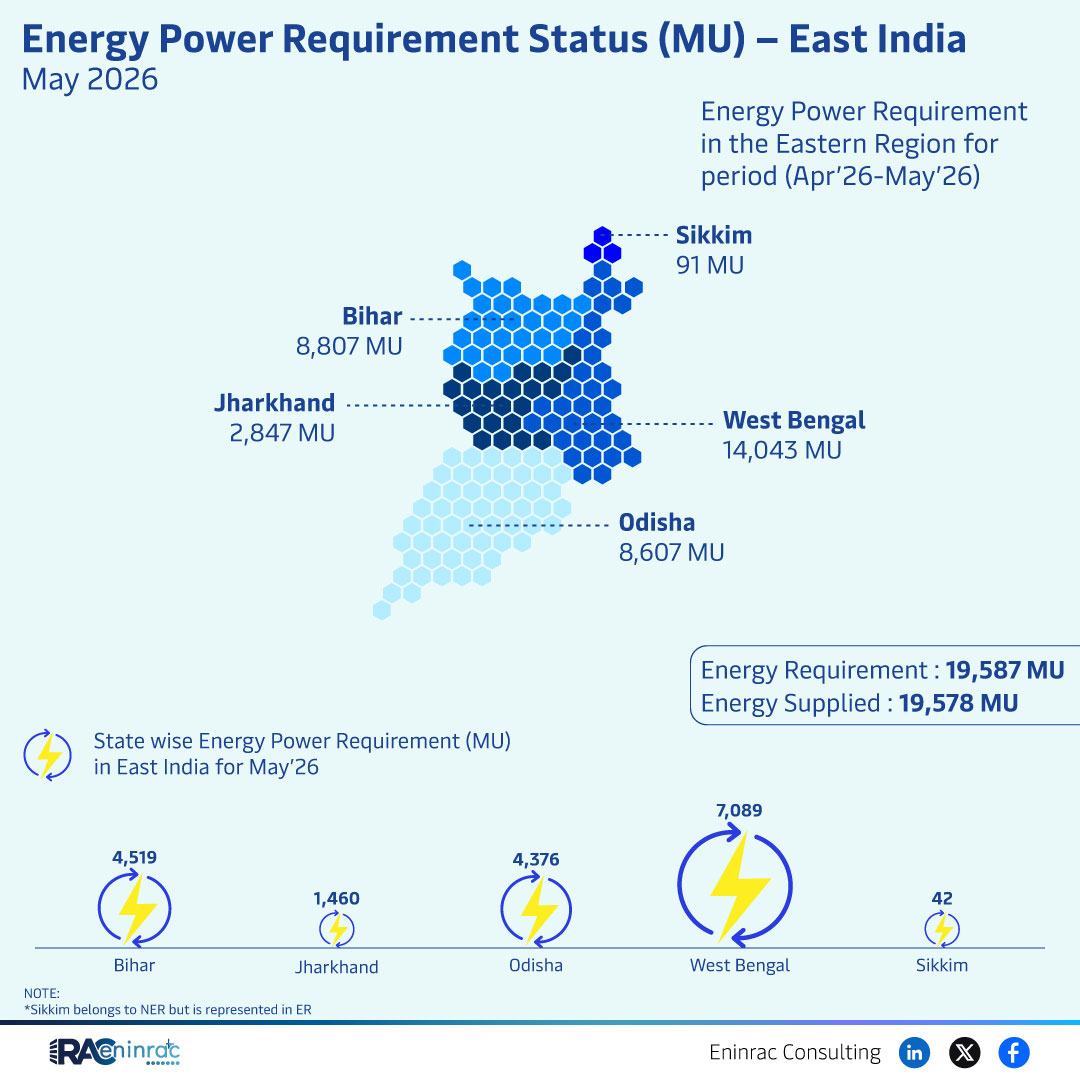
The core insight is that total energy demand in the Eastern Region for April‑May 2026 reached 19,587 MU, while actual supply was marginally lower at 19,578 MU, leaving a shortfall of only 9 MU. This near‑balance indicates that the grid is operating close to capacity, with each state contributing differently to the overall picture.
State‑Level Power Demand and Supply Dynamics
Among the six states, West Bengal recorded the highest requirement at 14,043 MU, followed by Odisha with 8,607 MU and Bihar at 8,807 MU. Jharkhand’s demand stood at 4,519 MU, while Sikkim contributed 7,089 MU despite being classified under NER. The data shows that West Bengal and Bihar together account for more than half of the regional demand, emphasizing their pivotal role in East India’s energy planning.
Impact on Sectors and Industries
These power figures directly affect manufacturing, agriculture, and services sectors that rely on stable electricity. A slight supply gap can increase load‑shedding risk, raise operational costs, and influence investment decisions. For investors, the tight supply‑demand balance signals opportunities for capacity expansion, especially in renewable and conventional generation projects. Policymakers must prioritize grid upgrades and demand‑side management to avoid future deficits.
Key Takeaways
- Overall demand (19,587 MU) slightly exceeds supply (19,578 MU) by 9 MU.
- West Bengal leads with 14,043 MU, driving the majority of regional demand.
- Jharkhand and Sikkim have lower but notable requirements, highlighting diverse regional needs.
- The near‑balanced grid suggests effective short‑term management but limited buffer for spikes.
- Investors may find growth potential in expanding generation capacity in high‑demand states.
- Policymakers should focus on grid resilience and renewable integration to sustain supply.
FAQs
What was the total power requirement for East India in May 2026?
The region required 19,587 MU of electricity for the April‑May 2026 period.
Which state had the highest power demand?
West Bengal recorded the highest demand at 14,043 MU.
Is there a supply deficit in the Eastern Region?
Yes, a small deficit of 9 MU exists, with supply at 19,578 MU.
How does the demand in Sikkim compare to other states?
Sikkim’s demand of 7,089 MU is moderate, lower than West Bengal and Bihar but higher than Jharkhand.
What opportunities does this data create for investors?
The tight supply‑demand balance highlights opportunities for new generation projects, especially in high‑demand states like West Bengal and Bihar.